

Commentary
Bashir Kitachaev
{
  "authors": [
    "Bashir Kitachaev"
  ],
  "type": "commentary",
  "blog": "Carnegie Politika",
  "centerAffiliationAll": "",
  "centers": [
    "Carnegie Endowment for International Peace",
    "Carnegie Russia Eurasia Center"
  ],
  "collections": [
    "Aso Tavitian Initiative",
    "Politika: The Best of 2025"
  ],
  "englishNewsletterAll": "",
  "nonEnglishNewsletterAll": "",
  "primaryCenter": "Carnegie Russia Eurasia Center",
  "programAffiliation": "",
  "programs": [],
  "projects": [],
  "regions": [
    "Russia",
    "Azerbaijan",
    "Caucasus"
  ],
  "topics": [
    "Foreign Policy",
    "Security",
    "Global Governance"
  ]
}
Source: Getty
The only losers of the confrontation are the Russians and Azeris who found themselves collateral damage. But their fate was never a priority for either Moscow or Baku.
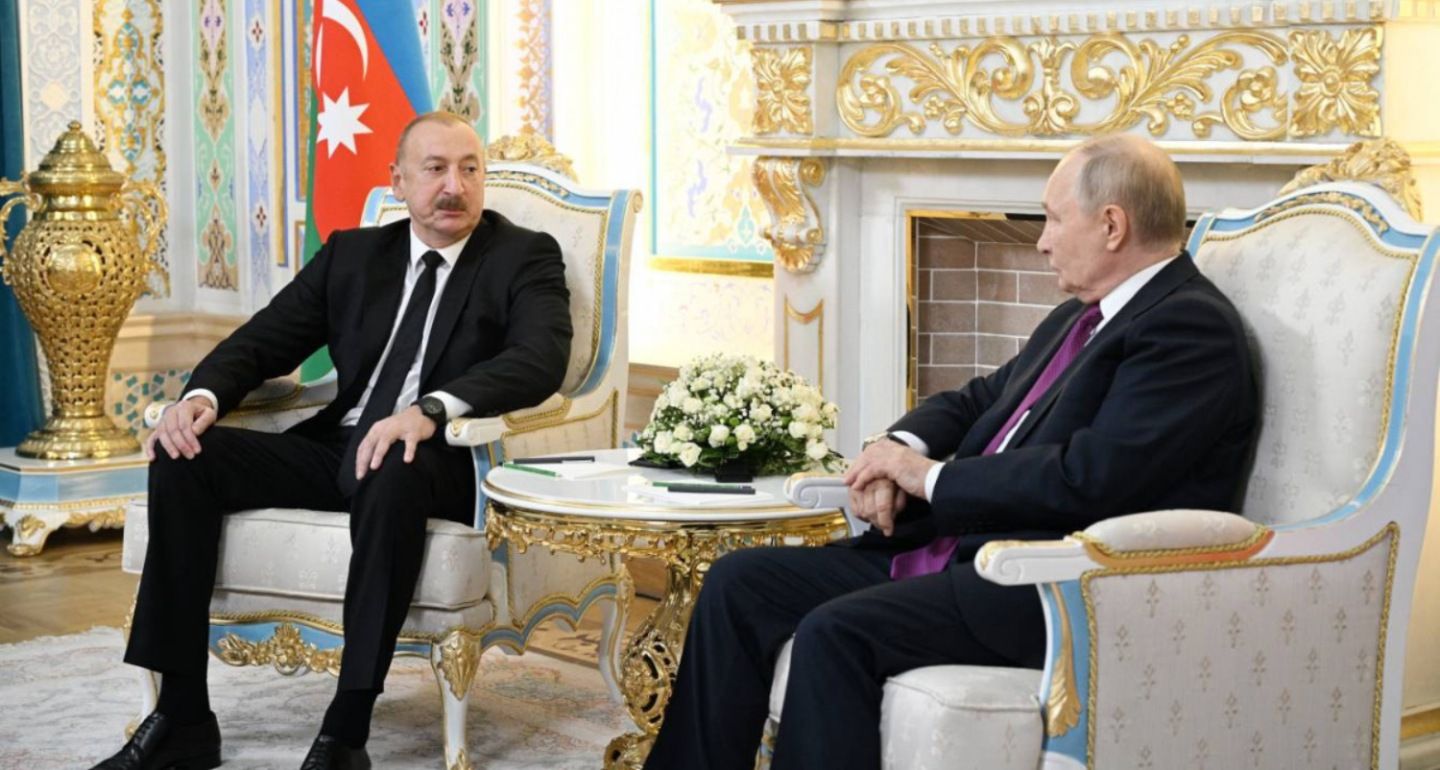
The high-profile spat between Russia and Azerbaijan that had been simmering since late last year has suddenly come to an end. On October 9, presidents Vladimir Putin and Ilham Aliyev met at a summit in Dushanbe, where the Russian leader publicly acknowledged the role of Russian air defenses in the downing of an Azerbaijan Airlines flight in December 2024 in which thirty-eight people were killed. Aliyev accepted the apology, along with promises to pay compensation and punish those responsible, and declared the conflict resolved.
In the end, the standoff, which had taken many by surprise for the strength of Baku’s criticism of Moscow, was concluded remarkably swiftly and easily. Despite diplomatic demarches and numerous arrests of each other’s nationals, both countries had diligently maintained a lid on the conflict and prevented it from spilling over into areas of genuine importance to them. That enabled them to quickly close the matter once the political dividends had been reaped.
Putin’s apology at his meeting with Aliyev was very much on brand for the Russian leader. He acknowledged that the plane had crashed as a result of Russian air defenses and apologized for the fact that “the incident occurred in the skies over Russia,” but ultimately put the blame on Ukraine for having drones flying nearby.
To further emphasize that Russia was only indirectly involved in the tragedy, Putin cited “technical glitches” in the air defense system and the fact that the missiles did not directly hit the aircraft, but exploded a few meters from it. That is, in fact, precisely how the Pantsir-S1 missile involved in the incident works: it explodes close to the target and showers it with shrapnel. But despite Putin’s obvious attempt to soften his apology by shifting responsibility for the tragedy, Aliyev was satisfied with the outcome.
The Azerbaijani president thanked his counterpart for his personal oversight of the investigation, assured him that he had never doubted the objectivity of the Russian investigation, and expressed hope that the clarifications provided “would be positively received by Azerbaijani society.”
From the very beginning of the dispute between Baku and Moscow, it was clear that both sides would try to avoid touching on the truly important issues in their relationship. Instead, they targeted each other’s nationals, whose well-being is not valued particularly highly by either regime.
The standoff reached its peak in June–July this year, when Russian special forces detained more than ten Azerbaijanis in Yekaterinburg in connection with an old criminal case. Two of the detainees died shortly afterward, most likely due to being tortured in custody.
Baku responded by arresting journalists from the Kremlin-backed media organization Sputnik, along with several Russian nationals whom it accused of cyber fraud and drug smuggling. Moscow hit back by detaining and deporting high-profile figures from the Azerbaijani diaspora in Russia.
Even the day before the presidents’ meeting in Dushanbe, a video surfaced on social media showing three Azerbaijani nationals who had been held for three days with no food at Zhukovsky Airport outside Moscow. Putin and Aliyev made no mention of any of these episodes during their public reconciliation.
So far, only the most important figures for the two regimes have been released from prison: Igor Kartavykh, editor in chief of Sputnik Azerbaijan in Baku, and Mamedali Agayev, the former director of Moscow’s Satire Theater, who had been accused of fraud.
Perhaps the other detainees will be released later—but perhaps not, or not all of them. Because if the crisis between Baku and Moscow has shown anything, it’s that both regimes treat their arrested citizens only as a pretext to escalate the conflict.
By and large, the dispute with Moscow ended exactly as Aliyev had hoped. Azerbaijani state media called the event a triumph for the president. Certainly, he managed to make the most of the situation. During the months of tension, Aliyev shed his image as Russia’s ally and burnished his credentials as an independent leader, improved his image in the West despite ongoing repression at home, and strengthened his authority within the country.
For the European Union, human rights in Azerbaijan have taken a back seat to more pressing concerns. While the confrontation with Russia was ongoing, Aliyev managed to present himself as an ally of Ukraine, sign a peace agreement with Armenia in Washington, and hold a series of meetings with European leaders.
During the trilateral summit with Trump, the parties agreed to establish a transit route through Armenia from Baku to the Azerbaijani exclave of Nakhchivan without Russian participation, cementing Moscow’s declining influence in the South Caucasus. Azerbaijan also signed gas contracts with several EU countries, and plans to purchase an oil refinery in Italy.
EU Enlargement Commissioner Marta Kos visited Baku in September and agreed to establish a working group to strengthen economic cooperation between the EU and Azerbaijan. The issue of releasing Azerbaijan’s 400 or so political prisoners was not even discussed.
These successes in relations with the West were complemented by some wins at home, too. For Azerbaijani society, the confrontation with Russia was intended to demonstrate the country’s growing international prestige and strengthen feelings of national pride.
While Aliyev was scoring points at home and abroad, Moscow chose not to interfere, since he was keeping out of the issues that truly mattered to it. For several months, Baku unleashed a torrent of accusations against the Kremlin, expressed support for Ukraine, and made reported offers to provide Kyiv with military aid. Russia kept quiet and waited for Aliyev to reap the full reputational dividends and return to the two countries’ previous level of cooperation.
For Russia, it was more important to maintain economic ties with Azerbaijan, which have grown dramatically following the imposition of Western sanctions against Moscow. For all the public mudslinging, the confrontation had no impact on the economy.
The North-South Corridor that links Russia with Iran and India via Azerbaijan continued to operate. Freight traffic between the two countries increased by 13 percent in the first half of 2025, while even at the height of the standoff, bilateral trade was growing at double-digit rates. On October 13, a trilateral meeting of delegations from Azerbaijan, Russia, and Iran took place to discuss facilitating freight transit along the North-South route.
Throughout the conflict, the Azerbaijani authorities were careful not to cross the Kremlin’s red lines and to avoid accidentally doing anything that would force Putin to respond. Baku never forgot that Azerbaijan is far more economically dependent on Russia than vice versa.
In the end, neither side lost out. Aliyev managed to boost his reputation, and ended the spat once he realized there was nothing else to gain. Putin, meanwhile, succeeded in drawing a line under the accidental downing of a passenger aircraft relatively quickly and painlessly.
Now the two countries will likely proceed as if the entire episode had never happened. At the meeting of leaders of Commonwealth of Independent States countries in Dushanbe, Aliyev embraced Putin, while settling for handshakes with the other presidents.
The only losers were the Russians and Azeris who were beaten, killed, or jailed during the falling-out. But their fate was never a priority for either Moscow or Baku.

Journalist specializing on the South Caucasus region
Recent Work
Bashir Kitachaev
Bashir Kitachaev
Carnegie does not take institutional positions on public policy issues; the views represented herein are those of the author(s) and do not necessarily reflect the views of Carnegie, its staff, or its trustees.

Japan’s long-term security policy is driven by concerns about China, and there is little appetite for (or interest in) pursuing a confrontation with Moscow.

James D.J. Brown

The truth of the strategic situation is that Europe and Russia are extremely unlikely to be able to “turn the page” on their confrontation within the next two decades.
Arkady Moshes
Russia spent years building a “sovereign internet,” concentrating web infrastructure exclusively within Russian territory. Ukrainian drone attacks have shown how vulnerable that approach has left the Russian internet.

Maria Kolomychenko

Putin’s conservative staffing policies and search for ever greater control have cemented parliament’s transformation into a bureaucratic appendage of the executive branch.

Andrey Pertsev

Russia’s AI-driven propaganda campaigns operate in a fragmented, chaotic, and often illogical manner. That’s not necessarily a problem for the Kremlin, though: It’s much easier to mimic genuine public debate that way.

Ilya Klishin