

Commentary
Arms supplies from Russia to Iran will not only continue, but could grow significantly if Russia gets the opportunity.
Nikita Smagin
{
  "authors": [
    "Bashir Kitachaev"
  ],
  "type": "commentary",
  "blog": "Carnegie Politika",
  "centerAffiliationAll": "",
  "centers": [
    "Carnegie Endowment for International Peace",
    "Carnegie Russia Eurasia Center"
  ],
  "collections": [
    "Aso Tavitian Initiative"
  ],
  "englishNewsletterAll": "",
  "nonEnglishNewsletterAll": "",
  "primaryCenter": "Carnegie Russia Eurasia Center",
  "programAffiliation": "",
  "programs": [],
  "projects": [],
  "regions": [
    "Azerbaijan",
    "Armenia",
    "Caucasus"
  ],
  "topics": [
    "Security",
    "Foreign Policy",
    "Military",
    "Political Reform",
    "Civil Society"
  ]
}
Source: Getty
While signaling internationally that it wants peace, the Azerbaijani regime continues to promote anti-Armenian sentiment at home to mobilize domestic support.
In recent months, it has seemed as though Azerbaijan is ready to engage in a process of reconciliation with Armenia to end decades of hostilities. The two South Caucasus nations have initialed a peace treaty, exchanged official visits, and are working on the delineation of their shared border. Baku has even sent Yerevan a delivery of oil products.
At the same time, the Azerbaijani authorities are in no hurry to dial down the anti-Armenian rhetoric at home. The result is something of a paradox. While Azerbaijan signals to the international community that it wants peace, the machinery of hate inside the country continues to operate as it has done for years. This begs the question: What does Baku really want?
Over the course of several decades, a system has developed in Azerbaijan to dehumanize Armenians—via education, state-owned media, and statements by senior officials. History textbooks in Azerbaijan often still portray Armenians as hostile people who were “relocated” in the nineteenth century to Nagorno-Karabakh—the territory at the center of the two countries’ long-running conflict—and refer to Armenia as “the historical land of Azerbaijan.” State-owned media regularly casts Armenians as “genetically inclined to treachery.”
These narratives have become fundamental to Azerbaijan’s state ideology, which was built upon the trauma of defeat in the First Nagorno-Karabakh War (1988–1994). For years, revanchism has been used to mobilize society and consolidate support: first for the regime of Heydar Aliyev, and then for that of his son, Ilham Aliyev, the current president.
This continued after Baku’s victory in the Second Nagorno-Karabakh War (2020), and its seizure three years later of Nagorno-Karabakh (which is internationally recognized as part of Azerbaijan). Now, Azerbaijan’s argument about its “historical lands” has been transferred to Armenia itself: a not-so-subtle hint of possible invasion.
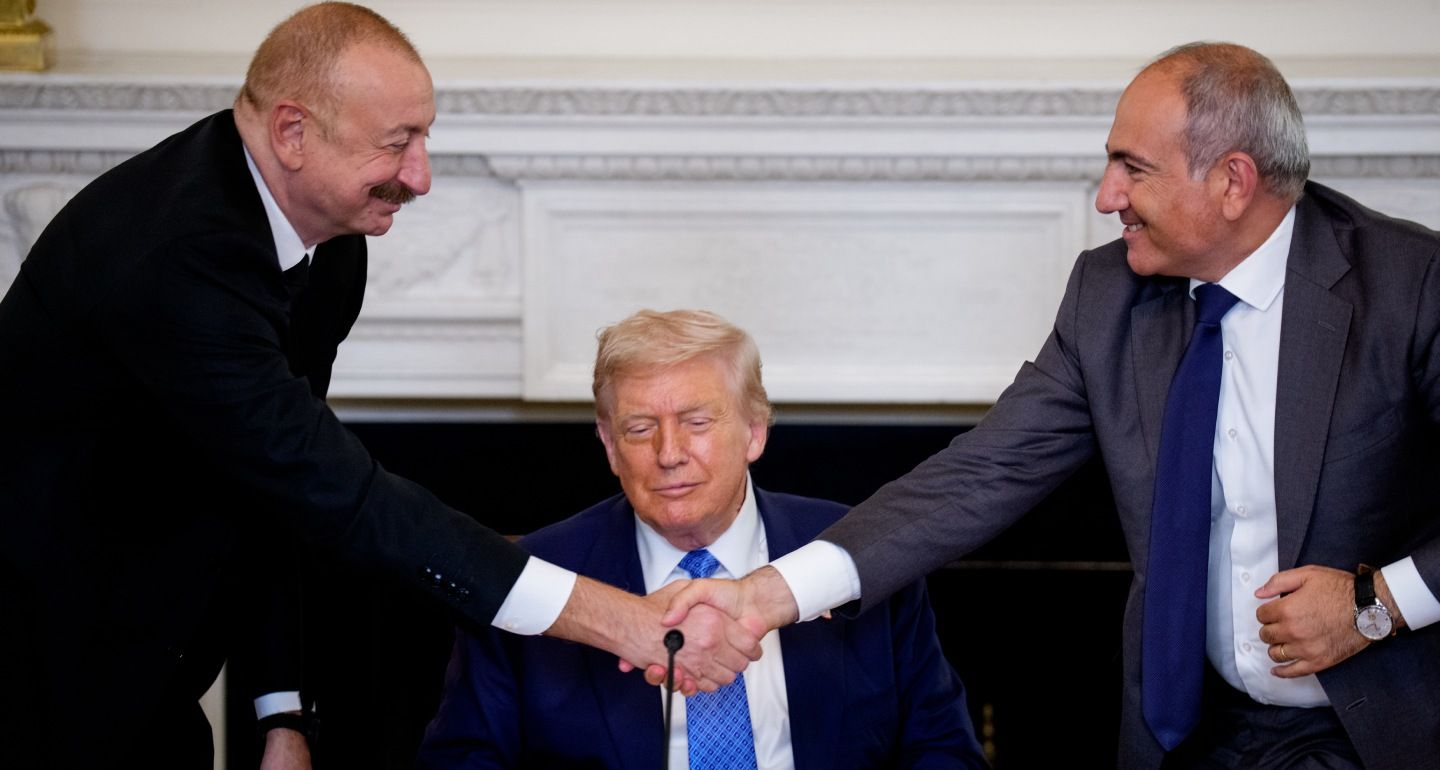
Many expected the U.S.-brokered Washington agreement signed by Aliyev and Armenian Prime Minister Nikol Pashinyan in August 2025 to be a watershed moment. Despite its overwhelming military superiority, Baku appeared to concede that the conflict was over and that it was time to move toward a legally binding peace treaty.
There was speculation about the dawn of a “new era” in the South Caucasus, and the atmosphere was friendly when expert groups from each country visited the other to discuss peace. In Baku, Hikmet Hajiyev, an adviser to President Aliyev, even asked the visiting Armenians to take home the message that Azerbaijan had no territorial claims on Armenia and considered the conflict to be over.
In addition to symbolic gestures, there have also been practical steps. In December, a delivery of grain from Kazakhstan to Armenia transited through Azerbaijan and Georgia for the first time. And on December 18, Baku sent Armenia a first-ever delivery of oil products.
Taken together, all this appears to suggest that the conflict is moving to a close. However, confrontation with Armenia remains central to the rhetoric used by Azerbaijani authorities. Aliyev stills talks about how Azerbaijan should “always be ready for war,” and how it does not have the right to “wash its bloody history from its memory.” Nor has the language used by state-owned media changed, with programs being produced about how “historical Azerbaijani land” is located in modern Armenia.
Indeed, state propaganda appears determined to make sure Azerbaijanis do not forget that—whatever the diplomatic back and forth—they should be ready for the conflict to reignite at any moment. Given that Azerbaijan’s military spending exceeded $5 billion in 2025 and is set to grow in 2026, it even seems possible there could be another war.
Nevertheless, a resumption of hostilities is unlikely. Aliyev does not want to see another military conflict jeopardize the international ties, investment, and reputation he has so carefully cultivated in recent years. Azerbaijan is now an important source of energy for the EU, as well as a logistics hub.
When European officials meet with Aliyev, they praise him for Azerbaijan’s progress toward peace. Europe fears new clashes could deprive it of both an alternative source of natural gas, and an energy supply route that avoids Russia. In other words, for Aliyev, the risks of sanctions and a loss of connections that a war would entail are too great.
Nor is there much desire for a war in broader Azerbaijani society. Following Baku’s victory in the Second Karabakh War, many Azerbaijanis hoped to see a rise in living standards, and even democratization. But instead, they faced rising prices and new taxes, and saw a systemic lack of support for veterans of the fighting.
At the same time, Azerbaijan has a vested interest in ensuring there is no swift end to the simmering tensions. Even though Azerbaijan’s demands are met in the proposed peace treaty, Baku continues to delay its final signing. After all, once Baku signs a peace treaty, it will have far less scope to pressure Armenia—and it will be harder to return to the language of escalation.
The truth is that its current two-pronged approach is advantageous for Azerbaijan. With one breath, Baku can talk about peace on the international stage; with another, it can continue spewing hate designed for domestic consumption. This appears to be a deliberate strategy.
If Armenia stops making concessions, such an approach means it would be easy for Baku to exert further military pressure. And this situation of “neither war nor peace” allows Aliyev to continue using revanchism to mobilize support for his regime.
Indeed, it would be extremely difficult for Baku to call time on its anti-Armenian propaganda. Over the course of thirty years, the regime’s ideology has been defined by the conflict over Nagorno-Karabakh—and a large element of this is rooted in hatred of Armenians. Embracing the language of reconciliation would therefore be a process fraught with risk. Nor does the regime have any compelling ideas with which it could fill the ideological vacuum that would inevitably arise.
By ditching the anti-Armenian rhetoric, Aliyev could end up undermining his own legitimacy while the county is struggling with stagnating living standards, economic problems, closed borders, corruption, and growing repression.
For these reasons, Baku is for now obliged to keep combining two parallel realities: peace signals abroad and revanchism at home. It will only be clear that this is changing when Baku takes some practical steps, such as altering the language used by state-owned media and textbooks, or allowing unfettered contact between representatives of Azerbaijani and Armenian civil society. Given how tightly the current regime controls the media and civil society, anything like that would have to be greenlit by Aliyev himself.

Bashir Kitachaev
Journalist specializing on the South Caucasus region
Carnegie does not take institutional positions on public policy issues; the views represented herein are those of the author(s) and do not necessarily reflect the views of Carnegie, its staff, or its trustees.
Arms supplies from Russia to Iran will not only continue, but could grow significantly if Russia gets the opportunity.

Nikita Smagin

The use of technology to mobilize Russians to vote—a system tied to the relative material well-being of the electorate, its high dependence on the state, and a far-reaching system of digital control—is breaking down.

Andrey Pertsev
Putin is stalling, waiting for a breakthrough on the front lines or a grand bargain in which Trump will give him something more than Ukraine in exchange for concessions on Ukraine. And if that doesn’t happen, the conflict could be expanded beyond Ukraine.

Alexander Baunov
As discussions about settlement and elections move from speculation to preparation, Kyiv will have to manage not only the battlefield, but also the terms of political transition. The thaw will not resolve underlying tensions; it will only expose them more clearly.

Balázs Jarábik
Disillusioned with the West over Gaza, Arab countries are not only trading more with Russia; they are also more willing to criticize Kyiv.

Ruslan Suleymanov