

Commentary
Bashir Kitachaev
{
  "authors": [
    "Bashir Kitachaev"
  ],
  "type": "commentary",
  "blog": "Carnegie Politika",
  "centerAffiliationAll": "",
  "centers": [
    "Carnegie Endowment for International Peace",
    "Carnegie Russia Eurasia Center"
  ],
  "collections": [
    "Aso Tavitian Initiative",
    "Politika: The Best of 2025"
  ],
  "englishNewsletterAll": "",
  "nonEnglishNewsletterAll": "",
  "primaryCenter": "Carnegie Russia Eurasia Center",
  "programAffiliation": "",
  "programs": [],
  "projects": [],
  "regions": [
    "Georgia",
    "Caucasus"
  ],
  "topics": [
    "Domestic Politics",
    "Political Reform",
    "Civil Society"
  ]
}
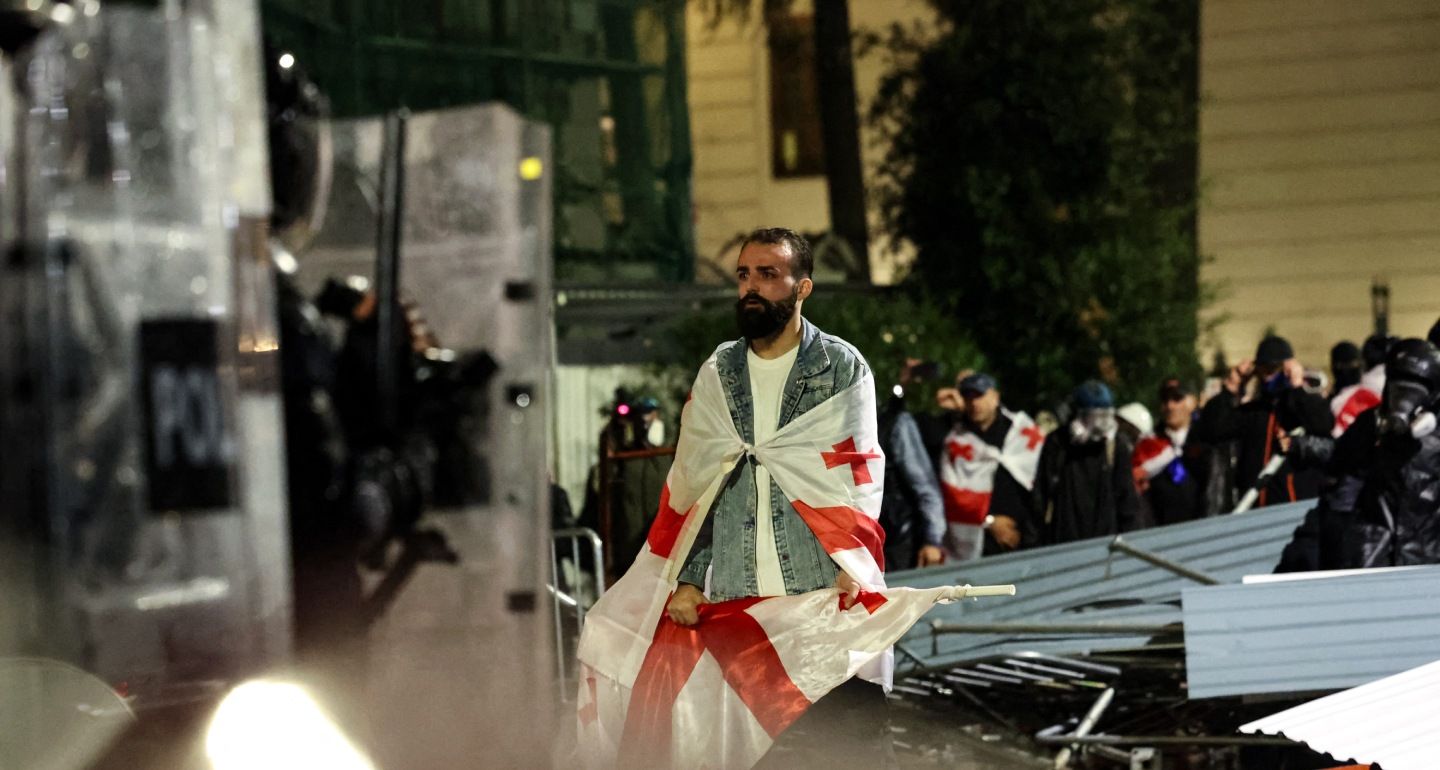
Source: Getty
Georgian Dream may continue along the path of “managed democracy” and growing pressure on the opposition and civil society. But this model of authoritarianism will still leave room for destabilization and a rollback to a more liberal political climate.
Georgia’s ruling party, Georgian Dream, has ramped up the pressure on the opposition to a new level in recent months. Opposition leaders and activists are regularly arrested or forced into foreign exile, and attempts are being made to outlaw rival political parties and stop Georgians voting from abroad. The government has made no secret of the fact that by the next elections in 2028 it hopes to have conclusively transformed the fragmented opposition into convenient sparring partners who exist purely for show.
Still, the chances of Georgian Dream succeeding in building a robust and resilient authoritarian regime like those in Azerbaijan, Belarus, and Russia still appear slim. The party has neither the resources nor the external patrons nor the unifying national idea to achieve that.
Following recent victories in national and regional elections, Georgian Dream has successfully weathered waves of accusations of widespread voter fraud, Western criticism, and street protests. While there are no visible serious threats to the ruling party right now, the party is not taking any chances and has increased pressure on its opponents all the same, strengthening the de facto one-party system ahead of the next electoral cycle.
In early November alone, the prosecutor’s office launched criminal cases against eight opposition figures on charges ranging from sabotage to attempting to overthrow the government. Six of them, including the leaders of the pro-European Coalition for Change and former President Mikheil Saakashvili, are already behind bars. The remaining two are the leaders of the Lelo for Georgia party, Mamuka Khazaradze and Badri Japaridze.
The arrests are in keeping with the broader context of Georgian Dream’s efforts to ban the three largest opposition parties and coalitions: the United National Movement party (UNM) founded by Saakashvili that held power from 2004 to 2012, the Coalition for Change, and the Strong Georgia—Lelo coalition. Georgian Dream has accused the UNM of human rights violations during its rule, and the other organizations of threatening the constitutional order.
Even according to the official results, which are highly questionable, these three opposition forces together won forty-nine of the 150 seats in the 2024 parliamentary elections, but subsequently boycotted parliament, claiming that there had been widespread violations during the vote.
Also facing criminal charges is Giorgi Gakharia, the exiled former prime minister and leader of the opposition party Gakharia for Georgia: the only one of the four opposition forces that won seats in the last parliamentary elections to have abandoned the boycott. Gakharia faces up to thirteen years in prison on charges of abuse of power and causing intentional bodily harm during the dispersal of protests in 2019, when he was prime minister. However, there are currently no plans to ban the party itself.
Finally, the authorities are simultaneously seeking to ban voting outside the country. Support for the opposition among the diaspora is traditionally strong: in the last parliamentary elections, only 13 percent of Georgians casting their ballots abroad voted for Georgian Dream.
Given this context, Georgia creates the impression of a country that is rapidly descending into a full-fledged dictatorship. For over a decade, the opposition’s efforts and hopes for EU integration kept Georgian Dream and its founder, the billionaire Bidzina Ivanishvili, from taking overly drastic steps toward usurping power. But now an economic boom and divisions among the opposition have given the authorities a chance to consolidate their control over the country to a level comparable to that of Russia or neighboring Azerbaijan.
To conclusively turn Georgia into a robust dictatorship, however, Georgian Dream would need a clear ideological project around which Georgians would be willing to unite and tolerate a further tightening of the screws. In theory, such an idea could be that of the return of the Russia-backed breakaway regions of Abkhazia and South Ossetia to Tbilisi’s control. But Georgian Dream is incapable of achieving that by force, and reaching an agreement with Moscow on the territories’ return is unlikely.
Nor is Georgian Dream able to consolidate power by expanding the public sector and buying the population’s loyalty through social programs. Georgia cannot count on easy income from commodity exports, which can be predicated and relatively easily redistributed. Instead, its impressive economic growth in recent years has come from foreign investment and trade (primarily related to the circumvention of sanctions against Russia). Chinese investment, Russian capital, and Arab construction projects are far less manageable and stable than oil and gas revenues, for example.
Georgia’s organized opposition may be weak, but the divisions in Georgian society have not disappeared. Nor has the demand for an alternative to Georgian Dream, nor the persistent accusations that the government is corrupt, has strayed from its pro-Western course, and has become too close to Moscow. Many Georgians are undoubtedly tired of the lack of tangible progress in the EU integration process, but that fatigue has not translated into widespread, grassroots dislike of the West.
As a result, the party has to consider reputational factors and cannot risk a complete severing of ties with the West. And so it contents itself with gradual but targeted pressure on Western media funding, without resorting to drastic measures such as banning foreign editorial offices, like in Azerbaijan, or suppressing all opposition parties. The Georgian government still values the achievements of EU integration, including visa-free travel with the bloc, and fears large-scale Western sanctions, which could really hurt the economy.
Georgian Dream also lacks external patrons interested in shoring up its power. Moscow appreciates Tbilisi’s neutral stance on the Ukraine war and its emphasis on protecting “traditional values,” but given the protracted war and Russia’s limited resources, it is not prepared to sponsor the Georgian regime. The West, meanwhile, simply tolerates Ivanishvili and only avoids putting serious pressure on the Georgian government for fear of pushing Tbilisi further toward Russia.
Ultimately, Georgian Dream could well continue along the path of building a “managed democracy” and increasing pressure on the opposition and civil society. But this model of authoritarianism will still leave room for destabilization and a rollback to a more liberal political climate—especially since unlike Belarus, for example, Georgia does not have either entrenched authoritarian traditions or a harsh repressive apparatus inherited from the Soviet era.
Georgia is still not a wealthy country and remains vulnerable to outbreaks of mass discontent like those seen in the final years of Saakashvili’s reign and that of his predecessor, Eduard Shevardnadze. Without a financial airbag or the potential for a “small victorious war,” any deterioration in the economic situation or fatigue with stagnation and the tightening of the screws could once again bring people out onto the streets.
The Georgian model of autocracy bears less resemblance to Belarus and Azerbaijan than to other EU candidate countries with authoritarian tendencies, such as Serbia. There, too, periods of relative political calm alternate with unexpected and powerful mass protests—like the recent rallies against President Aleksandar Vučić following the collapse of the Novi Sad railway station. The government in Tbilisi may jail opposition figures, disperse rallies, and ban opposition parties, but until it can eliminate the potential for new waves of public protest, it will be unable to establish a truly stable authoritarian regime.

Journalist specializing on the South Caucasus region
Recent Work
Bashir Kitachaev
Bashir Kitachaev
Carnegie does not take institutional positions on public policy issues; the views represented herein are those of the author(s) and do not necessarily reflect the views of Carnegie, its staff, or its trustees.

The European far right might fail to steer EU policy in the direction Russia wants, but they will create enough chaos inside Europe to benefit the Kremlin.

Dimitar Bechev

If the Russian-speaking community in Latvia cannot articulate their interests without being seen as disloyal, they could end up embracing a pro-Kremlin agenda.

Sergejs Potapkins

Russia’s ruling party would have benefited from Putin appearing as its distant patron, but as an active frontman imposing his views on the public, he has done nothing but harm both the party’s election campaign and the ruling system overall.

Andrey Pertsev

Depleted financial reserves and a shrinking tax base mean it is no longer possible to simultaneously deliver high defense spending, price stability, and economic growth.

Alexandra Prokopenko
Blurring the line between humans and animals is a long-standing tradition in social utopian prose. In his latest novel, Leonid Bershidsky reminds us that in social experiments, people are often treated no differently than animals.

Alexander Baunov