

Commentary
Nikita Smagin
{
  "authors": [
    "Nikita Smagin"
  ],
  "type": "commentary",
  "blog": "Carnegie Politika",
  "centerAffiliationAll": "",
  "centers": [
    "Carnegie Endowment for International Peace",
    "Carnegie Russia Eurasia Center"
  ],
  "englishNewsletterAll": "",
  "nonEnglishNewsletterAll": "",
  "primaryCenter": "Carnegie Russia Eurasia Center",
  "programAffiliation": "",
  "programs": [],
  "projects": [],
  "regions": [
    "Russia",
    "Iran",
    "Middle East"
  ],
  "topics": [
    "Foreign Policy",
    "Global Governance",
    "Security",
    "Civil Society"
  ]
}
Source: Getty
It’s one thing to export Russian helicopters to Iran to fight the insurgency, and it’s easy to imagine Moscow becoming a haven for fleeing Iranian leaders. But it’s very difficult to imagine Russian troops defending the Iranian regime on the ground.
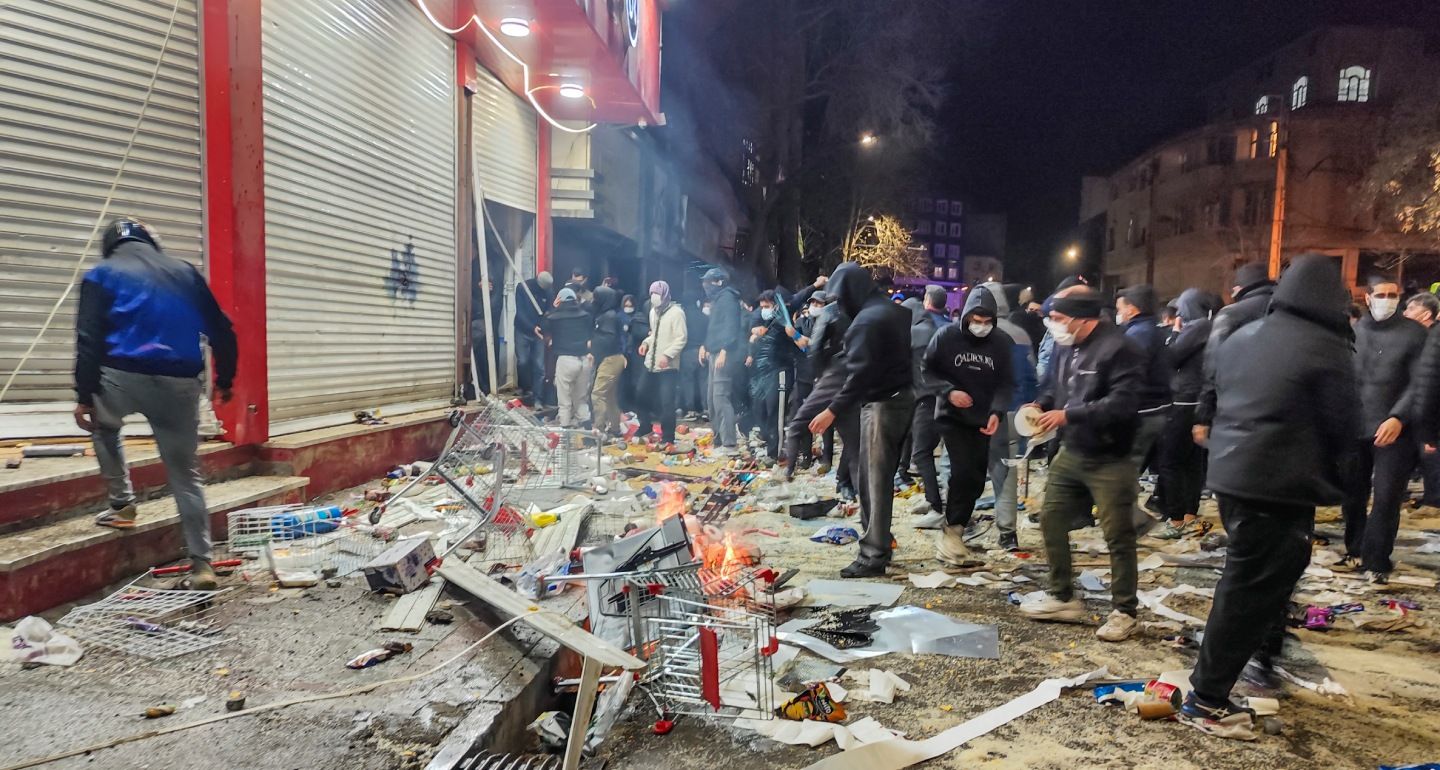
The Iranian regime is facing one of the most powerful protest waves in its history. Protesters are storming government buildings and sweeping entire cities, and despite the hundreds of fatalities that have occurred during the state’s crackdown, they show no sign of stopping anytime soon. Moreover, for the first time, the protesters are marching under relatively unified slogans: they are demanding the restoration of the monarchy.
The Kremlin, which has become one of Iran’s closest allies in recent years, appears to be prepared to support the Islamic regime in its time of need, and is supplying Tehran with weapons that could prove useful if the protests escalate into an armed uprising. The Kremlin is also closely studying Iran’s experience in dealing with the protesters in the hope of learning from the mistakes of others.
The protests that erupted at the end of last year are already the biggest in recent years. From the very beginning, they quickly became radicalized: protesters threw stones at police, attacked government buildings, set fire to security vehicles, and threw Molotov cocktails at law enforcement representatives.
The authorities, for their part, quickly resorted to using firearms to disperse the protests. Over the weekend, live rounds were reportedly being used, resulting in hundreds of casualties. According to human rights activists, over 500 people have been killed and over 10,000 detained. Iran has also been under an internet blackout since January 8 in an attempt to hinder the protests.
The current protests are also notable because, for the first time, the protesters are clearly articulating what they want: the restoration of the monarchy. However, they remain significantly hampered by their lack of effective coordination and real leadership.
If for any reason the authorities don’t manage to follow the typical scenario for quashing them, giving the demonstrators hope they might succeed, the protests may reach new levels. Strange as it may seem, the main factor making that a possibility is U.S. President Donald Trump.
Trump has repeatedly threatened Iran with strikes if the government continues to suppress the protests, saying on Monday that “we’re looking at some very strong options.” The recent U.S. military operation in Venezuela lends credibility to his threats, not to mention that the United States and Israel were already considering further strikes against Iran to destroy its nuclear program. A military intervention by the United States and Israel could spark hope of regime change among the protesters—though such hope is no guarantee that it will occur, of course.
After all, to achieve regime change, it would not be enough to launch a few strikes against Iranian territory: they would need to coordinate the protesters’ actions and mobilize them to take power. That is a complex and highly risky task that could very easily fail to go to plan. The combination of a U.S. intervention and domestic protests could be enough to topple the authorities. But it might also have the opposite effect of prompting them to rally against the external threat.
The scale of the Iranian protests has already given rise to reports that Supreme Leader Ali Khamenei is planning to flee to Russia if the situation worsens. That’s not out of the question: granting asylum to authoritarian leaders is one of Moscow’s key incentives in its cooperation with other autocracies.
The Kremlin itself is clearly far from thrilled by the Iranian protests. Firstly, for Russia, Iran is an important partner that it does not want to lose, which it might well do in the event of regime change.
Secondly, the Russian leadership often projects the problems of other autocracies onto itself and would not like Iran to serve as an example for other authoritarian countries. Hence the cautious support for the Iranian authorities voiced by the Russian embassy in Tehran, which described the actions of local security forces as “work to ensure order and the rule of law.”
During the protests, several Il-76 military transport aircraft have reportedly arrived in Iran from Russia and Belarus, along with the country’s first Mi-28 attack helicopters. Back in December, photographs surfaced of dozens of Russian Spartak armored vehicles arriving in Iran.
Mi-28 helicopters and Spartak armored vehicles are useless against Israeli or U.S. air strikes. Nor is there any need for them to deal with the current stage of the protests: guns and tear gas are sufficient to disperse stone-throwing protesters. This equipment is best suited for fighting armed insurgents. In other words, it will be needed in the event that the Iranian protests escalate into armed conflict.
However, Moscow’s willingness to come to the rescue of the Iranian regime should not be overestimated. The Kremlin has repeatedly demonstrated its willingness to abandon its allies if things take a truly serious turn for the worse. This is precisely what happened in Venezuela at the start of the year, in Syria when Bashar al-Assad’s regime collapsed in 2024, and in Iran itself during the twelve-day war last summer.
Accordingly, it’s one thing to export Russian helicopters to Iran to fight the insurgency, and it’s easy to imagine Moscow becoming a haven for fleeing Iranian leaders. But it’s very difficult to imagine Russian troops defending the Iranian regime on the ground.
What the Kremlin is doing, however, is attempting to thoroughly study what’s happening in Iran so as not to repeat its mistakes—just as it drew on Iran’s experience when building a system to circumvent sanctions. Now it’s also looking at the Iranian model of introducing internet restrictions.
Russia’s internet “whitelists” are a direct analogue of Iran’s “national internet,” which the Islamic Republic also uses to suppress protests. Key internal services—taxi booking, ticket purchasing, delivery, banking apps, and media websites in the .IR national zone—are still operational. But the entire external internet is cut off so completely that no VPN can help. Millions of Russians have already experienced this for themselves: their internet access is now being cut off, leaving only sites included in the “whitelists” accessible.

Expert on Iranian foreign and domestic policies, Islamism, and Russia's policy in the Middle East
Recent Work
Nikita Smagin
Nikita Smagin
Carnegie does not take institutional positions on public policy issues; the views represented herein are those of the author(s) and do not necessarily reflect the views of Carnegie, its staff, or its trustees.

Russian strikes are weakening the economy sustaining Ukraine’s war effort. Closing the growing funding gap will require more European support and politically contentious reforms in Kyiv.

Balázs Jarábik

Despite a new textbook, an influx of Russian teachers and managers, and an end to the teaching of Ukrainian, the Kremlin is unlikely to have “reprogrammed” locals.

Konstantin Skorkin

For every ruble allocated to social policy, health, and education in 2027, double that amount is earmarked for the army, the police, and the security services.

Alexandra Prokopenko

Cargo traffic through Russia’s Northern Sea Route has increased because of the disruption caused by the conflict in the Middle East, the Ukraine war, and U.S.-China tensions.

Mikhail Korostikov
An analysis of traffic accident data suggests that Ukrainian drone attacks caused a material but not disastrous fall in Russian gasoline consumption over the summer.

Sergey Vakulenko