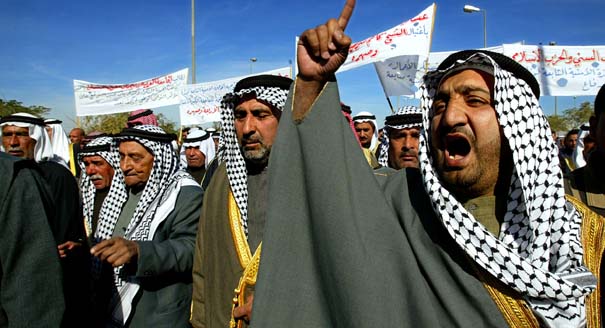
As Iraq’s second parliamentary election approaches, Sunnis appear as uncertain about what strategy to pursue and as divided among themselves as they were in 2004 and 2005.
Source: Analysis of the 2010 Iraqi Parliamentary Elections
Sunnis in Iraq, 6 Years after SaddamAs the second election for the Council of Representatives approaches, Sunnis appear as uncertain about what strategy to pursue and as divided among themselves as they were in 2004 and 2005. In the past, such problems probably left Sunnis underrepresented and certainly resentful, and also decreased their influence in the parliament. If present trends continue, the situation risks being perpetuated in the future. Sunnis are dispersing their efforts in ways that seem to be dictated less by genuine disagreement about goals and governance programs than by personal ambitions and reciprocal animosities. While Shi’i and Kurdish organizations suffer from similar problems, the outcome may be more serious for Sunnis. Shi’a are, to some extent, protected by their numbers, and Kurds by the fact that, no matter how divided on the issues, they ultimately coalesce around the goal of Kurdish autonomy. Sunnis lack both the advantage of numbers and an ultimate unifying goal.
Sunni Political Organizations
In preparation for the 2005 elections, Sunni politicians managed to unite into two broad organizations, the Iraqi Accord Front or Tawafuq, which gained 44 seats in the Council of Representatives, and the Iraqi Front for National Dialogue, a party that gained 11 seats. But many influential Sunnis remained on the margins of the political process, either because, as former Baathists, they were shunned, or because they chose to resist the U.S.-backed process. This weakened Sunni participation.
The two Sunni organizations represented in the parliament were mainly electoral alliances of convenience, rather than parties representing clear ideological trends or political demands. Tawafuq, dominated by the Iraqi Islamic Party (IIP), had also gathered a number of secular organizations, which flocked to Tawafuq for lack of better alternatives. The Iraqi Front for National Dialogue (IFND) was formed by Saleh al-Mutlaq, a former Baathist who had left the party in the 1970s. In 2005, he became a member of the committee in charge of drafting the Iraqi constitution, but in the end rejected the draft, which called for a weak central government, an autonomous Kurdish region, and opened the way for the formation of other autonomous regions. Mutlaq and the IFND stood instead for the restoration of a strong, centralized Iraqi state. They also opposed the IIP, which they considered to have been co-opted by the government. The party remains largely intact and has joined the Iraqi National Alliance.
Tawafuq broke apart in 2008 because of the increasing dissension between the IIP and secular politicians who had initially joined the alliance. At the same time, the IIP itself started losing members and eventually split. Tareq al-Hashemi, chairman of the IIP and one of the country’s two vice-presidents, resigned and then launched his own Renewal Party. A number of prominent personalities also left Tawafuq, as well as the Iraqi National Dialogue Council, which split from Tawafuq and then splintered: former parliament speaker and INDC member Mahmoud Mashhadani formed his own alliance, which remains quite small and inconsequential. Other prominent personalities also left Tawafuq.
While the old alliances were breaking down, new Sunni players started gaining prominence as individuals and tribal elements that had initially backed al-Qaeda became disenchanted with it and instead joined U.S. efforts to eradicate the organization. The formation of the tribal Anbar Salvation and of the Awakening Councils marked a turning point in the war, bringing al-Qaeda under control and reducing the level of violence in the country. It also generated new Sunni political players with ambitions of their own who are also strongly opposed to the IIP. However, the Awakening Councils did not manage to form a united front politically, and different leaders joined different coalitions.
Divisions Over Tactics: The Election Law Crisis
Sunnis are united in their resentment of what they consider to be their underrepresentation in the political system. It is very difficult to determine whether Sunnis are indeed underrepresented, and, if that is the case, whether this is as a result of a system that is stacked against them or of their lower level of electoral participation. Until Iraq holds a census—which will be very difficult because population figures are so sensitive in divided societies—claims of under or overrepresentation cannot easily by verified.
This grievance prompted Vice President Tareq al-Hashemi to veto the election law voted by parliament on November 18 on the grounds that it did not provide enough representation for Iraqis abroad. Unfortunately for Sunnis, by vetoing the law, Hashemi also gave the Council of Representatives the opportunity to reverse its decision to allow the Iraqi High Election Commission to decide how to apportion seats among the provinces. ِAccording to the Kurds, the IHEC had suggested a redistribution favorable to Sunnis and unfavorable to Kurds. After the veto, the parliament voted for an amendment to the election law that increased seats to all provinces by the same percentage, thus stripping Sunnis of the advantage they had accrued under the IHEC’s numbers.
While agreeing that Sunnis deserve better representation, many Sunni politicians have accused Hashemi of having caused the debacle by vetoing the first draft of the law, and they were divided over his threat to veto the amended law as well. The community displayed no unity or strategy in how to proceed on the matter. The issue of the election law and the veto has been solved, as minutes before the midnight deadline on Monday December 7, lawmakers came to an agreement that took into account Hashemi’s original demands. The issue of seat distribution was solved by increasing the number of seats by three to 325. The three additional seats will go to the Kurdish provinces, the rest will be distributed as specified by the Iraqi High Election Commission before Hashemis’s veto. This means that Sunni provinces will see a hefty increase in the number of seats from their 2005 numbers, but Kurds will also receive an increase. The number of compensatory seats will be fifteen, with eight set aside for minorities. Iraqis living abroad will vote for representatives of their home provinces, with no special seats reserved for them. .
Present Alignment of Sunni Organizations
The two organizations that represented Sunnis in the 2005 election and beyond have been replaced by a much more fragmented and complex alignment of political forces.
The IIP remains the dominant member of an almost exclusively Sunni alliance, the Iraqi Accord, but many of its prominent members have gone their separate ways. As a result the Iraqi Accord may not attract a large number of votes.
The Iraqi Front for National Dialogue of Saleh al-Mutlaq and the Renewal Party of Tareq al-Hashemi have joined with former prime minister Iyad Allawi, a Shi’i, in the Iraqi National Movement. This is a non-sectarian coalition where Sunnis play an important role. Iyad Allawi did not fare well in the 2005 elections, and the success of the INM may depend heavily on the appeal of his Sunni partners.
A number of prominent Sunni personalities, including Parliament Speaker Abdulghafour Sammurraie, Minister of Defense Saadoun al-Dulaimi, and the head of the Awakening Councils of Iraq, Ahmed Abu Risha, have joined the Unity Alliance of Iraq, which remains predominantly Sunni.
Only smaller Sunni organizations have joined the State of Law Coalition of Prime Minister Nouri al-Maliki, which is likely to do well in the election by virtue of incumbency. While courting small Sunni organizations, Maliki has been very hostile toward groups that may present a real challenge to his alliance. In particular, he has been attacking the Iraqi National Movement, thus, Saleh Mutlak, accusing it of having a Baathist agenda.
The Anbar Salvation Council has joined the virtually all-Shi’i Iraqi National Alliance, where it is unlikely to have much influence.
Mahmoud Mashhadani, a former speaker of parliament and Tawafuq member, has not joined any alliance but formed his own small and probably inconsequential coalition.
This realignment of Sunni forces is open to two interpretations. On the positive side, it may indicate a genuine effort by Sunnis to become better integrated in the political system and to reach our across the sectarian divide they all claim to reject. Also on the positive side, it can be seen as an effort to ensure that Sunnis will have adequate representation no matter who wins the elections.
On the negative side, the realignment is also the result of personal ambitions that continue to create deep divisions among Sunni leaders. Those personal rivalries, as well as the widespread refusal of many to work with the IIP, are leading Sunnis to join different alliances not because they share the goals of the particular coalition, but because rival Sunni parties have joined other groups.
Before joining the Endowment, Ottaway carried out research in Africa and in the Middle East for many years and taught at the University of Addis Ababa, the University of Zambia, the American University in Cairo, and the University of the Witwatersrand in South Africa.
Carnegie does not take institutional positions on public policy issues; the views represented herein are those of the author(s) and do not necessarily reflect the views of Carnegie, its staff, or its trustees.
Japan’s long-term security policy is driven by concerns about China, and there is little appetite for (or interest in) pursuing a confrontation with Moscow.
Putin’s conservative staffing policies and search for ever greater control have cemented parliament’s transformation into a bureaucratic appendage of the executive branch.
Without a ceasefire with Ukraine on attacking each other’s energy infrastructure—to which the Kremlin is unlikely to agree—the diesel agreement between Putin and Trump is largely for show, rather than representing a genuine increase in the volumes of Russian diesel on the global market.
Ex-president Gurbanguly Berdimuhamedov remains interested in politics, but his son Serdar, Turkmenistan’s current president, is becoming increasingly independent and willing to break with his father’s legacy. If their covert rivalry goes too far, both risk losing power.
Despite a new textbook, an influx of Russian teachers and managers, and an end to the teaching of Ukrainian, the Kremlin is unlikely to have “reprogrammed” locals.