{
  "authors": [
    "Amr Hamzawy"
  ],
  "type": "legacyinthemedia",
  "centerAffiliationAll": "",
  "centers": [
    "Carnegie Endowment for International Peace",
    "Malcolm H. Kerr Carnegie Middle East Center"
  ],
  "collections": [],
  "englishNewsletterAll": "",
  "nonEnglishNewsletterAll": "",
  "primaryCenter": "Carnegie Endowment for International Peace",
  "programAffiliation": "",
  "programs": [],
  "projects": [],
  "regions": [
    "Egypt",
    "Gulf",
    "Levant",
    "Maghreb"
  ],
  "topics": [
    "Political Reform"
  ]
}
Source: Getty
In The Media
The Gaza Flotilla - Three Common Misinterpretations in Arab Views
The reactions of Arab politicians, writers, and journalists to the Israeli raid on a flotilla of humanitarian aid have diverted public debate in the Arab world and undermined efforts to help Gaza.
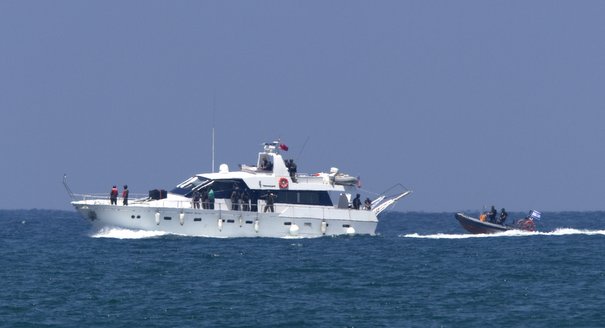
The Gaza Flotilla - Three Common MisinterpretationWhen Israeli forces attacked the Freedom Flotilla last week, large numbers of Arab politicians, writers, and journalists channeled their biased opinions and prejudices on the Arab-Israeli conflict through three common misinterpretations of the crime. Their positions―intentionally or unintentionally―diverted public debate in the Arab region from the gist of the crime, i.e. the illegal and excessive use of power against peaceful activists from a variety of religions and nations aboard a ship carrying humanitarian aid to Gaza that hoped to break an illegal and inhumane siege imposed by Israel since 2007.
Scores of politicians, writers, and journalists viewed the flotilla crime through a religious lens, using expressions and symbols to reinforce the dichotomy of the oppressing Jew versus the oppressed Muslim and their existential struggle against each other. This group neglected the fact that Freedom activists included some Jews in addition to Muslims and Christians, which was recalled only to signal global solidarity and boost relief efforts for besieged Gaza. This “religionization” trend was seen in some activists’ echoing of the Islamist slogan, “Jews! Beware! Beware! Mohamad’s armies will be there,” and similar religious symbolism was expressed in op-eds and TV interviews. In front of reporters, a number of released hostages, including parliamentarians and politicians from different countries in the Arab region, commented on the Israeli violence using phrases such as “racist Jews” or “criminal Jews.” This view confuses the Jews as followers of a religion and Israelis as citizens of an occupying and “always violent” state responsible for the attack. Media testimonies also failed to mention, almost completely, the rational distinction between the Israeli government making the decision to attack the Freedom Flotilla, Israeli armed forces executing the decision, and Israeli citizens both in favor or opposed to the decision, as this distinction clearly contradicts the religionization trend. Instead, all parties were described as part of the “violating Zionist entity.”
On the opposite end of the “religious” spectrum arose a second view that also diverts public debate from the gist of the flotilla crime and the criminal siege of Gaza: the violence and radicalism of some Israelis is a reaction to the violence and radicalism of some Palestinians, Arabs, and Muslims. It is true this dual violence and counter-violence theory partly explains aspects of the Israeli-Palestinian relationship, but the causal link between radicalism in Israel and radicalism in Palestinian, Arab, and Islamic environments does not supplant analysis. Examining the Arab-Israeli conflict from these constricted views and ignoring striking facts of ongoing Israeli occupation and structural violence (the building of settlements, Judaisation of East Jerusalem, and siege of Gaza) and daily violation of Palestinians’ freedoms, human rights, and right to self-determination are signs of irrational thinking and political bias, almost as dangerous as religionization. In this sense, the causal theory used to interpret the attack is a blatant distortion of facts. Activists legitimately defending themselves were accused of only claiming to be attacked and subjective interpretations portrayed the Freedom Flotilla as a careful plan launched by Arab and Muslim radicals (Hamas, Hezbollah, Iran, and other Islamist actors) to provoke Israel, implicitly holding them responsible for the crime. The fact remains that Israeli forces violated international law by attacking the flotilla in international waters and used excessive force against pacifistic activists who did not resort to any violence or threaten Israeli security and interests.
Similarly, a third irrational and biased misinterpretation was expressed, motivated by a will to settle scores between regional powers. During the 2008 Israeli attack on Gaza, Arab and non-Arab governments and movements targeted the Egyptian government, using their media tools―namely satellite channels―to erroneously hold it responsible for the suffering of Palestinians. These efforts obscured the responsibility of the Israeli government in Arab public opinion, and history repeated itself when the Freedom Flotilla was attacked. Only minutes after the start of the media coverage, the website of one satellite TV channel posted the following opinion poll asking visitors, “Do you believe that Egypt should permanently reopen the Rafah crossing in response to the Israeli attack on the Freedom Flotilla?” This question sought to link the actions of Israel to Egyptian policies, which are criticized as falling short of appropriate action. When President Husni Mubarak decided a day later to reopen the Rafah crossing (taking the “appropriate action”) for an undetermined period in order for humanitarian and medical aid to reach Gaza―a decision that received broad coverage from most Arab TV channels and their websites―the website of said channel initially took no notice. The decision was later covered in the “Latest News” feed, but after publishing this brief story, the channel removed word of the opening of the crossing as if it were suddenly a minor detail.
Despite the variety of these misinterpretations and regardless of their underlying motives, they serve only to enlarge the gap between Arab countries, divert attention from the gist of the Israeli crime on the Freedom Flotilla and the ongoing siege of Gaza, and hinder Arab ability to expose Israeli violence and radicalism to further the Arab cause.
Amr Hamzawy is a senior fellow and the director of the Carnegie Middle East Program. His research and writings focus on Egypt’s and other middle powers’ involvement in regional security in the Middle East, particularly through collective diplomacy and multilateral conflict resolution
Carnegie does not take institutional positions on public policy issues; the views represented herein are those of the author(s) and do not necessarily reflect the views of Carnegie, its staff, or its trustees.
If the Russian-speaking community in Latvia cannot articulate their interests without being seen as disloyal, they could end up embracing a pro-Kremlin agenda.
Russia’s ruling party would have benefited from Putin appearing as its distant patron, but as an active frontman imposing his views on the public, he has done nothing but harm both the party’s election campaign and the ruling system overall.
The greater threat to Zelensky comes not from Fedorov alone, but from the convergence between the former defense minister’s political campaign and the anti-corruption investigations moving ever closer to the presidential administration.