

Article
Uri Dadush, Vera Eidelman, Taiya M. Smith
{
  "authors": [
    "Taiya M. Smith"
  ],
  "type": "other",
  "centerAffiliationAll": "dc",
  "centers": [
    "Carnegie Endowment for International Peace",
    "Carnegie Europe"
  ],
  "collections": [],
  "englishNewsletterAll": "asia",
  "nonEnglishNewsletterAll": "",
  "primaryCenter": "Carnegie Endowment for International Peace",
  "programAffiliation": "AP",
  "programs": [
    "Asia"
  ],
  "projects": [],
  "regions": [
    "North America",
    "United States",
    "East Asia",
    "China",
    "Asia"
  ],
  "topics": [
    "Foreign Policy"
  ]
}
Source: Getty
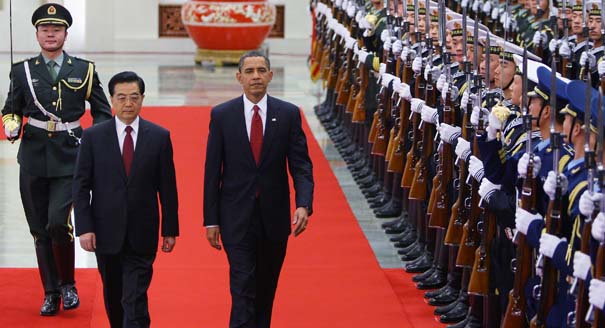
While the United States and China—the world’s two largest economies—are becoming increasingly interdependent, there is a growing risk of misunderstanding or even clashes. The two powers need a dialogue to provide strategic vision to their relationship.
While the United States and China—the world’s two largest economies—are becoming increasingly interdependent, there is a growing risk of misunderstanding or even clashes. In a new paper, Taiya Smith says the two powers need a dialogue to provide strategic vision to their relationship.
Smith, who led the U.S.-China Strategic Economic Dialogue for Treasury Secretary Paulson, draws on examples from her experience to analyze the recent history of strategic dialogues and recommends steps for Washington and Beijing to take to improve the broader bilateral relationship.
“What the U.S.-China relationship needs is a truly strategic discussion to steer a critically important, yet increasingly complex, bilateral relationship while still managing the time-sensitive issues of the day,” writes Smith.
Former Senior Associate, Energy and Climate Program, Asia Program
Smith has spent the last decade working in international negotiations. Most recently, she served as a member of Secretary Hank Paulson’s senior management team from 2006 to 2009 as the deputy chief of staff and executive secretary for the U.S. Department of the Treasury.
Recent Work

Uri Dadush, Vera Eidelman, Taiya M. Smith
William Chandler, Taiya M. Smith
Carnegie does not take institutional positions on public policy issues; the views represented herein are those of the author(s) and do not necessarily reflect the views of Carnegie, its staff, or its trustees.

Despite a new textbook, an influx of Russian teachers and managers, and an end to the teaching of Ukrainian, the Kremlin is unlikely to have “reprogrammed” locals.

Konstantin Skorkin

Cargo traffic through Russia’s Northern Sea Route has increased because of the disruption caused by the conflict in the Middle East, the Ukraine war, and U.S.-China tensions.

Mikhail Korostikov

Trump has promised Belarus a massive potash deal. But Minsk is seeking something greater: restored Western transit and greater room for maneuver from Russia.

Balázs Jarábik

Minsk clearly expected the dialogue with Washington to yield more results, in particular the lifting of EU sanctions and permission to export potash.

Artyom Shraibman

With the growth in points of friction between the great powers, organizations like the SCO will continue to play a role in the strategic adaptation of the smaller powers caught between them.

Temur Umarov