• Research
  • Politika
  • About
Carnegie Russia Eurasia center logoCarnegie lettermark logo
  • Donate
{
  "authors": [
    "Amr Hamzawy"
  ],
  "type": "legacyinthemedia",
  "centerAffiliationAll": "",
  "centers": [
    "Carnegie Endowment for International Peace",
    "Carnegie Europe",
    "Malcolm H. Kerr Carnegie Middle East Center"
  ],
  "collections": [
    "Arab Awakening"
  ],
  "englishNewsletterAll": "",
  "nonEnglishNewsletterAll": "",
  "primaryCenter": "Carnegie Endowment for International Peace",
  "programAffiliation": "",
  "programs": [],
  "projects": [],
  "regions": [
    "North Africa",
    "Egypt",
    "Middle East"
  ],
  "topics": [
    "Political Reform"
  ]
}
Source: Getty

In The Media

Egypt: At a Crucial Moment, Road Map Toward Democracy

As Egypt hovers on threshold of transition toward democratic governance, the current regime has an opportunity to administer a peaceful transition of power by responding to the demands of the Egyptian people.

Link Copied
By Amr Hamzawy
Published on Feb 1, 2011

Source: Commentary

Egypt: At a Crucial Moment, Road Map Toward DemocrEgypt is at a crucial moment of democratic change being driven by a dynamic popular movement. The time available to press for a transition toward democracy and a genuine response to citizens’ demands is being counted in hours and minutes, not days.

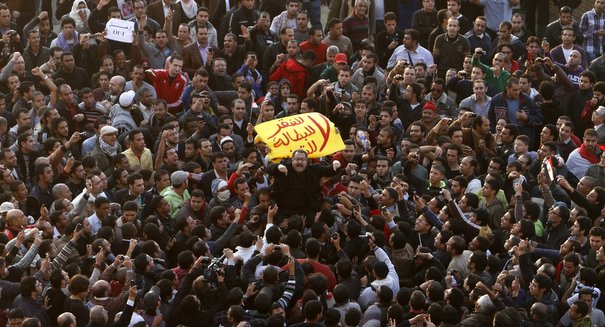
Egyptian citizens are bravely overcoming attempts by some to incite fear with chaos. The popular will to change has not wavered. Rather, the people have persisted with a clear, collective and frank expression of their desire to oust the current regime and create a democratic, free and just nation.

The matter has been decided and the clock’s hands will not turn back to the time of authoritarianism.

Egypt stands today assuredly on the threshold of transition toward democratic governance. Egyptians are now demanding the realization of swift national consensus regarding the method of this transition and its administration.

Given the choice of the military to cooperate both with the people and the existing government, the regime has an opportunity right now to administer a safe transition toward democracy. Such a transition could prevent Egypt from a dragged-out confrontation between the prevailing popular will to change and the desire of some power-players in the current regime to resist it.

A peaceful transition of power is dependent on the current regime responding to the demands Egyptians are raising:

  • Form a national unity government based on genuine participation to administer the country’s affairs. Civilians of every stripe, affiliation and creed must be brought together alongside military officers to develop a new form of governance. Likewise, political leaders must be seen as credible in the eyes of their constituents. The military must also commit to its full support of the unity government during a transition period not to exceed six months.
     
  • Dissolve the current parliament. Representation in both the upper and lower chambers lost any semblance of legitimacy following the rigged electoral processes of 2010. A constituent assembly — not an expert commission — should be formed. It should encompass all aspects of Egyptian society to include legal experts, representatives of every political ideology, academics, writers and other independent thinkers. If such an assembly is created and President Mubarak commits to refraining from a repeated run for the presidency, his era can end with dignity.
     
  • Amend constitutional articles 76 and 77 to allow for open candidacy in the presidential elections and to limit presidential terms to two. A round of amendments from 2007 moved progress toward fair electoral processes backward, and they must be either reversed or modified. Furthermore, any change to the Constitution or government must uncompromisingly protect equal rights of both Muslims and Copts, as well as the secular nature of the Egyptian state.
     
  • Immediately terminate emergency law and remove all restraints on civil and political liberties. Namely, the laws regulating political parties, the exercise of political rights, and the activities of civil society organizations must be either abolished or rewritten. Freedoms of expression and organization must be constitutionally guaranteed. With such assurances, the citizens who have been engaged in this uprising will have a legitimate stake in the transition. The bickering among the opposition over who speaks for the Egyptian street is now over. With this opening of political space, true communication is possible between citizens and the spectrum of political forces, as well as with the elites.
     
  • Hold accountable all those involved in corruption and violence against peaceful protesters. The judiciary must commit to bringing to justice all members of the regime who have enriched themselves at the expense of the Egyptian people. Citizens participating now in the creation of Egypt’s democratic present must understand, however, that taking such action may not affect all those who are guilty. The essential point here is to set in place sufficient legal and political guarantees to avoid the repetition of such crimes both today and in the future.

The moment for the military to administer a secure transition toward democracy and guarantee a dignified exit for President Mubarak is now. It is time to open the door of political life wide to the plethora of Egypt’s political players so that all may compete to represent the will of the people. What Egyptian citizens are accomplishing in this moment in history is magnificent. Yet, the clock is still ticking and time is running short. It is hoped that the military, with all its patriotism, will seize this opportunity and avoid the potential dangers posed by a volatile transition to democracy. Any other alternative could cost Egypt dearly.

About the Author

Amr Hamzawy

Director, Middle East Program

Amr Hamzawy is a senior fellow and the director of the Carnegie Middle East Program. His research and writings focus on governance in the Middle East and North Africa, social vulnerability, and the different roles of governments and civil societies in the region.

    Recent Work

  • Commentary
    Iran Is Pushing Its Neighbors Toward the United States

      Amr Hamzawy

  • Paper
    U.S. Peace Mediation in the Middle East: Lessons for the Gaza Peace Plan
      • Sarah Yerkes

      Amr Hamzawy, Sarah Yerkes, Kathryn Selfe

Amr Hamzawy
Director, Middle East Program
Amr Hamzawy
Political ReformNorth AfricaEgyptMiddle East

Carnegie does not take institutional positions on public policy issues; the views represented herein are those of the author(s) and do not necessarily reflect the views of Carnegie, its staff, or its trustees.

More Work from Carnegie Russia Eurasia Center

  • Commentary
    Carnegie Politika
    After Ilia II: What Will a New Patriarch Mean for Georgia?

    The front-runner to succeed Ilia II, Metropolitan Shio, is prone to harsh anti-Western rhetoric and frequent criticism of “liberal ideologies” that he claims threaten the Georgian state. This raises fears that under his leadership the Georgian Orthodox Church will lose its unifying role and become an instrument of ultraconservative ideology.

      Bashir Kitachaev

  • Commentary
    Carnegie Politika
    Tokayev’s New Constitution Is a Bet on Stability—At Freedom’s Expense

    Kazakhstan’s new constitution is an embodiment of the ruling elite’s fears and a self-serving attempt to preserve the status quo while they still can.

      Serik Beysembaev

  • Commentary
    Carnegie Politika
    The Kremlin Is Destroying Its Own System of Coerced Voting

    The use of technology to mobilize Russians to vote—a system tied to the relative material well-being of the electorate, its high dependence on the state, and a far-reaching system of digital control—is breaking down.

      Andrey Pertsev

  • Commentary
    Carnegie Politika
    Notes From Kyiv: Is Ukraine Preparing for Elections?

    As discussions about settlement and elections move from speculation to preparation, Kyiv will have to manage not only the battlefield, but also the terms of political transition. The thaw will not resolve underlying tensions; it will only expose them more clearly.

      Balázs Jarábik

  • Commentary
    Carnegie Politika
    Once Neutral on the Ukraine War, Arab States Increasingly Favor Moscow

    Disillusioned with the West over Gaza, Arab countries are not only trading more with Russia; they are also more willing to criticize Kyiv.  

      Ruslan Suleymanov

Get more news and analysis from
Carnegie Russia Eurasia Center
Carnegie Russia Eurasia logo, white
  • Research
  • Politika
  • About
  • Experts
  • Events
  • Contact
  • Privacy
Get more news and analysis from
Carnegie Russia Eurasia Center
© 2026 Carnegie Endowment for International Peace. All rights reserved.