

Commentary
Russia’s AI-driven propaganda campaigns operate in a fragmented, chaotic, and often illogical manner. That’s not necessarily a problem for the Kremlin, though: It’s much easier to mimic genuine public debate that way.
Ilya Klishin
{
  "authors": [
    "Yan Xuetong"
  ],
  "type": "legacyinthemedia",
  "centerAffiliationAll": "",
  "centers": [
    "Carnegie Endowment for International Peace",
    "Carnegie China"
  ],
  "collections": [
    "U.S.-China Relations",
    "China’s Foreign Relations"
  ],
  "englishNewsletterAll": "",
  "nonEnglishNewsletterAll": "",
  "primaryCenter": "Carnegie China",
  "programAffiliation": "",
  "programs": [],
  "projects": [],
  "regions": [],
  "topics": [
    "Security"
  ]
}
Source: Getty
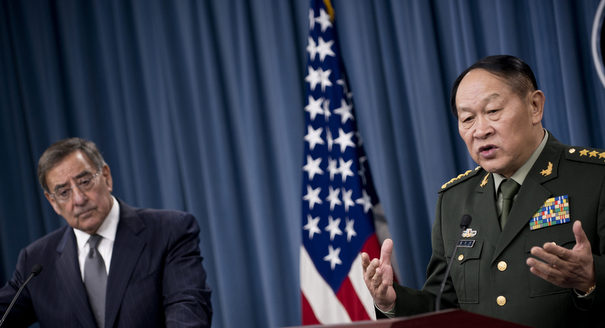
In an effort to justify high defense budgets and military supremacy, the United States seems to be making an imaginary enemy out of China.
Source: CCTV
Speaking in Chinese on CCTV, Carnegie’s Yan Xuetong commented on the release of a report on the state of U.S. military power by the China Strategy Culture Promotion Association, the first time a Chinese NGO has issued a report on another country’s military power. Yan argued that the U.S. approach to security is through gaining a decided advantage in military power and that the U.S. Department of Defense needed to create an imaginary enemy in order to justify its proportionally high spending. The choice of China as an imaginary enemy, Yan added, can be seen as a reflection of the fact that China is indeed a rising power.

Yan Xuetong
Former President, Carnegie China Management Board, Carnegie-Tsinghua Center for Global Policy
Yan Xuetong was president of the Carnegie-Tsinghua Center Management Board until June 2020.
Carnegie does not take institutional positions on public policy issues; the views represented herein are those of the author(s) and do not necessarily reflect the views of Carnegie, its staff, or its trustees.

Russia’s AI-driven propaganda campaigns operate in a fragmented, chaotic, and often illogical manner. That’s not necessarily a problem for the Kremlin, though: It’s much easier to mimic genuine public debate that way.

Ilya Klishin

Russian strikes are weakening the economy sustaining Ukraine’s war effort. Closing the growing funding gap will require more European support and politically contentious reforms in Kyiv.

Balázs Jarábik

The European far right might fail to steer EU policy in the direction Russia wants, but they will create enough chaos inside Europe to benefit the Kremlin.

Dimitar Bechev

With the growth in points of friction between the great powers, organizations like the SCO will continue to play a role in the strategic adaptation of the smaller powers caught between them.

Temur Umarov

Two divergent trends—Putin’s hardline vision of how to prosecute the war in Ukraine, and a growing desire for change in Russia—could tear the regime apart.

Tatiana Stanovaya