

Commentary
Yukon Huang, Isaac B. Kardon, Matt Sheehan
{
  "authors": [
    "Yukon Huang"
  ],
  "type": "legacyinthemedia",
  "centerAffiliationAll": "dc",
  "centers": [
    "Carnegie Endowment for International Peace",
    "Carnegie China"
  ],
  "collections": [
    "U.S.-China Relations"
  ],
  "englishNewsletterAll": "asia",
  "nonEnglishNewsletterAll": "",
  "primaryCenter": "Carnegie China",
  "programAffiliation": "AP",
  "programs": [
    "Asia"
  ],
  "projects": [],
  "regions": [
    "North America",
    "United States",
    "East Asia",
    "China"
  ],
  "topics": [
    "Economy"
  ]
}
Source: Getty
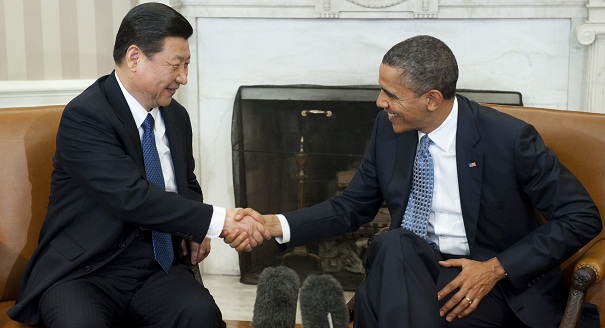
China and the United States may seem to offer radically different versions of capitalism, but both economies face similar challenges of reducing inequality, improving regulation, and promoting innovation.
Source: Bloomberg

In democracies such as the U.S., market-led capitalism draws its legitimacy from the belief that everyone has an equal chance of getting rich, even if outcomes turn out to be unequal. In authoritarian regimes such as China, state-led capitalism is legitimized because it is assumed to provide more equitable outcomes as well as opportunities, although the reality may be quite different.
Both the U.S. and Chinese versions of capitalism have produced impressive results and fallen short in specific aspects. The U.S. brand of capitalism has generated exceptional innovation, but it accords a primacy to individual rights that has kept the country from collectively meeting longer-term needs. In contrast, China has shown a knack for forging collective solutions that have enhanced the welfare of hundreds of millions, but at the cost of neglecting the rights of the individual.
The U.S. system may seem preferable in theory, but the Chinese system in practice appears to be doing a better job preparing for the next decade. China is putting its money in infrastructure, human capital and energy efficiency to become more competitive. At the same time, the U.S. is seen as putting too much into consumption, unnecessary social services and defense, which compromises future needs.
However sharp the distinction between their respective systems, both countries face surprisingly similar challenges to their variations of capitalism, from reducing inequality to promoting innovation.
1. Moderating rising income disparities: The U.S. version of capitalism has had no more success in curbing inequality than China’s. Both have generated a Gini inequality coefficient of about 0.45, albeit with different factors at work.
The dominance of China’s state-owned banks and enterprises through Communist Party connections exacerbates disparities and encourages corruption. But crony capitalism and dollar politics in the West can be just as pernicious as state capture in China. Both favor well-connected insiders over entrepreneurial outsiders.
In both economies, globalization has amplified disparities. The returns for those with skills in international demand have increased, while they have stagnated across countries for those whose skills are common. In the U.S., that has been bad news for middle-class workers; in China, it has widened wage disparities between China’s trade-driven coastal areas and its interior.
In both countries, trying to moderate such disparities with regulatory and fiscal policies runs the risk of stifling innovation. However, the U.S. economy can’t escape the need to invest more in the productivity of its workers. China, with rapidly rising wages, must move up the value chain and away from activities dependent on cheap labor to keep growth going.
2. Designing effective regulatory systems: State-run services are no guarantee of adequate regulatory regimes. The lax standards surrounding China’s government-operated, high- speed railways illustrate the importance of separating regulatory and operating responsibilities, even for state-run services. But the U.S. model of encouraging private provision of utility services is prone to rising prices and declining quality as monopolistic forces emerge.
The financial sector is where weak regulatory regimes pose the greatest risks to both systems. Mergers have only increased concentration in the U.S. and the risk of too-big-to-fail corporations. China’s state-led approach in banking has its own problems, including the generation of quasi-fiscal deficits and lending practices that fuel speculative property bubbles and risky shadow lending.
3. Reshaping the role of their fiscal and financial systems: Both countries will have to find better ways to support innovation and provide public services to moderate disparities. The share of public expenditures relative to GDP has increased across all countries, reflecting the bigger role of the state, and this has fostered concerns about affordability in the West. Meanwhile, China’s budget plays a surprisingly limited role in an economy where the state controls the bulk of resources and is still responsible for many services. As a result, China relies excessively on banks to fund activities that should be financed publicly, and it fails to support much-needed social and environmental services.
4. Promoting innovation: Traditionally, market-led capitalism has been seen as more effective in fostering innovation, but the U.S. has lost dynamism because the state hasn’t played a sufficiently supportive role. China, meanwhile, needs a much broader range of industries as its economy becomes more sophisticated, and the state is seen as being relatively unable to jump-start such initiatives. China’s major state companies may have a prime position at home, but they are not yet global champions. If domestic returns are high, pressures to innovate or take risks may be reduced. Abroad, its managers may make wasteful investments because they undervalue financial costs and the state has seemingly unlimited resources.
Ultimately, both the U.S. and China need to find the right mix between the invisible hand of the market and the visible hand of the state. An excessive dependence on either can create excessive returns for a few by giving them unfair advantages and shortchanging society.
The argument in favor of capitalism lies in its potential to raise living standards and encourage the pursuit of personal satisfaction in broadly respected ways. The U.S. political system may have an inherent legitimacy that the Chinese system lacks, but it won’t be much of a model if its major players remain divided. Meanwhile, China’s version has lost trust because it is increasingly seen as having an excessive influence over the lives of its citizens.
In both systems, strengthened rule of law is what will ensure legitimacy and effectiveness. Whereas China needs a more effective rule of law governing the actions of the state, the U.S. must enhance the rule of law governing the role of markets. The skill that each country brings to its respective task will determine whether it continues to prosper -- a shared challenge that ought to give the leaders of the U.S. and China more to talk than to fight about.

Senior Fellow, Asia Program
Huang is a senior fellow in the Carnegie Asia Program where his research focuses on China’s economy and its regional and global impact.
Recent Work


Yukon Huang, Isaac B. Kardon, Matt Sheehan
Yukon Huang, Genevieve Slosberg
Carnegie does not take institutional positions on public policy issues; the views represented herein are those of the author(s) and do not necessarily reflect the views of Carnegie, its staff, or its trustees.

Ongoing uncertainty in the Middle East allows Moscow to both increase its influence in Tehran and continue to enjoy the financial windfall of higher oil prices.

Nikita Smagin

A much-discussed disagreement over internet restrictions in Russia was never an existential threat for Putin: It was about elite groups protecting their interests.

Alexandra Prokopenko

The demands of the Kremlin’s war in Ukraine, demographic problems, and public hostility toward Central Asians mean Russia does not have enough workers.

Salavat Abylkalikov

Minsk’s faith in the future of its larger neighbor’s economy is fading as Belarusian firms in Russia see record losses.

Olga Loiko
With no key agreement signed on the Power of Siberia 2 gas pipeline, there is a risk that the window of opportunity for Russia will close if Chinese power generation becomes so green that new gas sources are no longer of any interest to Beijing.

Alexander Gabuev