

Q&A
Matt Ferchen
{
  "authors": [
    "Matt Ferchen"
  ],
  "type": "legacyinthemedia",
  "centerAffiliationAll": "",
  "centers": [
    "Carnegie Endowment for International Peace",
    "Carnegie China"
  ],
  "collections": [
    "China and the Developing World",
    "China’s Foreign Relations"
  ],
  "englishNewsletterAll": "",
  "nonEnglishNewsletterAll": "",
  "primaryCenter": "Carnegie China",
  "programAffiliation": "",
  "programs": [],
  "projects": [],
  "regions": [
    "North America",
    "South America",
    "East Asia",
    "China"
  ],
  "topics": [
    "Economy"
  ]
}
Source: Getty
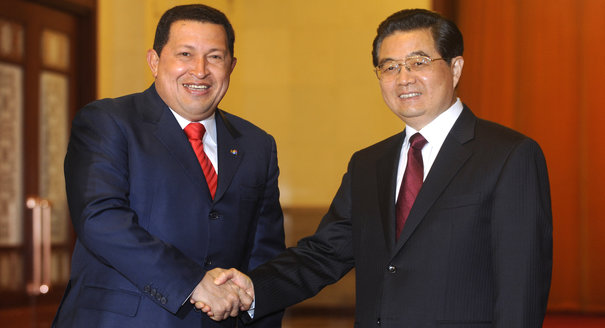
After a decade-long partnership, Hugo Chávez’s withdrawal from Venezuelan politics has led many to question what the future may hold for Chinese investments and companies in the country.
Source: Latin America Advisor
Inter-American Dialogue: India’s Reliance Industries is reportedly still considering investments totaling more than $2 billion in Venezuela’s oil industry, despite uncertainty about the future of President Hugo Chávez’s leadership. Private investors have driven up demand for PDVSA bonds on the bet that the sector will open up, while some of Venezuela’s allies, including China, are withholding additional funding until the political situation becomes clear. What does Chávez’s absence mean for the country’s oil sector? If Chávez steps down, how would that affect energy relations with China and other state partners? Is China too heavily invested in the country? Are there bright spots for private companies and investors?
Matt Ferchen: Venezuela, China faces its first major crisis management test in over a decade of booming ties with Latin America. China’s unprecedented build-up of oil-related finance and investment in Venezuela has overlapped with Hugo Chávez’s rise to almost complete domination of Venezuelan politics and economics. Chávez was eager to have China as a “socialist” ally, including as an alternative source of oil demand so that Venezuela could diversify exports away from reliance on the United States. The Chinese government has been reluctant to cooperate with Chávez’s anti-American rhetoric, but its state-owned banks, oil companies and construction firms have more than compensated for cautious diplomacy with bold, some might say reckless, financial initiatives in Venezuela. Now that Chávez’s treatment for cancer in Cuba has thrown Venezuelan politics into a slow-motion crisis, China and its firms face tough economic and diplomatic challenges. On the economic front, while the China Development Bank claims that its nearly $40 billion in loans are insulated from Venezuelan political risk, such public confidence obscures a much deeper anxiety about how a post-Chávez government will treat Chinese banks, oil firms and other companies. Ultimately, through its state-owned firms’ behavior, China has come to be seen by many inside and outside of Venezuela as an ally of Chávez and this leaves China economically and diplomatically exposed to the vicissitudes of post-Chávez politics. A post-Chávez government will almost certainly seek to alter some elements of the political and economic relationship with China. However, it is instability—the not knowing what will come after Chávez—that is the deepest cause of anxiety for Chinese officials and firms. Having aligned themselves with the absolute leader of Venezuela, China’s crisis management skills will be tested by a potentially leaderless Venezuela.

Former Nonresident Scholar, Carnegie-Tsinghua Center for Global Policy
Ferchen specializes in China’s political-economic relations with emerging economies. At the Carnegie–Tsinghua Center for Global Policy, he ran a program on China’s economic and political relations with the developing world, including Latin America.
Recent Work
Matt Ferchen
Matt Ferchen, Anarkalee Perera
Carnegie does not take institutional positions on public policy issues; the views represented herein are those of the author(s) and do not necessarily reflect the views of Carnegie, its staff, or its trustees.

A much-discussed disagreement over internet restrictions in Russia was never an existential threat for Putin: It was about elite groups protecting their interests.

Alexandra Prokopenko

The demands of the Kremlin’s war in Ukraine, demographic problems, and public hostility toward Central Asians mean Russia does not have enough workers.

Salavat Abylkalikov
Minsk’s faith in the future of its larger neighbor’s economy is fading as Belarusian firms in Russia see record losses.

Olga Loiko
With no key agreement signed on the Power of Siberia 2 gas pipeline, there is a risk that the window of opportunity for Russia will close if Chinese power generation becomes so green that new gas sources are no longer of any interest to Beijing.

Alexander Gabuev

The cost of air defense has become an unregistered tax on revenue for businesses. While military rents are consolidated in the federal budget, the costs of defense are being spread across the balance sheets of companies and regional governments.
Alexandra Prokopenko