

Commentary
- +1
Paul Haenle, Xue Gong, Ngeow Chow Bing, …
{
  "authors": [
    "Paul Haenle"
  ],
  "type": "legacyinthemedia",
  "centerAffiliationAll": "",
  "centers": [
    "Carnegie Endowment for International Peace",
    "Carnegie China"
  ],
  "collections": [
    "U.S.-China Relations",
    "China’s Foreign Relations"
  ],
  "englishNewsletterAll": "",
  "nonEnglishNewsletterAll": "",
  "primaryCenter": "Carnegie China",
  "programAffiliation": "",
  "programs": [],
  "projects": [],
  "regions": [
    "North America",
    "United States",
    "East Asia",
    "South Korea",
    "China",
    "North Korea"
  ],
  "topics": [
    "Security",
    "Arms Control",
    "Economy",
    "Nuclear Policy",
    "Foreign Policy"
  ]
}
Source: Getty
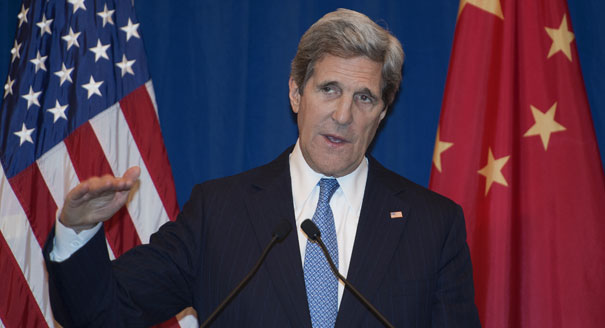
U.S. Secretary of State John Kerry’s first visit to China will likely see a focus on security on the Korean peninsula, the Trans-Pacific Partnership agreement, and cyber security.
Source: China Radio International
Speaking to China Radio International, Carnegie’s Paul Haenle detailed the strengths and agenda of the new U.S. Secretary of State, John Kerry. Haenle explained that throughout Kerry’s time on the Senate Committee on Foreign Relations, he showed a great commitment and interest in China. Now that he is Secretary of State, it is unlikely that the U.S. policy of rebalancing toward to Asia will change. Haenle stressed that this policy is not hostile or hardline and in fact is designed to facilitate cooperation and collaboration between both countries.
Haenle then turned to some of the individual issues likely to be raised during Kerry’s visit. Haenle stated that the United States is taking the threats coming from North Korea more seriously. He said that the “United States should be looking for opportunities, as the policy shifts in China, to find areas where China and the United States, South Korea, and Japan and the other members of the Six Party Talks can work together to bring stability to the region”. Haenle also clarified the nature of the Trans-Pacific Partnership and its origins and indicated that it would be beneficial for all if China would join. Cyber security is another area of tension between China and the United States, he added, but the nascent nature of this threat means there is greater scope for all major powers to work together to contain it.

Former Maurice R. Greenberg Director’s Chair, Carnegie China
Paul Haenle held the Maurice R. Greenberg Director’s Chair at the Carnegie Endowment for International Peace and is a visiting senior research fellow at the East Asian Institute, National University of Singapore. He served as the White House China director on the National Security Council staffs of former presidents George W. Bush and Barack Obama.
Recent Work


Paul Haenle, Xue Gong, Ngeow Chow Bing, …

Paul Haenle, Chong Ja Ian
Carnegie does not take institutional positions on public policy issues; the views represented herein are those of the author(s) and do not necessarily reflect the views of Carnegie, its staff, or its trustees.

Cargo traffic through Russia’s Northern Sea Route has increased because of the disruption caused by the conflict in the Middle East, the Ukraine war, and U.S.-China tensions.

Mikhail Korostikov

Trump has promised Belarus a massive potash deal. But Minsk is seeking something greater: restored Western transit and greater room for maneuver from Russia.

Balázs Jarábik

The European far right might fail to steer EU policy in the direction Russia wants, but they will create enough chaos inside Europe to benefit the Kremlin.

Dimitar Bechev

Minsk clearly expected the dialogue with Washington to yield more results, in particular the lifting of EU sanctions and permission to export potash.

Artyom Shraibman

Depleted financial reserves and a shrinking tax base mean it is no longer possible to simultaneously deliver high defense spending, price stability, and economic growth.

Alexandra Prokopenko