

Article
Wang Tao
{
  "authors": [
    "Wang Tao"
  ],
  "type": "legacyinthemedia",
  "centerAffiliationAll": "",
  "centers": [
    "Carnegie Endowment for International Peace",
    "Carnegie China"
  ],
  "collections": [],
  "englishNewsletterAll": "",
  "nonEnglishNewsletterAll": "",
  "primaryCenter": "Carnegie China",
  "programAffiliation": "",
  "programs": [],
  "projects": [],
  "regions": [
    "East Asia",
    "China"
  ],
  "topics": [
    "Climate Change"
  ]
}
Source: Getty
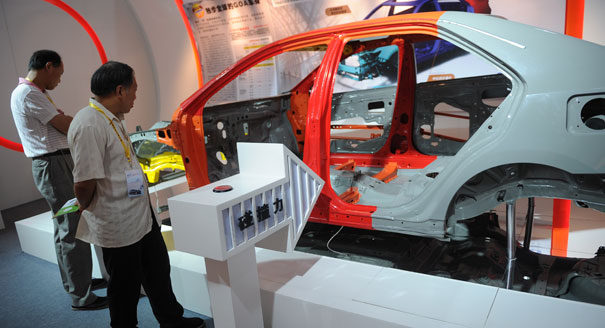
It is easy to see why promoting electric vehicle technology appeals to the Chinese government. Widespread use of electric vehicles means less oil imports, thus improving the country’s energy security.
Source: Global Times
It is not difficult to see why promoting electric vehicle technology appeals to the Chinese government. Widespread use of electric vehicles means less oil imports, improving the country's energy security. It would also mitigate carbon emissions from the fast-growing transportation sector, improving air quality. And the economic advantage of leading in the electric vehicle industry could provide a new economic engine.
The Chinese government started its large-scale support of electric vehicle research and development with the National High-Technology Research and Development Program (or 863 Program) in 2001. It then began the Ten Cities, Thousand Vehicles Program in 2009 with large-scale pilot projects. By the end of 2010, this program had expanded from 10 to 25 cities with six of them subsidizing private purchases.
The State Council, China's cabinet, identified new energy vehicles as one of seven strategic new industries in 2012 and approved the Energy Saving and New Energy Vehicle Industry Development Plan, aiming to sell 500,000 battery-powered electric vehicles and plug-in hybrids by 2015 and 5 million by 2020.The government has spent several billion dollars on research and development programs so far, and it provides substantial subsidies for purchase. In some cities, consumers can get nearly $20,000 from central and local governments together for buying battery-powered electric vehicles with other benefits.
But by the end of 2012, the deadline of the first phase of the Ten Cities, Thousand Vehicles Program, only a few cities had reached their targets. The private market is still lagging, and technology gaps remain.
The Chinese government's commitment to electric vehicles deserves a great deal of praise, but there are a few things that policymakers may want to reconsider if they really want to jump-start the electric vehicle market.
First, unlike other advanced energy technologies, including wind power and high-speed rail, China took an independent path on electric vehicles by mostly relying on its own innovation and indigenous vehicle manufacturers. After years of development and heavy subsidy, however, Chinese vehicle manufacturers still trail their counterparts in developed countries in terms of core technologies, including batteries and motor control systems.
It will thus be difficult to catch up with the industry leaders in a short time, and more financial support alone will not push Chinese automakers ahead of their foreign competitors. Therefore China needs to replicate the successes in wind power and high-speed rail, opening the domestic electric vehicle market to leading international automakers and advancing technological development through technology collaboration and joint ventures.
Second, Chinese automakers have little incentive to focus on electric vehicles because the sales are not even enough for them to install a separate production line. They are reluctant to spend their hard-earned profits on the research and development of electric vehicles.
To quickly upscale the market, the government needs to prioritize promoting electric vehicle use in commercial operations that rely on large numbers of vehicles, such as car-rental and car-sharing services, business distribution networks, taxi in city centers, and official government vehicles rather than continue to depend on individual consumers' market, which will not take off until technology breakthrough overcomes the range and charging barriers. Public procurement and corporate fleet orders is key to the early electric vehicle market's success.
Third, the government is spending a lot of resources to heavily subsidize the purchase of electric vehicles, while the lack of infrastructure and incentives to use that is the major barrier for electric vehicles in the current high-end niche market.
The government needs to create an environment that encourages electric vehicle use, including building the necessary infrastructure and providing incentives to use rather than purchase electric vehicles, such as exemption from Beijing's registration plate lottery and travel limitation, creating priority lanes and exclusive parking spaces in public places with charging posts. This also needs to be better integrated with ongoing urbanization and the entire transportation system.
Fourth, setting a sales target is important for electric vehicles, but it also risks locking the country in less advanced technologies especially when technology evolves quickly in this sector. Without a self-sustaining business model, high stock could damage the industry's long-term survival once subsidies are withdrawn. China's solar-panel industry paid a heavy price to learn this lesson, which should not be repeated for electric vehicles.
So China should shift from setting sales numbers to emphasizing the development of a self-sustaining business model for electric vehicles. The government needs to periodically review the performance of the pilot cities and reward those with better business models, so when there is a need to scale up in the future, the sector could support itself instead of relying on the government.
Nurturing a new, globally competitive industry requires more than just political will. China needs to learn from these lessons to refocus its efforts on measures that improve both the users' experience and the business environment for electric vehicles' success.

Former Nonresident Scholar, Carnegie-Tsinghua Center for Global Policy
Wang Tao was a nonresident scholar in the Energy and Climate Program based at the Carnegie–Tsinghua Center for Global Policy.
Recent Work
Wang Tao
Wang Tao, Yang Yifang
Carnegie does not take institutional positions on public policy issues; the views represented herein are those of the author(s) and do not necessarily reflect the views of Carnegie, its staff, or its trustees.

With the growth in points of friction between the great powers, organizations like the SCO will continue to play a role in the strategic adaptation of the smaller powers caught between them.

Temur Umarov

When faced with fuel shortages in the past, Central Asian governments could always count on additional supplies from Moscow. That safety net no longer exists.

Galiya Ibragimova

Official discussions about mini oil refineries are unlikely to come to anything—but the mere fact they’re happening reveals the regime is failing to deliver a functioning economy.

Sergey Vakulenko
With no key agreement signed on the Power of Siberia 2 gas pipeline, there is a risk that the window of opportunity for Russia will close if Chinese power generation becomes so green that new gas sources are no longer of any interest to Beijing.

Alexander Gabuev

Tokyo would have to surmount a lot of obstacles—not least Western sanctions—if it wanted to return Russian oil imports to even modest pre-2022 volumes.

Vladislav Pashchenko