

Q&A
- +1
Amr Hamzawy, Andrew Leber, Eric Lob, …
{
  "authors": [
    "Marwan Muasher"
  ],
  "type": "legacyinthemedia",
  "centerAffiliationAll": "dc",
  "centers": [
    "Carnegie Endowment for International Peace",
    "Malcolm H. Kerr Carnegie Middle East Center",
    "Carnegie Russia Eurasia Center"
  ],
  "collections": [],
  "englishNewsletterAll": "menaTransitions",
  "nonEnglishNewsletterAll": "",
  "primaryCenter": "Carnegie Endowment for International Peace",
  "programAffiliation": "MEP",
  "programs": [
    "Middle East"
  ],
  "projects": [
    "Eurasia in Transition"
  ],
  "regions": [
    "North America",
    "United States",
    "Middle East",
    "Syria",
    "Levant"
  ],
  "topics": [
    "Foreign Policy"
  ]
}
Source: Getty
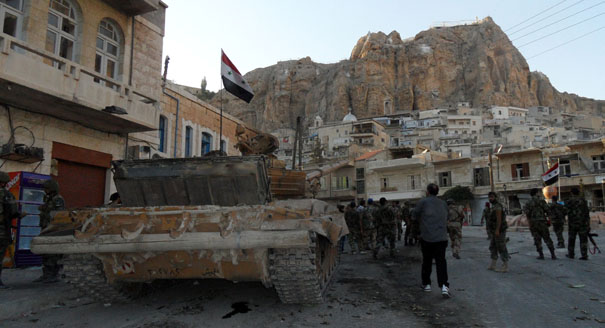
If the conflict in Syria is to be resolved, it is important to go beyond the chemical attack issue and work through a political process that would end the war.
Source: Bloomberg TV
Speaking on Bloomberg TV’s In the Loop, Carnegie’s Marwan Muasher explained that if the conflict in Syria is to be resolved, it is important to go beyond the chemical attack issue and work through a political process that would end the war. A U.S. strike against Syria, Muasher argued, will be more of a face saving measure rather than solving the problem. “Let us remember than the chemical weapons issue is not the only issue on the table. There’s still a war going on with a 100,000 people killed,” he asserted.
Offering context on a peaceful solution to the crisis, Muasher said that the United States and Russia should agree to take the two sides to the Geneva II talks and start the political process that was agreed on by the UN last year in which a transitional government would be established and which will end with President Bashar Al-Assad and the regime leaving power in Syria. Even if the chemical weapons issue is resolved, Muasher noted, the war will still continue if there is no political process in place to end it.

Vice President for Studies
Marwan Muasher is vice president for studies at Carnegie, where he oversees research in Washington and Beirut on the Middle East. Muasher served as foreign minister (2002–2004) and deputy prime minister (2004–2005) of Jordan, and his career has spanned the areas of diplomacy, development, civil society, and communications.
Recent Work



Amr Hamzawy, Andrew Leber, Eric Lob, …
Marwan Muasher
Carnegie does not take institutional positions on public policy issues; the views represented herein are those of the author(s) and do not necessarily reflect the views of Carnegie, its staff, or its trustees.

Trump has promised Belarus a massive potash deal. But Minsk is seeking something greater: restored Western transit and greater room for maneuver from Russia.

Balázs Jarábik

Minsk clearly expected the dialogue with Washington to yield more results, in particular the lifting of EU sanctions and permission to export potash.

Artyom Shraibman

With the growth in points of friction between the great powers, organizations like the SCO will continue to play a role in the strategic adaptation of the smaller powers caught between them.

Temur Umarov

When faced with fuel shortages in the past, Central Asian governments could always count on additional supplies from Moscow. That safety net no longer exists.

Galiya Ibragimova

Despite unhappiness on the ground, Moscow is determined to use both carrot and stick to ensure there is record support for United Russia in occupied Ukraine.

Konstantin Skorkin