

Commentary
With the growth in points of friction between the great powers, organizations like the SCO will continue to play a role in the strategic adaptation of the smaller powers caught between them.
Temur Umarov
{
  "authors": [
    "Bayram Balci",
    "Kenan Rovshenoglu"
  ],
  "type": "legacyinthemedia",
  "centerAffiliationAll": "dc",
  "centers": [
    "Carnegie Endowment for International Peace",
    "Malcolm H. Kerr Carnegie Middle East Center",
    "Carnegie Russia Eurasia Center"
  ],
  "collections": [],
  "englishNewsletterAll": "menaTransitions",
  "nonEnglishNewsletterAll": "",
  "primaryCenter": "Carnegie Endowment for International Peace",
  "programAffiliation": "MEP",
  "programs": [
    "Middle East"
  ],
  "projects": [
    "Eurasia in Transition"
  ],
  "regions": [
    "Middle East",
    "Syria",
    "Caucasus",
    "Azerbaijan",
    "Levant"
  ],
  "topics": [
    "Security",
    "Foreign Policy"
  ]
}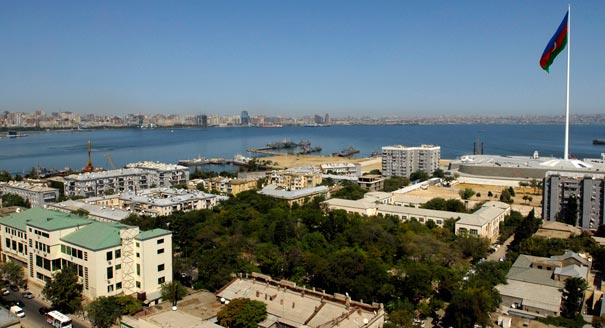
Source: Getty
Azerbaijan, like all of Syria’s regional neighbors, is affected by the ongoing civil war there.
Source: Globalist
Azerbaijan, like all of Syria’s regional neighbors, is affected by the ongoing civil war there. Until now, the Syrian crisis has had, overall, a limited impact on the largely secular Azerbaijan, which is geographically separated from the war-torn country by Iran and Turkey.
But Azerbaijan is one of just four countries in the world with a Shia majority — an estimated 65% of the country. The sectarianism in Syria is drawing Azerbaijani attention as the civil war’s central dynamic of a Shia-Sunni divide could potentially complicate Azerbaijan’s future.Azerbaijan is a post-Soviet country where the population and the institutions are widely secular. Credit for that goes to ties with the West and the Russian colonial heritage, which has modernized the country.
Meanwhile, in religious and historic terms, the country has been influenced by both Iranian Shia and Turkish/Ottoman Sunnism.
A third and very different movement, the ultraconservative Salafism, has been promoted in the region by the Gulf states of Qatar and Saudi Arabia.
Azerbaijan’s government is led by President Ilham Aliev, the successor and son of the previous president. His father was a former KGB branch officer and Soviet Politburo official for Azerbaijan. While not committed to democratic values, the Aliev government has been committed to secularism.
Since independence from the Soviet Union, the Aliev regime’s policy has been to promote dialogue and good relations between all the religious groups and communities.
Generally speaking, this policy has been successful, although many view the government as being too authoritarian toward both Shia and Sunni groups it deems too radical.
In recent years, the regime has kept a close eye on religious groups and organizations as well as imposing tight controls on mosques.
But the result of the secularism policy so far has been harmonious relations between Shia and Sunni groups, both treated equally by the secular state. Azerbaijan, in this regard, has far excelled nearby Iraq, whose fractious population is similarly about 65% Shia.
When the Arab Spring started, the government in Azerbaijan was wary of developments in the region. But it did not express its fears of regime change openly.
In the opposition, pro-democratic and secular elites were optimistic that change was imminent, as the Arab world uprisings were against authoritarian regimes similar to that in Baku.
Religious groups in Azerbaijan were generally indifferent toward the Arab Spring initially, as religion seemed to only be playing a minor role. However, this started to change when Sunni Islamic parties in Tunisia and Egypt grew in strength under what then seemed to be the new order.
In Azerbaijan, this shift was not particularly welcomed by the more sectarian Shia groups, but few were truly alarmed — until the uprising in Syria became a religious and sectarian civil war.
In Syria, the ruling Alawite minority, led by the Assad family for decades, belongs to the Shia branch of Islam.
Although the Alawites of Syria and the Shia of Azerbaijan are actually quite different strands of the sect, there is still some affinity. Both groups share a core belief that the 7th century Caliph Ali was the true successor to Muhammad — a belief not shared by Sunnis.
In Azerbaijan, as the Syrian crisis became more sectarian — with Sunni rebels fighting for power against Alawites and both sides committing acts of ethnic cleansing — the reactions were mixed.
For the Azerbaijani regime, which had previously remained silent about the Syrian crisis, the brutally violent stalemate was actually viewed as a positive development. The leadership feels that the brutal and chaotic sectarian violence that followed the uprising against Assad discredits any push for regime change in Baku, a fate they are keen to avoid.
Some Azerbaijani Shia, possibly seeking to drive a wedge, insist that the Syrian uprising was explicitly one of Sunnis against an Alawite government, not people against dictators.
For many other Shia in Azerbaijan, the purported democratic motive of these revolutions is — at minimum — not convincing. They do not understand why Western democracies allowed the same revolution against a Sunni regime in Bahrain, the smallest of the four Shia-majority nations, to be crushed.
Yet now the United States is trying to rally the world to conduct a military intervention in Syria. The casus belli is that the Alawite regime there used chemical weapons against civilian (presumably Sunni) populations.
Thirty years ago, there was no such U.S. opposition when the Sunni-led regime in Iraq used chemical weapons on Shia Iran.
If the West appears to support democracy only for Sunni populations and continues to oppose Iran, the Shia homeland, it is no surprise that some Shia would wonder what was really at work in the Arab Spring.
These Shia groups in Azerbaijan became particularly concerned as their rivals, the moderate Sunni and hard-line Salafi Sunni groups, rapidly gained power in the new constellation across the region.
No wonder the Syria situation has fueled extensive and heated debate in private within Muslim communities in Azerbaijan.
Troublingly, some isolated individuals from the Sunni minority in Azerbaijan have been radicalized enough to join the sectarian war in Syria.
It appears that at least 20 Azerbaijani jihadists have died in Syria in their struggle alongside the Sunni rebels against the Shia regime. As many as 200 Azerbaijani jihadists are still fighting there.
More recently, there have been reports that some Azerbaijani Shia have also joined the Syrian war. They crossed through Iranian territory to aid the Alawite-dominated Syrian Army, as well as the allied Alawite sectarian paramilitary forces and Shia Hezbollah fighters.
These Azerbaijan Shia fighters believe it is their duty to combat the Salafis who have flooded the ranks of the Sunni rebels.
Human rights monitors have implicated both the Sunni jihadists and the Shia paramilitaries in massacres of civilian populations of the opposing sects.
For now, the day-to day-relations between the Shia and Sunni population in Azerbaijan are still generally peaceful. It remains to be seen what the consequences will be when radical sectarian fighters return home from Syria’s war.
Azerbaijan’s President Aliev has seized upon the situation in Syria to contrast a divisive religious war there with the tradition of tolerance and peaceful cohabitation in Azerbaijan.
As has been true in authoritarian regimes across the region, he presents his policy of maintaining secular peace as the only alternative to sectarian chaos.
He is expected to make the most of that contrast during the presidential election scheduled for October 2013.
Former Nonresident Scholar, Russia and Eurasia Program
Balci was a nonresident scholar in Carnegie’s Russia and Eurasia Program, where his research focuses on Turkey and Turkish foreign policy in Central Asia and the Caucasus.
Kenan Rovshenoglu
Carnegie does not take institutional positions on public policy issues; the views represented herein are those of the author(s) and do not necessarily reflect the views of Carnegie, its staff, or its trustees.

With the growth in points of friction between the great powers, organizations like the SCO will continue to play a role in the strategic adaptation of the smaller powers caught between them.

Temur Umarov

When faced with fuel shortages in the past, Central Asian governments could always count on additional supplies from Moscow. That safety net no longer exists.

Galiya Ibragimova

Two divergent trends—Putin’s hardline vision of how to prosecute the war in Ukraine, and a growing desire for change in Russia—could tear the regime apart.

Tatiana Stanovaya

Andrey Melnichenko’s essay offers no answer to the fundamental question of how, under any kind of negotiated settlement, Europe can protect itself from the Russian ressentiment that is inevitable in all scenarios except for an outright victory for Putin.

Leonid Bershidsky

Despite unhappiness on the ground, Moscow is determined to use both carrot and stick to ensure there is record support for United Russia in occupied Ukraine.

Konstantin Skorkin