

Commentary
Thomas de Waal
{
  "authors": [
    "Thomas de Waal"
  ],
  "type": "commentary",
  "centerAffiliationAll": "",
  "centers": [
    "Carnegie Endowment for International Peace",
    "Carnegie Europe",
    "Carnegie Russia Eurasia Center"
  ],
  "collections": [],
  "englishNewsletterAll": "",
  "nonEnglishNewsletterAll": "",
  "primaryCenter": "Carnegie Europe",
  "programAffiliation": "",
  "programs": [],
  "projects": [],
  "regions": [
    "Caucasus",
    "Russia",
    "Georgia",
    "Western Europe"
  ],
  "topics": [
    "Security",
    "Foreign Policy"
  ]
}
Source: Getty
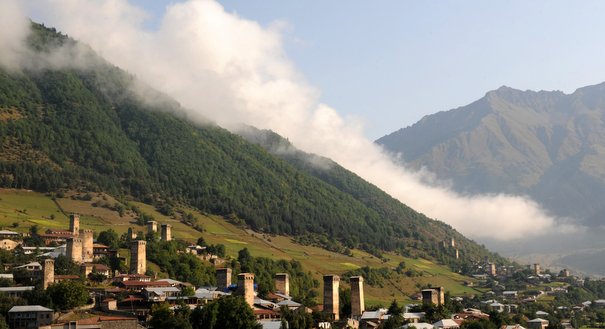
Philippe Lefort is stepping down as the EU’s special representative for the South Caucasus. Now a new representative will have to start again from zero in Abkhazia and South Ossetia, and the worry is that in the meantime the Caucasus conflicts will slip down the EU agenda.
It is not a good moment to be announcing a change in Caucasus policy.
The turmoil in Ukraine and the Sochi Olympics are making Georgians feel nervous vis-à-vis Russia. Yet the announcement has come that French diplomat Philippe Lefort is stepping down as the European Union's special representative for the South Caucasus, a post he combines with that of co-chair of the Geneva talks on the Abkhazia and South Ossetia conflicts.
Officially, it will be business as usual and Lefort's successor will be named soon. But there are persistent rumors that he has fallen foul of parts of the Brussels bureaucracy and that his departure signals yet another structural overhaul of EU policy toward the South Caucasus.
His is not an easy job. The Geneva talks, convened in 2008 after the August war over South Ossetia, are a painful process. Currently, their value is in providing a venue for Abkhaz, Ossetians, Georgians, and Russians to meet and discuss not very much, hoping that when the time comes for serious talks the format for them is already there. As the only co-chair which represents an organization that does not count Russia as a member (the other two co-chairs are the OSCE and UN), the EU has the leading role.
Both Lefort and his two predecessors have had to fight to maintain a niche in the EU policy hierarchy. Currently, he is not responsible for EU foreign policy toward the region as a whole (that is the job of the European External Action Service), EU neighborhood policy (the brief of commissioner Stefan Füle), the Nagorny Karabakh conflict (France and the Minsk Group) or the border monitoring mission (the Georgia-based European Union Monitoring Mission).
That means the major responsibility of the special representative is to be EU envoy to Abkhazia and South Ossetia. And Lefort indeed kept up important channels of communication with the Abkhaz (the South Ossetians are less cooperative), when almost no one else except the Russians is talking to them.
Lefort's immediate predecessor Peter Semneby faced similar challenges. He devised a strategy of "non-recognition and engagement" for Abkhazia and South Ossetia, which provided a useful road-map for active EU involvement in those two territories without recognizing them as sovereign states. Unfortunately, despite Lefort's efforts, that strategy has made little headway and the EU presence in Abkhazia is still minimal.
Now a new special representative, perhaps with a different role and different mandate, will have to start again from zero in Abkhazia. The worry is that in the meantime the institutional memory in Brussels of where Abkhazia is and why the Geneva talks matter will decline even further and the Caucasus conflicts will slip down the EU agenda.

Senior Fellow, Carnegie Europe
Thomas de Waal is a senior fellow at Carnegie Europe, specializing in Eastern Europe and the Caucasus.
Recent Work
Thomas de Waal
Thomas de Waal
Carnegie does not take institutional positions on public policy issues; the views represented herein are those of the author(s) and do not necessarily reflect the views of Carnegie, its staff, or its trustees.

The European far right might fail to steer EU policy in the direction Russia wants, but they will create enough chaos inside Europe to benefit the Kremlin.

Dimitar Bechev

Minsk clearly expected the dialogue with Washington to yield more results, in particular the lifting of EU sanctions and permission to export potash.

Artyom Shraibman

Russia’s ruling party would have benefited from Putin appearing as its distant patron, but as an active frontman imposing his views on the public, he has done nothing but harm both the party’s election campaign and the ruling system overall.

Andrey Pertsev

Depleted financial reserves and a shrinking tax base mean it is no longer possible to simultaneously deliver high defense spending, price stability, and economic growth.

Alexandra Prokopenko
Blurring the line between humans and animals is a long-standing tradition in social utopian prose. In his latest novel, Leonid Bershidsky reminds us that in social experiments, people are often treated no differently than animals.

Alexander Baunov