

Article
Frederic Wehrey, Charles H. Johnson
{
  "authors": [
    "Frederic Wehrey"
  ],
  "type": "legacyinthemedia",
  "centerAffiliationAll": "dc",
  "centers": [
    "Carnegie Endowment for International Peace",
    "Malcolm H. Kerr Carnegie Middle East Center"
  ],
  "collections": [],
  "englishNewsletterAll": "menaTransitions",
  "nonEnglishNewsletterAll": "",
  "primaryCenter": "Carnegie Endowment for International Peace",
  "programAffiliation": "MEP",
  "programs": [
    "Middle East"
  ],
  "projects": [],
  "regions": [
    "Middle East",
    "Gulf",
    "Levant",
    "Iran"
  ],
  "topics": [
    "Political Reform",
    "Civil Society",
    "Religion"
  ]
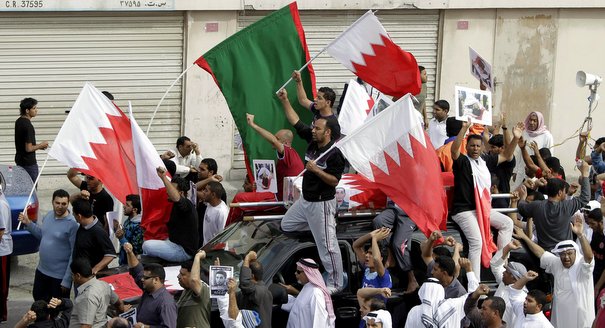
}
Source: Getty
What is missing in the interpretations of sectarianism and identifying its roots is a focus on the role of institutions and the agency of political actors in deliberately invoking and amplifying sectarian passions.
Source: Lawfare
Sectarian passions are once again inflaming the Middle East. Syria’s ferocious civil war has spilled over into fragile Lebanon and Iraq. Saudi Arabia and Iran are at loggerheads, funding and equipping protagonists in conflict zones that are arrayed along sectarian lines. The winds of Shi’a-Sunni strife are spreading, and the referee of American power is nowhere to be seen.
The sectarian lens has long been an appealing, shorthand way to make sense of a confounding, complex region. President Obama, in his September 2013 speech before the United Nations General Assembly, attributed Bahrain’s violence to “sectarian tensions.” But focusing exclusively on the Shiite-Sunni split conflates symptoms with root causes. Often what seems to be a religious or doctrinal difference is more accurately a byproduct of political repression, provincial marginalization or uneven access to economic resources...

Senior Fellow, Middle East Program
Frederic Wehrey is a senior fellow in the Middle East Program at the Carnegie Endowment for International Peace, where his research focuses on governance, conflict, and security in Libya, North Africa, and the Persian Gulf.
Recent Work
Frederic Wehrey, Charles H. Johnson
Frederic Wehrey, Charles H. Johnson
Carnegie does not take institutional positions on public policy issues; the views represented herein are those of the author(s) and do not necessarily reflect the views of Carnegie, its staff, or its trustees.

Sergei Kiriyenko used Russia’s parliamentary vote to further hone his strategy of corporate mobilization that is designed to maximize votes for United Russia.

Andrey Pertsev

The European far right might fail to steer EU policy in the direction Russia wants, but they will create enough chaos inside Europe to benefit the Kremlin.

Dimitar Bechev

If the Russian-speaking community in Latvia cannot articulate their interests without being seen as disloyal, they could end up embracing a pro-Kremlin agenda.

Sergejs Potapkins

Russia’s ruling party would have benefited from Putin appearing as its distant patron, but as an active frontman imposing his views on the public, he has done nothing but harm both the party’s election campaign and the ruling system overall.
Andrey Pertsev

In the tenth year of his presidency, President Mirziyoyev’s system is becoming even more personalized than that of his predecessor Karimov.

Galiya Ibragimova