

Commentary
Thomas de Waal
{
  "authors": [
    "Thomas de Waal"
  ],
  "type": "commentary",
  "centerAffiliationAll": "",
  "centers": [
    "Carnegie Endowment for International Peace",
    "Carnegie Europe",
    "Carnegie Russia Eurasia Center"
  ],
  "collections": [],
  "englishNewsletterAll": "",
  "nonEnglishNewsletterAll": "",
  "primaryCenter": "Carnegie Europe",
  "programAffiliation": "",
  "programs": [],
  "projects": [],
  "regions": [
    "Russia",
    "Eastern Europe",
    "Ukraine"
  ],
  "topics": [
    "Foreign Policy"
  ]
}
Source: Getty
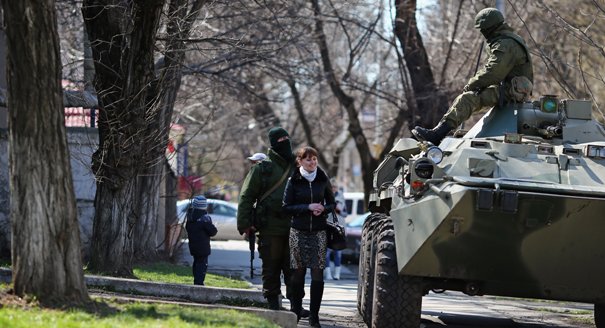
Most Crimeans probably do not realize it yet, but without a shot being fired and in the space of just a few days, Crimea has joined the list of European territories that live in the twilight zone of international sovereignty.
Most Crimeans probably do not realize it yet, but without a shot being fired and in the space of just a few days, Crimea has joined the list of European territories that live in the twilight zone of international sovereignty.
It is not a happy list. It begins with Northern Cyprus and in the former Soviet space extends to Nagorny Karabakh, Abkhazia, South Ossetia and Transnistria. In the Balkans, Kosovo has mostly come out of the shadows, being recognized by 107 states, but has still not taken up a seat at the United Nations. Republika Srpska and Chechnya have renounced their shadow status—for the time being at least.
But that will not make it any easier for the territory to have international legitimacy. Obviously those who want to stay part of Ukraine—Ukrainians, Tatars and European-looking Russians—will suffer the most. But Crimean Russians, who were partying in the streets of Simferopol will also soon discover that life is not so easy for them.
What happens to your bank account and what currency is it held in? Already there are reports of confusion.
Can your airports take international flights? How do you travel abroad and on what passport? These are problems that Abkhaz and Transnistrians know about through bitter experience.
And that is even before you try to deal with the issues of Ukrainian property rights and deliveries of electricity and water from mainland Ukraine.
The strangest aspect of the Crimean case is that this is not a situation born out of conflict. The other territories reached their sad, isolated status in large part because they had no other option in a time of bloodshed. In Crimea, the only fighting has begun after the Russian annexation. Its secession is taking place, as the Russians say, in an empty place, na pustom meste for no other reason than that President Putin has willed it so.
However, ominous precedents for conflict are all around. Natalia Mirimanova fears a repeat of Northern Ireland, in which a large minority felt it had been disenfranchised by an act of partition.
Gerard Toal is worried about the example of Bosnia, with President Vladimir Putin playing Slobodan Milosevic and Prime Minister of Crimea Sergei Aksyonov the role of Radovan Karadzic, deliberating tearing a hole through a multi-ethnic society.
The potential for violence in Crimea is surely less than in Bosnia. The tragedy is that this is a choice no one needed to take. Crimea had plenty of autonomy already and most people did not seek an either-or of Russia or Ukraine. They were quite contentedly living with both, until the Kremlin's Sword of Damocles descended this week.

Senior Fellow, Carnegie Europe
De Waal is a senior fellow at Carnegie Europe, specializing in Eastern Europe and the Caucasus.
Recent Work
Thomas de Waal
Thomas de Waal, ed.
Carnegie does not take institutional positions on public policy issues; the views represented herein are those of the author(s) and do not necessarily reflect the views of Carnegie, its staff, or its trustees.
Most of Moscow’s military resources are tied up in Ukraine, while Beijing’s foreign policy prioritizes economic ties and avoids direct conflict.


Alexander Gabuev, Temur Umarov
With the White House only interested in economic dealmaking, Georgia finds itself eclipsed by what Armenia and Azerbaijan can offer.

Bashir Kitachaev
If the regime in Tehran survives, it could be obliged to hand Moscow significant political influence in exchange for supplies of weapons and humanitarian aid.

Nikita Smagin
The interventions in Iran and Venezuela are in keeping with Trump’s strategy of containing China, but also strengthen Russia’s position.

Mikhail Korostikov
Arms supplies from Russia to Iran will not only continue, but could grow significantly if Russia gets the opportunity.
Nikita Smagin