

Q&A
- +1
Amr Hamzawy, Andrew Leber, Eric Lob, …
{
  "authors": [
    "Marwan Muasher"
  ],
  "type": "legacyinthemedia",
  "centerAffiliationAll": "dc",
  "centers": [
    "Carnegie Endowment for International Peace",
    "Malcolm H. Kerr Carnegie Middle East Center"
  ],
  "collections": [
    "Arab Awakening"
  ],
  "englishNewsletterAll": "menaTransitions",
  "nonEnglishNewsletterAll": "",
  "primaryCenter": "Carnegie Endowment for International Peace",
  "programAffiliation": "MEP",
  "programs": [
    "Middle East"
  ],
  "projects": [],
  "regions": [
    "Middle East",
    "Israel",
    "North Africa",
    "Palestine",
    "Levant",
    "Maghreb"
  ],
  "topics": [
    "Political Reform",
    "Security"
  ]
}
Source: Getty
The parameters of the Arab-Israeli peace process are known. What is needed is the political will.
Source: WNYC Brian Lehrer Show
“Post-independence, no Arab country has given serious attention to putting into place democratic institutions that would ensure a culture of pluralism,” argued Carnegie’s Marwan Muasher on the Brian Lehrer Show. “If the second Arab awakening is to be finally successful, it has to go beyond getting rid of despotic rule and putting in place the necessary pillars for a democratic society.” The United States for a long time prioritized stability over reform in the Arab world and did not pay much attention to the domestic challenges facing these countries in the region, he said. While the process of democratization needs to be homegrown, the United States should support it and let the process evolve on its own.
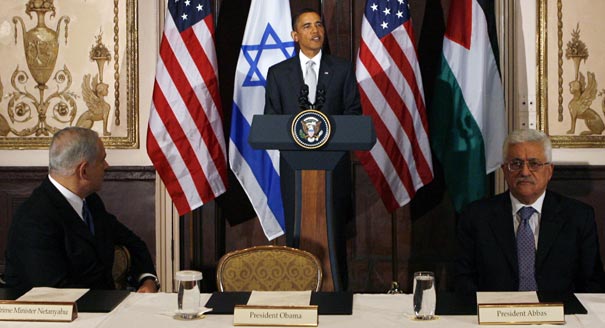
Turning to the Arab-Israeli peace process, Muasher argued that the U.S. failure to carry through a successful peace process has undermined the U.S. reputation in the Arab world. “We know what the solution is. The problem is not finding a solution, but finding a credible path to get us there,” he said, contending that the more time the process is given, the less of a chance there is for a two state solution. “The parameters are known, what is needed is the political will,” he added.

Vice President for Studies
Marwan Muasher is vice president for studies at Carnegie, where he oversees research in Washington and Beirut on the Middle East. Muasher served as foreign minister (2002–2004) and deputy prime minister (2004–2005) of Jordan, and his career has spanned the areas of diplomacy, development, civil society, and communications.
Recent Work



Amr Hamzawy, Andrew Leber, Eric Lob, …
Marwan Muasher
Carnegie does not take institutional positions on public policy issues; the views represented herein are those of the author(s) and do not necessarily reflect the views of Carnegie, its staff, or its trustees.

Japan’s long-term security policy is driven by concerns about China, and there is little appetite for (or interest in) pursuing a confrontation with Moscow.

James D.J. Brown

The truth of the strategic situation is that Europe and Russia are extremely unlikely to be able to “turn the page” on their confrontation within the next two decades.

Arkady Moshes

Putin’s conservative staffing policies and search for ever greater control have cemented parliament’s transformation into a bureaucratic appendage of the executive branch.

Andrey Pertsev

Russia’s AI-driven propaganda campaigns operate in a fragmented, chaotic, and often illogical manner. That’s not necessarily a problem for the Kremlin, though: It’s much easier to mimic genuine public debate that way.

Ilya Klishin

Russian strikes are weakening the economy sustaining Ukraine’s war effort. Closing the growing funding gap will require more European support and politically contentious reforms in Kyiv.

Balázs Jarábik