

Commentary
Thomas de Waal
{
  "authors": [
    "Thomas de Waal"
  ],
  "type": "commentary",
  "centerAffiliationAll": "",
  "centers": [
    "Carnegie Endowment for International Peace",
    "Carnegie Europe",
    "Carnegie Russia Eurasia Center"
  ],
  "collections": [],
  "englishNewsletterAll": "",
  "nonEnglishNewsletterAll": "",
  "primaryCenter": "Carnegie Europe",
  "programAffiliation": "",
  "programs": [],
  "projects": [],
  "regions": [
    "Caucasus",
    "Azerbaijan",
    "Armenia"
  ],
  "topics": [
    "Security",
    "Military",
    "Global Governance",
    "Civil Society",
    "Foreign Policy"
  ]
}
Source: Getty
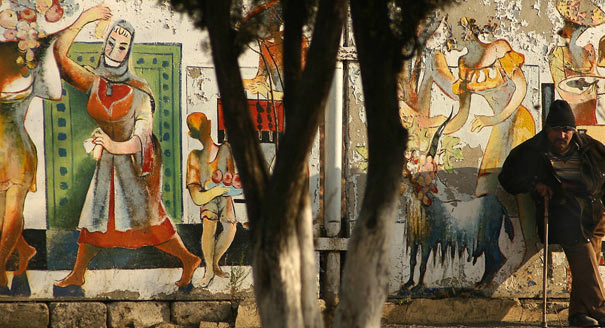
The ceasefire, which halted the war over Nagorny Karabakh 20 years ago, has been broken with grim regularity. Ordinary soldiers and civilians are the ones who pay the price for a lack of agreement on the front line, which is called Karabakh’s Line of Contact.
As episodes of mass violence grab our attention in Syria, Iraq or, more recently, Ukraine, it’s easy to forget a slow but steady casualty list from a conflict that is sometimes mistakenly referred to as “frozen.”
This week marked the 20th anniversary of the Russian-brokered ceasefire of May 12, 1994 that halted the war over Nagorny Karabakh. Fighting stopped, the Armenians secured a de facto victory on the ground and a 160-mile front line was drawn across what is internationally regarded as the territory of Azerbaijan. Without peacekeeping forces, a “self-regulating ceasefire” came into force.
Since then, Karabakh’s Line of Contact, as it is called, has developed into a World War I battle-zone with trenches sometimes less than 100 meters apart—and the ceasefire has been broken with grim regularity.
What is the accumulated death toll of 20 years? Sometimes the parties to the conflict have an interest in talking up the numbers, sometimes in concealing them. This week, an Azerbaijani journalistic organization called Doktrina came up with depressing figures. They are higher than anything I have seen, but worth taking seriously, as they have been compiled from both military sources and soldiers’ families in Azerbaijan.
Doktrina said that over this period Armenian fire had killed 610 Azerbaijani soldiers and 15 civilians and wounded 710 soldiers and more than 40 civilians. They reported that mines had killed 120 soldiers and 18 civilians and wounded more than 200 soldiers and 40 civilians.
I have not seen overall casualty figures from the Armenian side but they are almost certainly very similar to those of Azerbaijan. Almost no Armenian civilians live near the Line of Contact but there are reports of Armenian villagers dying near the Azerbaijani frontier—including one fatality last month.
If these deaths are barely recorded and hard to verify that is largely because there are only six international monitors from the OSCE covering the entire front line.
In his speech at the Carnegie Endowment last week, U.S. Karabakh negotiator James Warlick stressed that the OSCE needs to have a stronger presence on the ground for the casualty figures to go down. The monitors, he said, currently “have neither the mandate nor the resources to put a stop to the frequent casualties, or even to identify responsibility.”
Azerbaijan has traditionally resisted a stronger ceasefire monitoring mandate on the grounds that this would only “normalize” a status quo it does not like. Although Baku does not put it in quite these words, as the losing side in the conflict it sees its ability to destabilize the Line of Contact as one rare bit of leverage over the Armenians.
But a deal could be done. Extra OSCE monitors could have a mandate that extends beyond the Line of Contact. For example, they could monitor the ceasefire more vigilantly, as the Armenians want, and they could also report on the situation in the occupied Azerbaijani territories around Karabakh—an issue of concern to Baku.
Whatever the merits of the arguments of each side, ordinary soldiers and civilians are the ones who pay the price for a lack of agreement on this front line.

Senior Fellow, Carnegie Europe
Thomas de Waal is a senior fellow at Carnegie Europe, specializing in Eastern Europe and the Caucasus.
Recent Work
Thomas de Waal
Thomas de Waal
Carnegie does not take institutional positions on public policy issues; the views represented herein are those of the author(s) and do not necessarily reflect the views of Carnegie, its staff, or its trustees.

Minsk clearly expected the dialogue with Washington to yield more results, in particular the lifting of EU sanctions and permission to export potash.

Artyom Shraibman

If the Russian-speaking community in Latvia cannot articulate their interests without being seen as disloyal, they could end up embracing a pro-Kremlin agenda.

Sergejs Potapkins

With the growth in points of friction between the great powers, organizations like the SCO will continue to play a role in the strategic adaptation of the smaller powers caught between them.

Temur Umarov
A regime founded on force, coercion, and repression does not want its propaganda, with all its flaws of logic, omissions, and outright lies, to be competing with the most simple of all messages: Thou shalt not kill.

Leonid Bershidsky
With his public call for new elections in Ukraine, ex-defense minister Mykhailo Fedorov has opened Pandora’s box.

Konstantin Skorkin