

Commentary
Thomas de Waal
{
  "authors": [
    "Thomas de Waal"
  ],
  "type": "commentary",
  "centerAffiliationAll": "",
  "centers": [
    "Carnegie Endowment for International Peace",
    "Carnegie Europe",
    "Carnegie Russia Eurasia Center"
  ],
  "collections": [],
  "englishNewsletterAll": "",
  "nonEnglishNewsletterAll": "",
  "primaryCenter": "Carnegie Europe",
  "programAffiliation": "",
  "programs": [],
  "projects": [],
  "regions": [
    "North America",
    "United States",
    "Caucasus",
    "Azerbaijan",
    "Armenia"
  ],
  "topics": [
    "Security",
    "Foreign Policy",
    "Global Governance"
  ]
}
Source: Getty
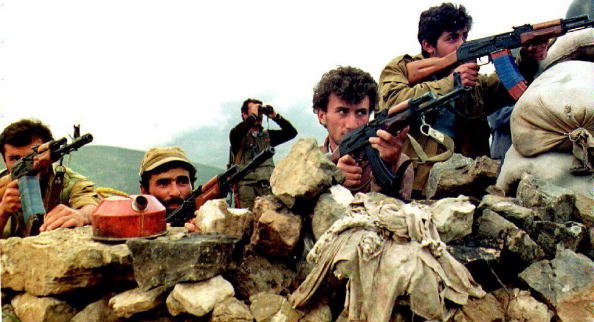
For the first time in many years, the U.S. government made its own policy statement on the Nagorny Karabakh conflict on the occasion of the 20th anniversary of the 1994 ceasefire. In his speech, the American co-chair of the Minsk Group of the OSCE issued an invitation to the governments in Baku and Yerevan to step up their commitment to the peace process.
For the first time in many years, the U.S. government made its own policy statement on the Nagorny Karabakh conflict on Wednesday on the occasion of the 20th anniversary of the 1994 ceasefire.
In his speech delivered at the Carnegie Endowment, the American co-chair of the Minsk Group of the OSCE, Ambassador James Warlick issued an invitation to the governments in Baku and Yerevan to step up their commitment to the peace process. It was a nuanced and discreet challenge, but a challenge nonetheless.
It was a low-key occasion. But the fact of a speech on behalf of the U.S. government rather than the Minsk Group co-chairs—France, Russia and the United States—was significant. The main weak spot of the Minsk Group over the last few years has been its lack of public diplomacy. Armenian and Azerbaijani narratives have filled the airwaves and the international mediators have said little to contradict them. To hear one of the co-chairs air some truths in public was refreshing.
Warlick was very careful to stress Washington's partnership with Russia in the Minsk Group, despite the Ukraine crisis. Moscow and Paris were both briefed about the speech and the Minsk Group is likely to issue a statement of its own next week on the anniversary of the Russian-brokered ceasefire of May 12, 1994.
But the text suggests that if the parties want to be more ambitious, Washington will devote more resources to the conflict.
The ambassador acknowledged Azerbaijan's real frustration, 20 years after the ceasefire, at having territories occupied and refugees unable to go home. But he also reminded Baku that a strengthened ceasefire mandate would save lives on the Line of Contact. And it was emphasized that for the mediators, some kind of vote—"a mutually agreed and legally binding expression of will" on the future status of Nagorny Karabakh—is "not optional."
Warlick endorsed the importance of Track II diplomacy, voicing his support to the Azerbaijani activists who are under assault in Baku (and about whom I wrote last week) with the words, "A lasting peace must be built not on a piece of paper, but on the trust, confidence and participation of the people of both countries."
He also said that "any enduring peace must reflect the views of all affected parties if it is to succeed"—a coded reminder that at some point the Minsk Group expects the Karabakh Armenians to join the talks.
There were messages for the Armenian side as well. The ambassador clearly used the phrase "occupied territories" to describe the Azerbaijani regions outside Karabakh and said that the Lachin Corridor linking Karabakh and Armenia should be a corridor, not a whole region.
Ever since the failure of the Kazan summit in 2011, the Armenians have more or less sat on a perch, saying that they want to keep on negotiating over the document that was under discussion that day.
I call this excessively cautious approach "passive aggressive." As he invited the parties to "take that last, bold step forward," Warlick was prodding the Armenians to show more creativity. The phrase, "It is not realistic to conclude that occasional meetings are sufficient by themselves to bring about a lasting peace," looked to me like a message that the two foreign ministers are not going to solve this by themselves and the presidents need to take the initiative.
The ambassador's speech will be spun, misquoted, greeted with cynical shrugs. But there are plenty of elements in there for those who read it closely enough which, if taken up, could constitute the making of a real peace process.

Senior Fellow, Carnegie Europe
Thomas de Waal is a senior fellow at Carnegie Europe, specializing in Eastern Europe and the Caucasus.
Recent Work
Thomas de Waal
Thomas de Waal
Carnegie does not take institutional positions on public policy issues; the views represented herein are those of the author(s) and do not necessarily reflect the views of Carnegie, its staff, or its trustees.
A leak of Russian gas price data helps establish that China is paying Russia far less than Central Asian countries and Gazprom’s former European customers.

Sergey Vakulenko

Japan’s long-term security policy is driven by concerns about China, and there is little appetite for (or interest in) pursuing a confrontation with Moscow.

James D.J. Brown

The truth of the strategic situation is that Europe and Russia are extremely unlikely to be able to “turn the page” on their confrontation within the next two decades.

Arkady Moshes

Russia’s AI-driven propaganda campaigns operate in a fragmented, chaotic, and often illogical manner. That’s not necessarily a problem for the Kremlin, though: It’s much easier to mimic genuine public debate that way.

Ilya Klishin

Without a ceasefire with Ukraine on attacking each other’s energy infrastructure—to which the Kremlin is unlikely to agree—the diesel agreement between Putin and Trump is largely for show, rather than representing a genuine increase in the volumes of Russian diesel on the global market.
Sergey Vakulenko