

Commentary
Dmitri Trenin
{
  "authors": [
    "Dmitri Trenin"
  ],
  "type": "commentary",
  "centerAffiliationAll": "",
  "centers": [
    "Carnegie Endowment for International Peace",
    "Carnegie Russia Eurasia Center"
  ],
  "collections": [],
  "englishNewsletterAll": "",
  "nonEnglishNewsletterAll": "",
  "primaryCenter": "Carnegie Russia Eurasia Center",
  "programAffiliation": "",
  "programs": [],
  "projects": [],
  "regions": [
    "East Asia",
    "China",
    "Russia"
  ],
  "topics": [
    "Political Reform",
    "Foreign Policy",
    "Civil Society"
  ]
}
Source: Getty
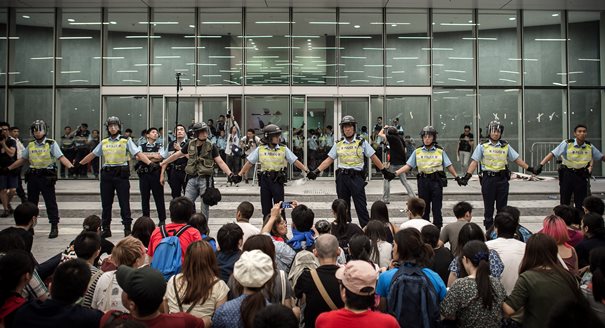
The Chinese do not have to listen to the Russians to see threats to their national sovereignty and domestic stability on the horizon. Both see Western support for democracy as a tool to contain them internationally and to weaken them from within.
When the senior Russian participant at the recent Shangri-La dialogue, Deputy Defense Minister Anatoly Antonov, devoted a major part of his remarks to the threat of color revolutions in the Asia-Pacific region, he received a lot of blank stares in return. A number of Asian delegates took Antonov's focus as evidence of how much Moscow is obsessed with Ukraine and how little it understands Asia. Earlier this month, Eurasia Outlook published a participant's takeaway from the conference which referred to precisely that reaction. However, one country in the region probably shares, at least in part, Antonov's assessment, and is prepared to act accordingly.
The central government in Beijing was not amused. It fears foreign encouragement for pro-democracy protestors. These fears were not calmed by the statements by the U.S. and UK consulates in Hong Kong, and the remarks by a former Canadian consul-general, in support of freedom of expression as a linchpin of the city's continued vitality and attractiveness. Moreover, Beijing let it be known it was developing a similar warning paper for Macau. To make things absolutely clear, retired Chinese officials made references to the PLA's duty of maintaining law and order in an emergency. Coming days after the 25th anniversary of Tiananmen, these references were chilling.
As the new Chinese leadership embarks on a serious economic and administrative reform agenda, it wants to minimize the risk of domestic instability. "People power" and direct elections in Hong Kong can project destabilizing influence onto the mainland. The spike in terrorist activity and continued ethnic tensions in Xinjiang is even more worrisome. There, as in Tibet, Beijing points to outside interference as one of the sources of the problem. In the capital itself, the Communist Party disciplinarians have recently warned the Chinese Academy of Social Science against becoming a tool of foreign influence.
In its neighborhood, China has been witnessing a Western effort to "give democracy a chance" in Myanmar, which, to Beijing at least, has a geopolitical and strategic element to it as well. For their own part, the Chinese are now reaching out to the Thai military, who have just carried out a coup to end a long period of domestic political infighting which paralyzed the country. A democratic uprising in North Korea—if one were to imagine such a thing—would have enormous negative consequences for China's national security.
The Chinese do not have to listen to the Russians, of course, to spot problems on the horizon. The fact is that China's and Russia's views on their own national sovereignty and on the threats to domestic stability coincide to a significant degree. Both see Western support for democracy as a tool to contain them internationally and to weaken them from within. As Antonov was speaking, the PLA Deputy Chief of the General Staff, his co-panelist, was not visibly nodding. But he hardly disagreed.
Former Director, Carnegie Moscow Center
Trenin was director of the Carnegie Moscow Center from 2008 to early 2022.
Recent Work
Dmitri Trenin
Dmitri Trenin
Carnegie does not take institutional positions on public policy issues; the views represented herein are those of the author(s) and do not necessarily reflect the views of Carnegie, its staff, or its trustees.
This year’s wars have made alternative routes to transit through Russia no less risky for Central Asian countries.

Galiya Ibragimova
Reestablishing a dialogue with Moscow is not a goal in its own right. The goal is to guarantee the independence of Ukraine and the peace and security of Europe.
Arkady Moshes
Ukraine’s increasingly confrontational posture on Belarus reflects Kyiv’s effort to shape the emerging regional order in Eastern Europe. Kyiv wants to limit European normalization with Minsk—and any future rapprochement with Russia.

Balázs Jarábik
The ruling elites in contemporary Russia are not a political class, but a community of managers who are not subject to competition or public accountability. The state is becoming an operating apparatus without any internal autonomy.

Alexandra Prokopenko

Pashinyan’s pro-European party has been re-elected with a decisive victory. But the pro-Russian opposition could still slow Armenia’s progress toward peace with Azerbaijan and rapprochement with Europe.
Mikayel Zolyan