

Commentary
Bayram Balci
{
  "authors": [
    "Bayram Balci"
  ],
  "type": "legacyinthemedia",
  "centerAffiliationAll": "dc",
  "centers": [
    "Carnegie Endowment for International Peace",
    "Malcolm H. Kerr Carnegie Middle East Center"
  ],
  "collections": [],
  "englishNewsletterAll": "menaTransitions",
  "nonEnglishNewsletterAll": "",
  "primaryCenter": "Carnegie Endowment for International Peace",
  "programAffiliation": "MEP",
  "programs": [
    "Middle East"
  ],
  "projects": [],
  "regions": [
    "Middle East",
    "Türkiye"
  ],
  "topics": [
    "Political Reform",
    "Foreign Policy"
  ]
}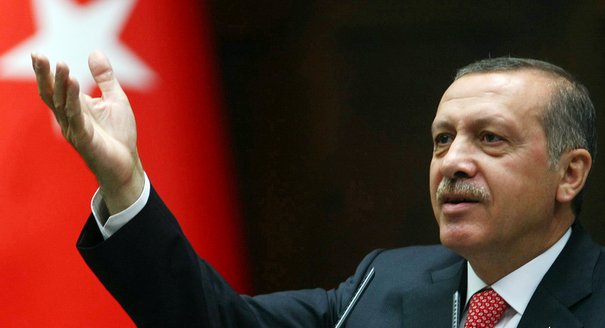
Source: Getty
The Syrian and Iraqi crises revealed that Turkey cannot guarantee its own security without solid cooperation from its western allies. As Erdogan transitions from prime minster to president, he must recognize this reality.
Source: World Policy Blog
Earlier this month, Prime Minister Recep Tayyip Erdogan was elected Turkey’s new president, carrying almost 52 percent of the vote. Having been in power since 2003, Erdogan may leverage this victory for an additional five years in office. However, while elected in the first round and possessing both experience and charisma, he will nevertheless face many challenges—particularly in foreign policy, where his multiple miscalculations and blunders have considerably damaged Turkey's image abroad. At the same time, this presidency marks the beginning of a new chapter in Turkey’s history and could be a good opportunity for Erdogan to reset Turkish foreign policy, an urgent task that won’t be easy to implement.
One of the most successful and popular governments until now in Turkey, the ruling Justice and Development Party (Adalet ve Kalkinma Partisi, AKP )built ambitious and responsible foreign policy. The government's “Zero Problems With Neighbors” policy, formulated by then Minister of Foreign Affairs Ahmet Davutoglu, improved Turkey’s relations with almost every country in the Middle East. Turkey subsequently got on good terms with Israel, Syria, and Iran, improved its traditionally tense relations with Greece and Armenia, and became a mediator between several disputing countries. As the Arab Spring developed, eliminating powerful dictators and giving Islamic nations hope for liberty and democracy, Turkey reached the height of its popularity. Erdogan and his team were able to showcase Turkey’s exemplary achievements – a strong economy, an Islamic democracy, and an ambitious foreign policy – that made Turkey a model for Muslim countries in the region.
However, Turkey’s prestige started to erode when the Arab Spring was blocked in Syria—the country with which Turkey shares its longest border. Unable to convince its former ally Bashar al-Assad to undertake reforms, Turkey started to support the opposition. However, Syria’s ongoing conflict began to have dramatic consequences for Turkey's economy and security. Ankara renounced its initial support of the moderate opposition, irresponsibly deciding to support both directly and indirectly the jihadist part of the Syrian opposition. Jabhat al Nusra and ISIS forces benefited from Ankara’s ambiguous policy and emerged as the most dangerous forces in the region, though Ankara denies it. In other words, Turkey’s interference in the Syrian conflict, though inspired more by desperation and miscalculation than by adherence to the ideas of Jabhat al Nusrat and ISIS, has contributed to Syria’s disintegration—a scenario that Ankara wanted to avoid at the beginning of the Syrian crisis.Turkey’s mistakes and miscalculations in Iraq were also greatly detrimental to its foreign policy. Accusing the Baghdad regime of a sectarian, pro-Shia policy, Erdogan nevertheless employed a similar policy in the Middle East. In effect, Turkey has encouraged the Kurdish leaders to achieve a de facto independence from Baghdad, In doing so, Turkey has contributed to the disintegration of Iraq, as it did in Syria. Moreover, Turkey’s ambiguous attitude towards the Jihadists was a factor in their strength in Syria and Iraq, creating a new jihadistan in the heart of the Middle East.
In addition to a catastrophic policy with its two major neighbors, Turkey has also remained on bad terms with Israel, cutting ties in May 2010 when a Turkish humanitarian convoy linked to the AKP government was targeted by the Israeli army, Turkey was just about to normalize its relations with Israel, a rapprochement made necessary by the deterioration of security issues in the Middle East; however, the Israeli army’s Operation Protective Edge broke out and put a new obstacle in the way .
Turkey's relations with the West are no better. When Erdogan rose to power, he spent his two first mandates building a strong relationship with the EU, and Turkey's EU candidacy made significant steps forward. However, the relations between Ankara and Brussels have since deteriorated considerably—due to the Europeans' reluctance to admit Turkey into the EU, and Turkey’s increasingly authoritarian domestic policies,
In light of Turkey’s tumultuous foreign policy, the new president’s task is huge. Turkey currently stands on good terms with Hamas, Iran, and the Kurds of Iraq. Its relations with the U.S. and EU are tense, but very friendly with Putin’s Russia. This situation cannot be satisfying for a country with aspirations of entering into the top ten greatest nations of the world by 2023, when the republic will celebrate its centennial anniversary.
Turkey must, therefore, establish a new foreign policy in the Middle East, Erdogan’s current strategy is not paying off. His ambivalent relations with ISIS did not keep these jihadists from kidnapping Turkish diplomats (who remain hostages in Iraq), while the Turkish consulate in Mosul became headquarters for the terrorist organization. In terms of the Israeli-Palestinian conflict, Erdogan’s sincere personal sympathy for the Palestinian cause should not stop him from reestablishing good relations with Israel. If Turkey wants to play a positive role in the Middle East, it must be able to talk to all the major actors in the region, including Israel.
If Erdogan wants to give his country a real chance of resolving its security concerns in the Middle East, a new relationship with the West is crucial. To be fair, Erdogan is not solely responsible for the deterioration of relations between his country and the U.S. The Obama administration rightly denounces Erdogan’s authoritarianism, particularly its assault against the media and interferences with the justice system. However, the U.S. cannot blame him for his relations with the jihadists in Syria, for the U.S. essentially abandoned him in the Syrian crisis as Washington’s inaction weakened the moderate Syrian opposition.
As prime minister, Erdogan strengthened his country during his first two terms. Elected for a third term in 2011, he attempted to use this strength to assert more autonomy and independence in Turkey's foreign policy. The Syrian and Iraqi crises revealed that Turkey cannot guarantee its own security without solid cooperation from its western allies. As Erdogan transitions from prime minster to president, he must recognize this reality.
This article was originally published in the World Policy Blog.
Former Nonresident Scholar, Russia and Eurasia Program
Balci was a nonresident scholar in Carnegie’s Russia and Eurasia Program, where his research focuses on Turkey and Turkish foreign policy in Central Asia and the Caucasus.
Recent Work
Bayram Balci
Bayram Balci, Daniyar Kosnazarov
Carnegie does not take institutional positions on public policy issues; the views represented herein are those of the author(s) and do not necessarily reflect the views of Carnegie, its staff, or its trustees.

Japan’s long-term security policy is driven by concerns about China, and there is little appetite for (or interest in) pursuing a confrontation with Moscow.

James D.J. Brown

Putin’s conservative staffing policies and search for ever greater control have cemented parliament’s transformation into a bureaucratic appendage of the executive branch.

Andrey Pertsev

Without a ceasefire with Ukraine on attacking each other’s energy infrastructure—to which the Kremlin is unlikely to agree—the diesel agreement between Putin and Trump is largely for show, rather than representing a genuine increase in the volumes of Russian diesel on the global market.

Sergey Vakulenko

Ex-president Gurbanguly Berdimuhamedov remains interested in politics, but his son Serdar, Turkmenistan’s current president, is becoming increasingly independent and willing to break with his father’s legacy. If their covert rivalry goes too far, both risk losing power.

Galiya Ibragimova

Despite a new textbook, an influx of Russian teachers and managers, and an end to the teaching of Ukrainian, the Kremlin is unlikely to have “reprogrammed” locals.

Konstantin Skorkin