

Article
C. Raja Mohan, Darshana M. Baruah
{
  "authors": [
    "C. Raja Mohan"
  ],
  "type": "legacyinthemedia",
  "centerAffiliationAll": "dc",
  "centers": [
    "Carnegie Endowment for International Peace",
    "Carnegie India"
  ],
  "collections": [],
  "englishNewsletterAll": "ctw",
  "nonEnglishNewsletterAll": "",
  "primaryCenter": "Carnegie India",
  "programAffiliation": "SAP",
  "programs": [
    "South Asia"
  ],
  "projects": [],
  "regions": [
    "South Asia",
    "India"
  ],
  "topics": [
    "Domestic Politics",
    "Foreign Policy",
    "Political Reform",
    "Religion"
  ]
}
Source: Getty
It is easy to forget that domestic stability holds the key to a successful foreign policy.
Source: Indian Express
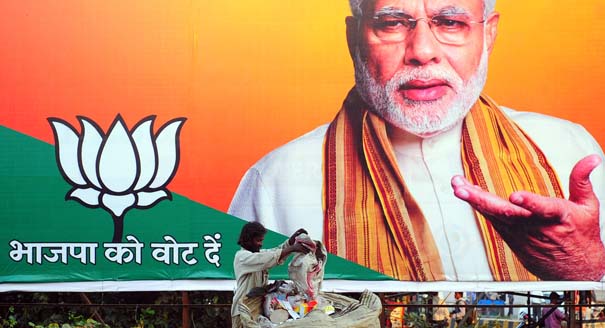
In his frequent travels across the world over the last few months, Prime Minister Narendra Modi has continually affirmed that India can re-emerge as the “Vishwaguru”. Modi’s global dream for India, however, is at odds with the deeply divisive religious agenda and the anti-modernism that have been unleashed by the RSS and its affiliates.
That India, as one of the world’s oldest and continuing civilisations, may have much to teach the world is not a new proposition. Different schools of Indian nationalism, including those which focused on India’s past and others which understood modern India’s future potential, believed that an Indian leadership role on the world stage was inevitable. Even those who were deeply suspicious of nationalist passions, both religious and secular, were convinced that India’s spiritual civilisation had much relevance for the contemporary world.
India’s higher economic growth rates in the reform era and the steady expansion of its relative weight in the international system have lent new credibility to the notion of an Indian international leadership. The example of China has been difficult to miss. After three decades of rapid growth, China is now the second-largest economy in the world and its aggregate GDP will soon be larger than that of the United States. Beijing is also the world’s largest defence spender after America.The dramatic expansion of China’s comprehensive national power has allowed Beijing to now begin reshaping the Asian and global orders. A similar prospect awaits India if it continues to modernise and grow its economy at a reasonable clip. Much of the international enthusiasm for Modi, like that for his predecessor, Manmohan Singh, in the middle of the last decade, was based precisely on that expectation.
Faster growth rates of the last decade triggered international calls on India to become a responsible global power and a “net security provider”. Yet Delhi has been hesitant to accept a leadership role. Many in Delhi interpreted these calls as a pressure point rather than the recognition of India’s expanding weight in the world. Modi, in contrast, is discarding this defensiveness and embracing the prospect of a leadership role. Whether Delhi actively pursues such a role or not, India’s democracy, which thrives amid extraordinary diversity, religious, ethnic and linguistic, is a source of quiet optimism in a world that is being torn apart by multiple tensions.
Modi’s hopes for India as “Vishwaguru” are inspired by Vivekananda. The swami spoke of the contributions that India’s rich vedantic heritage could make in addressing the spiritual challenges of the contemporary world. Modi, of course, is stretching the idea a bit when he speaks of how India’s democracy and demography can be deployed in the service of the world today.
Modi also believes the diaspora that has spread around the world and has impressive resources, intellectual and financial, can help realise India’s potential as “Vishwaguru”. He reminded his audiences in Sydney that Vivekananda had urged his countrymen to forget their gods and goddesses for 50 years and worship only “Mother India”.
His suggestion that development might be more important than religion is obviously not shared by the extremist outfits of the Sangh Parivar, which have lost no time in pushing their polarising politics on the nation. Modi is surely aware that the growing assertiveness of the Hindu right will complicate the development agenda that was at the heart of his successful election campaign. At equal risk is the BJP’s promise — “sab ka saath, sab ka vikas” — to put development for all above the sectarian Hindu agenda.
Given his own experience in Gujarat and the political consequences of the 2002 riots, Modi has every reason not to let religious controversies overwhelm his prime ministerial tenure. In his maiden Independence Day speech this August, Modi declared that casteism, communalism and regionalism were obstacles to development and called for a 10-year moratorium on divisive issues.
The last few weeks have shown that the RSS and Hindu-right outfits are not ready to heed Modi’s appeals to avoid derailing his government’s development agenda. Modi should also be aware that the new Hindutva agenda at home will also seriously complicate India’s external relations, a domain in which Modi has surprised everyone with his passion and effectiveness.
It is easy to forget that domestic stability holds the key to a successful foreign policy. A nation that is at war with itself will inevitably be diminished on the world stage. When a nation turns faith into a contentious question, it invites intervention from religious extremists from around the world. It will also draw into the debate secular forces around the world that want freedom of faith and a separation of religion and state in India.
The new push for a Hindu rashtra, then, is bound to generate many costs for Indian diplomacy. Just when Modi appears to have succeeded in reducing the fears of the neighbours and the world about India’s internal orientation under the BJP, the RSS and the Hindu right seem determined to revive them. Equally problematic for India is the resurgent anti-modernism of the Sangh Parivar. Its leaders, including the prime minister, have made extravagant claims, ranging from the proposition that astrology is superior to science to the suggestion that Vedic India conducted nuclear tests.
While asking his countrymen to take pride in their rich cultural inheritance and appreciate its relevance to the modern world, Vivekananda had also insisted that India must sit at the feet of the West to learn about improving the nation’s material condition. India, then, must strive to be a good teacher and a better student. It must invest in the serious study of its ancient heritage and master modern knowledge. But if Hindu extremism prevails, India will have little to give the world and be in no mood to learn. Unless he acts now to check these negative forces, Modi and the agenda for India could end up being a minor part of the vast collateral damage.
This article was originally published in the Indian Express.
Former Nonresident Senior Fellow, Carnegie India
A leading analyst of India’s foreign policy, Mohan is also an expert on South Asian security, great-power relations in Asia, and arms control.
Recent Work

C. Raja Mohan, Darshana M. Baruah


Alexander Gabuev, Paul Haenle, C. Raja Mohan, …
Carnegie does not take institutional positions on public policy issues; the views represented herein are those of the author(s) and do not necessarily reflect the views of Carnegie, its staff, or its trustees.
Russia spent years building a “sovereign internet,” concentrating web infrastructure exclusively within Russian territory. Ukrainian drone attacks have shown how vulnerable that approach has left the Russian internet.

Maria Kolomychenko

Putin’s conservative staffing policies and search for ever greater control have cemented parliament’s transformation into a bureaucratic appendage of the executive branch.

Andrey Pertsev

Without a ceasefire with Ukraine on attacking each other’s energy infrastructure—to which the Kremlin is unlikely to agree—the diesel agreement between Putin and Trump is largely for show, rather than representing a genuine increase in the volumes of Russian diesel on the global market.

Sergey Vakulenko

Ex-president Gurbanguly Berdimuhamedov remains interested in politics, but his son Serdar, Turkmenistan’s current president, is becoming increasingly independent and willing to break with his father’s legacy. If their covert rivalry goes too far, both risk losing power.

Galiya Ibragimova

Despite a new textbook, an influx of Russian teachers and managers, and an end to the teaching of Ukrainian, the Kremlin is unlikely to have “reprogrammed” locals.

Konstantin Skorkin