

Paper
Ashley J. Tellis
{
  "authors": [
    "Ashley J. Tellis"
  ],
  "type": "other",
  "centerAffiliationAll": "dc",
  "centers": [
    "Carnegie Endowment for International Peace"
  ],
  "collections": [],
  "englishNewsletterAll": "ctw",
  "nonEnglishNewsletterAll": "",
  "primaryCenter": "Carnegie Endowment for International Peace",
  "programAffiliation": "SAP",
  "programs": [
    "South Asia"
  ],
  "projects": [],
  "regions": [
    "North America",
    "United States",
    "South Asia",
    "India",
    "East Asia",
    "South Korea",
    "China",
    "Taiwan",
    "Japan",
    "Southeast Asia",
    "North Korea"
  ],
  "topics": []
}
Source: Getty
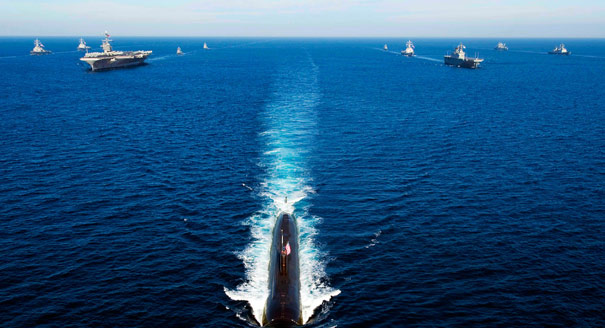
The United States has consistently rejected both isolationism and multilateralism as instruments for meeting its highest strategic ambitions, instead utilizing a dialectical relationship between confederationism and unilateralism to achieve hegemony.
Source: National Bureau of Asian Research
This chapter reviews how the U.S. came to treat alliances and partnerships as essential instruments of its quest for hegemony over time, what tasks U.S. alliances performed in the past, and how their functions promise to mutate in the future.Despite frequent references to the U.S.’s early isolationist past, the country has consistently rejected both isolationism and multilateralism as instruments for meeting its highest strategic ambitions, instead utilizing a dialectical relationship between confederationism and unilateralism to achieve hegemony. U.S. power, no matter how formidable, benefits from the presence of partners, thanks to both their capacity to supplement American resources and their ability to bestow legitimacy to various U.S. policies. Even when these are not at issue, however, the company of confederates is undoubtedly valuable because it enhances the freedom that the U.S. enjoys to undertake unilateral actions whenever these are demanded by its global interests.
This chapter is the introduction to Strategic Asia 1014-15: U.S. Alliances and Partnerships at the Center of Global Power . Read more about Strategic Asia, including information on how to order the complete book, here.
Former Senior Fellow
Ashley J. Tellis was a senior fellow at the Carnegie Endowment for International Peace.
Recent Work
Ashley J. Tellis
Ashley J. Tellis
Carnegie does not take institutional positions on public policy issues; the views represented herein are those of the author(s) and do not necessarily reflect the views of Carnegie, its staff, or its trustees.
Ongoing uncertainty in the Middle East allows Moscow to both increase its influence in Tehran and continue to enjoy the financial windfall of higher oil prices.

Nikita Smagin

The demands of the Kremlin’s war in Ukraine, demographic problems, and public hostility toward Central Asians mean Russia does not have enough workers.

Salavat Abylkalikov
With no key agreement signed on the Power of Siberia 2 gas pipeline, there is a risk that the window of opportunity for Russia will close if Chinese power generation becomes so green that new gas sources are no longer of any interest to Beijing.

Alexander Gabuev

The truth is that Japan’s government is seeking a degree of reengagement but at a vastly reduced level than under Abe. Most significantly, Japan has shown no willingness to ease sanctions.

James D.J. Brown

Governments in Estonia, Latvia, and Lithuania want to ensure that a U.S. military withdrawal would not leave them dangerously exposed to a Russian attack.

Sergejs Potapkins