

Commentary
Cornelius Adebahr
{
  "authors": [
    "Cornelius Adebahr"
  ],
  "type": "legacyinthemedia",
  "centerAffiliationAll": "dc",
  "centers": [
    "Carnegie Endowment for International Peace",
    "Carnegie Europe"
  ],
  "collections": [
    "Transatlantic Cooperation"
  ],
  "englishNewsletterAll": "ctw",
  "nonEnglishNewsletterAll": "",
  "primaryCenter": "Carnegie Europe",
  "programAffiliation": "EP",
  "programs": [
    "Europe"
  ],
  "projects": [],
  "regions": [
    "Eastern Europe",
    "North America",
    "United States",
    "Russia",
    "Ukraine",
    "Western Europe",
    "Iran"
  ],
  "topics": [
    "Foreign Policy",
    "Security",
    "Political Reform",
    "Democracy",
    "Military"
  ]
}
Source: Getty
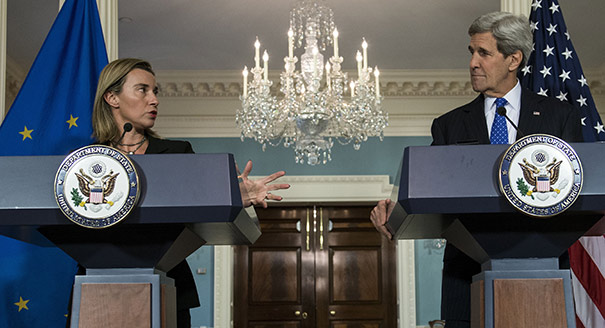
Closing in on the first 100 days in office, Federica Mogherini embarked on her trip to the United States as the EU’s top diplomat. Her visit was an uneasy one due to one topic: Russia.
Source: Global Policy Journal
Closing in on the first 100 days in office, Federica Mogherini, embarked on her first long-distance trip as the EU’s top diplomat to the United States. Washington was also, she noted in a press conference with Secretary Kerry, her first destination as Italian foreign minister. More than that, as the audience of her public presentation at the Brookings Institution learned, she feels a strong bond with America ever since she spend an intensive period of time there as a Marshall Memorial Fellow in 2007.
Still, her visit was an uneasy return if only for one topic: Russia. It was a memo leaked by the Financial Times ahead of the Foreign Affairs Council meeting on Monday before her trip across the Atlantic that caused a stir. With it, the High Representative for Foreign and Security Policy and Vice-President of the European Commission was seen to propose a softer approach on Russia – an impression that Mogherini adamantly tried to counter in Washington. She stressed that the paper was part of coming to a strategic political approach towards Russia rather than just reacting – by way of economic sanctions – to this country’s meddling in neighbouring Ukraine.
With Russian troops allegedly entering Ukrainian territory at the very time that EU foreign ministers were meeting in Brussels, there could be “no back to business as usual”, she said. Instead, taking the Minsk ceasefire agreement of September as the only accepted reference point, the ball was in Moscow’s court to live up to its commitments made therein. On this, not only the European states but also the EU and the U.S. shared the same goals.As an expression of this (new-found) unity, Mogherini put a lot of emphasis on the Paris attacks as “our 9/11” – obviously less for the scale of the damage but for the symbols of European culture and values which had been targeted: media freedom, the police, the Jewish community. In that sense, her optimism about finding new compromises on the sharing of data, especially on a European passenger name records database, were quite welcome in Washington – with interlocutors hardly holding back their “we’ve been telling you” comments.
On Iran, Mogherini reinforced the European message in particular to the U.S. Congress that new sanctions passed now – even if held back until after the presumed end of the negotiations – would likely wreck the multilateral talks. With a hearing in the Senate’s Foreign Relations Committee in the morning of her second day ahead of two critical bills coming up, these efforts – following similarly intensive lobbying by British Prime Minister David Cameron a few days earlier – were much needed, though may be futile. Still, a Washington Post editorial by Mogherini and her colleagues from France, Germany, and the United Kingdom following her departure to Europe was a remarkable first.
Those who were following an internal European quarrel about whether Mogherini’s predecessor as HR/VP should stay on as the facilitator of the E3+3 talks will have taken note of her comments during the press briefing at State. In these, she did not mention her “special advisor” for the negotiations, Catherine Ashton, when she said “There’s a UN Security Council resolution that […] tasks the High Representative of the European Union to facilitate the negotiations. […] My role is facilitating the dialogue.”
Other issues dear to her heart included two less covered items, the Israeli-Palestinian conflict (still “Middle East Peace Process” in EU parlance, despite its apparent death a number of years ago) and the ongoing civil war in Libya. Both topics were part of her off-the-record policy discussions, including at the Carnegie Endowment for International Peace (which I attended – full disclosure). It showed that she has a real interest in using her freshman status to seek out room for new initiatives on these protracted conflicts, including by broadening the Middle East “Quartet” – of the EU, Russia, the UN, and the US – to include important neighbouring Arab states.
Given all the talk about crises around the world where the EU and the U.S. (have to) cooperate, one surprising topic of agreement was combating climate change. On the day after President Obama used his State of the Union address to put climate change high on his remaining policy agenda, Mogherini underlined the opportunity for joint diplomatic efforts by the transatlantic partners. With the help of the EU’s and its member states’ 90.000 diplomats around the world, she wants to achieve an historic breakthrough at the next climate summit in Paris in December this year.
Finally, this wouldn’t be the EU if there weren’t any discernible differences between member states. At a time when many policymakers in Washington seem to believe to finally have found “Europe’s phone number”, once claimed by Mogherini’s pre-predecessor but now actually thought to begin with the area code for Germany, the former Italian foreign minister stressed that also smaller member states ought to be heard on the big issues of the day. Why, one might ask, should the EU High Representative be any luckier than her American counterparts and escape the ‘domestic politics’ even on a trip abroad? Certainly not in DC.
This article originally appeared in the Global Policy Journal.
Former Nonresident Fellow, Carnegie Europe
Cornelius Adebahr was a nonresident fellow at Carnegie Europe. His research focuses on foreign and security policy, in particular regarding Iran and the Persian Gulf, on European and transatlantic affairs, and on citizens’ engagement.
Recent Work
Cornelius Adebahr
Cornelius Adebahr, Barbara Mittelhammer
Carnegie does not take institutional positions on public policy issues; the views represented herein are those of the author(s) and do not necessarily reflect the views of Carnegie, its staff, or its trustees.

Russian strikes are weakening the economy sustaining Ukraine’s war effort. Closing the growing funding gap will require more European support and politically contentious reforms in Kyiv.

Balázs Jarábik

Ex-president Gurbanguly Berdimuhamedov remains interested in politics, but his son Serdar, Turkmenistan’s current president, is becoming increasingly independent and willing to break with his father’s legacy. If their covert rivalry goes too far, both risk losing power.

Galiya Ibragimova

Despite a new textbook, an influx of Russian teachers and managers, and an end to the teaching of Ukrainian, the Kremlin is unlikely to have “reprogrammed” locals.

Konstantin Skorkin

For every ruble allocated to social policy, health, and education in 2027, double that amount is earmarked for the army, the police, and the security services.

Alexandra Prokopenko

Cargo traffic through Russia’s Northern Sea Route has increased because of the disruption caused by the conflict in the Middle East, the Ukraine war, and U.S.-China tensions.

Mikhail Korostikov