
Arms supplies from Russia to Iran will not only continue, but could grow significantly if Russia gets the opportunity.
Nikita Smagin
{
"authors": [
"Mario Abou Zeid",
"Mamoun Abu-Nowar",
"Kamel Wazne"
],
"type": "legacyinthemedia",
"centerAffiliationAll": "dc",
"centers": [
"Carnegie Endowment for International Peace",
"Malcolm H. Kerr Carnegie Middle East Center"
],
"collections": [],
"englishNewsletterAll": "menaTransitions",
"nonEnglishNewsletterAll": "",
"primaryCenter": "Malcolm H. Kerr Carnegie Middle East Center",
"programAffiliation": "MEP",
"programs": [
"Middle East"
],
"projects": [],
"regions": [
"Levant",
"Syria",
"Middle East"
],
"topics": [
"Political Reform",
"Security"
]
}Source: Getty
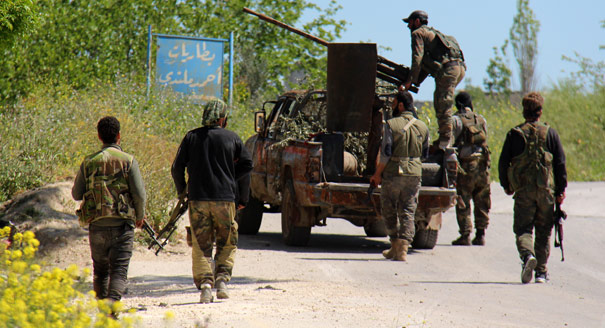
An alliance of opposition forces has seized control of a second strategic city from government troops.
Source: Al Jazeera’s Inside Story
A loose alliance of rebel groups in Syria is claiming a second significant victory against government forces in less than a month. The opposition offensive in northern Idlib province was spearheaded by al-Qaeda’s affiliate in Syria, Nusra Front. Fighting under the banner, “Army of Conquest,” rebel allies seized control of the provincial capital Idlib at the end of March.
A broader union of fighters says it has now overrun nearby Jisr al Shughur. The city was one of the first places to take up arms against president Assad, when security forces cracked down on protests.
The fight for Idlib province comes ahead of UN-backed talks in Geneva on May 4.
So can opposition groups present a united front in the push for peace? Or will the pursuit of different agendas eclipse the fight against a common enemy? Carnegie’s Mario Abou Zeid spoke with Al Jazeera’s Inside Story.
This interview was originally broadcast by Al Jazeera’s Inside Story.
Former Research Analyst, Middle East Center
Abou Zeid was a research analyst at the Carnegie Middle East Center, where his work focuses on political developments in Lebanon, Syria, Iraq, and Iran.
Mamoun Abu-Nowar
Kamel Wazne
Carnegie does not take institutional positions on public policy issues; the views represented herein are those of the author(s) and do not necessarily reflect the views of Carnegie, its staff, or its trustees.
Arms supplies from Russia to Iran will not only continue, but could grow significantly if Russia gets the opportunity.
Nikita Smagin
The use of technology to mobilize Russians to vote—a system tied to the relative material well-being of the electorate, its high dependence on the state, and a far-reaching system of digital control—is breaking down.
Andrey Pertsev
Putin is stalling, waiting for a breakthrough on the front lines or a grand bargain in which Trump will give him something more than Ukraine in exchange for concessions on Ukraine. And if that doesn’t happen, the conflict could be expanded beyond Ukraine.
Alexander Baunov
As discussions about settlement and elections move from speculation to preparation, Kyiv will have to manage not only the battlefield, but also the terms of political transition. The thaw will not resolve underlying tensions; it will only expose them more clearly.
Balázs Jarábik
Disillusioned with the West over Gaza, Arab countries are not only trading more with Russia; they are also more willing to criticize Kyiv.
Ruslan Suleymanov







