

Article
C. Raja Mohan, Darshana M. Baruah
{
  "authors": [
    "C. Raja Mohan"
  ],
  "type": "legacyinthemedia",
  "centerAffiliationAll": "dc",
  "centers": [
    "Carnegie Endowment for International Peace",
    "Carnegie India"
  ],
  "collections": [],
  "englishNewsletterAll": "ctw",
  "nonEnglishNewsletterAll": "",
  "primaryCenter": "Carnegie India",
  "programAffiliation": "SAP",
  "programs": [
    "South Asia"
  ],
  "projects": [],
  "regions": [
    "South Asia",
    "India"
  ],
  "topics": [
    "Foreign Policy",
    "Religion"
  ]
}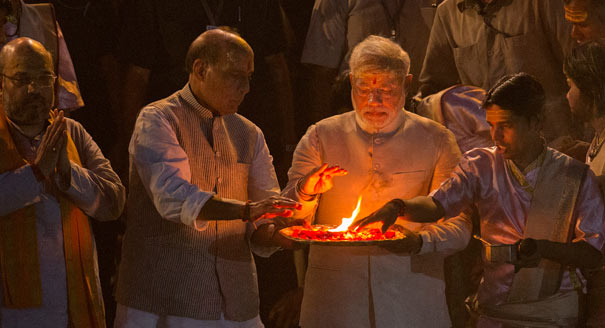
Source: Getty
Purposeful engagement with religious communities around the world can increase the efficacy of India’s international relations, but only when handled with great care and diplomatic competence.
Source: Indian Express
One of the distinguishing features of Prime Minister Narendra Modi’s diplomacy has been his effort to rebuild the long-neglected Buddhist bridge to the world. Modi’s plans are likely to come into sharper focus this week as he addresses a conference called “A Global Hindu-Buddhist Initiative on Conflict Avoidance and Environment Consciousness” in the capital.
Ignore the ungainly title of the conference. But do note that it is being organised by the Vivekananda International Foundation, which is close to the Modi government and the Sangh Parivar, in partnership with the Tokyo Foundation and the International Buddhist Confederation.
A number of leading political and religious figures from across Buddhist Asia are participating in the initiative. Modi will also join the delegates in Bodh Gaya, where they will travel to after the conference concludes in New Delhi. External Affairs Minister Sushma Swaraj will deliver the valedictory address to the conference.From a seeming personal fad of the PM, Buddhism has begun to acquire an unprecedented weight in India’s Asian policy. In his address to the parliament of Mongolia in June this year, Modi went beyond the notion of promoting India’s soft power to highlight the importance of Buddhism in dealing with the contemporary political challenges before Asia and the world. For one, he insisted that the spiritual values of Buddhism are deeply connected to the principles of democracy. “If we follow the ‘right path’ of the master,” Modi said, “it will also be natural to walk on the path of democratic values.” Modi added that “the convergence of Buddhism and democracy provides us a path to build an Asia of peace and cooperation, harmony and equality.” Modi also argued that Buddhism is “a call for each of us, as individuals and as nations, to assume the universal responsibility to mankind and our planet”.
That Modi was not being quirky in injecting religion into the messy debate on climate change was confirmed by none other than Pope Francis, who released the encyclical on climate change a few days later, insisting on our collective moral responsibility to pass on a clean planet to the next generations.
In Delhi, there is bound to be some unease at Modi’s attempt to bring religion into the conduct of Indian foreign policy. After all, independent India has consciously kept its diplomacy apart from religion all these decades. Even when India talked of shared culture and deep civilisational links with its Asian friends, Delhi was quite careful to edit religion out of it.
In being unafraid of bringing faith into foreign policy, Modi may be treading new ground in India. But he is quite in tune with an emerging international trend. Many leading powers are getting their foreign offices to be more attentive to religious issues. While many secular states have traditionally seen religion as a source of international conflict, some are beginning to argue that it might, under certain conditions, be a force for some good.
The avowedly godless Chinese Communist Party now deploys Buddhism as a major diplomatic tool to win friends and influence religious communities across the world. The deeply secular West European states are acknowledging the resurgence of religion as a major factor in world politics, especially on their doorstep in the Middle East, and are finding ways to cope with it. Although the professional US diplomatic corps has no religious bias, America’s political leaders have long seen the nation as the “chosen one” and its foreign policy as “god’s work”. More recently, Washington has begun to strengthen the institutional capacity of the United States government to deal with matters of faith. The US Department of State now has an Office of Religion and Global Affairs that advises the secretary of state on policy issues relating to faith and helps the US government agencies engage religious communities around the world.
While Modi must bring Indian foreign policy in line with this trend, he must also guard against the real dangers of faith-based diplomacy. Delhi must recognise that putting religion into statecraft does not mean privileging one faith over another. If Buddhism has the potential to reinforce India’s engagement with many East Asian countries, a similar outreach on Islam might boost India’s ties with the Muslim world. As the power of Christian groups rises across the world, Delhi also has a good reason to engage them.
India must also avoid creating any impression that its new interest in Buddhism is directed against any particular country. Even more important, Delhi must be acutely conscious of being drawn into religious quarrels of others or allowing external intervention in its own multiple contentions on faith. A purposeful engagement with key religious communities around the world could certainly lend new effectiveness to India’s international relations, but only when it is handled with great political care and diplomatic competence.
This article was originally published in the Indian Express.
Former Nonresident Senior Fellow, Carnegie India
A leading analyst of India’s foreign policy, Mohan is also an expert on South Asian security, great-power relations in Asia, and arms control.
Recent Work

C. Raja Mohan, Darshana M. Baruah


Alexander Gabuev, Paul Haenle, C. Raja Mohan, …
Carnegie does not take institutional positions on public policy issues; the views represented herein are those of the author(s) and do not necessarily reflect the views of Carnegie, its staff, or its trustees.

Despite a new textbook, an influx of Russian teachers and managers, and an end to the teaching of Ukrainian, the Kremlin is unlikely to have “reprogrammed” locals.

Konstantin Skorkin

Cargo traffic through Russia’s Northern Sea Route has increased because of the disruption caused by the conflict in the Middle East, the Ukraine war, and U.S.-China tensions.

Mikhail Korostikov

Minsk clearly expected the dialogue with Washington to yield more results, in particular the lifting of EU sanctions and permission to export potash.

Artyom Shraibman
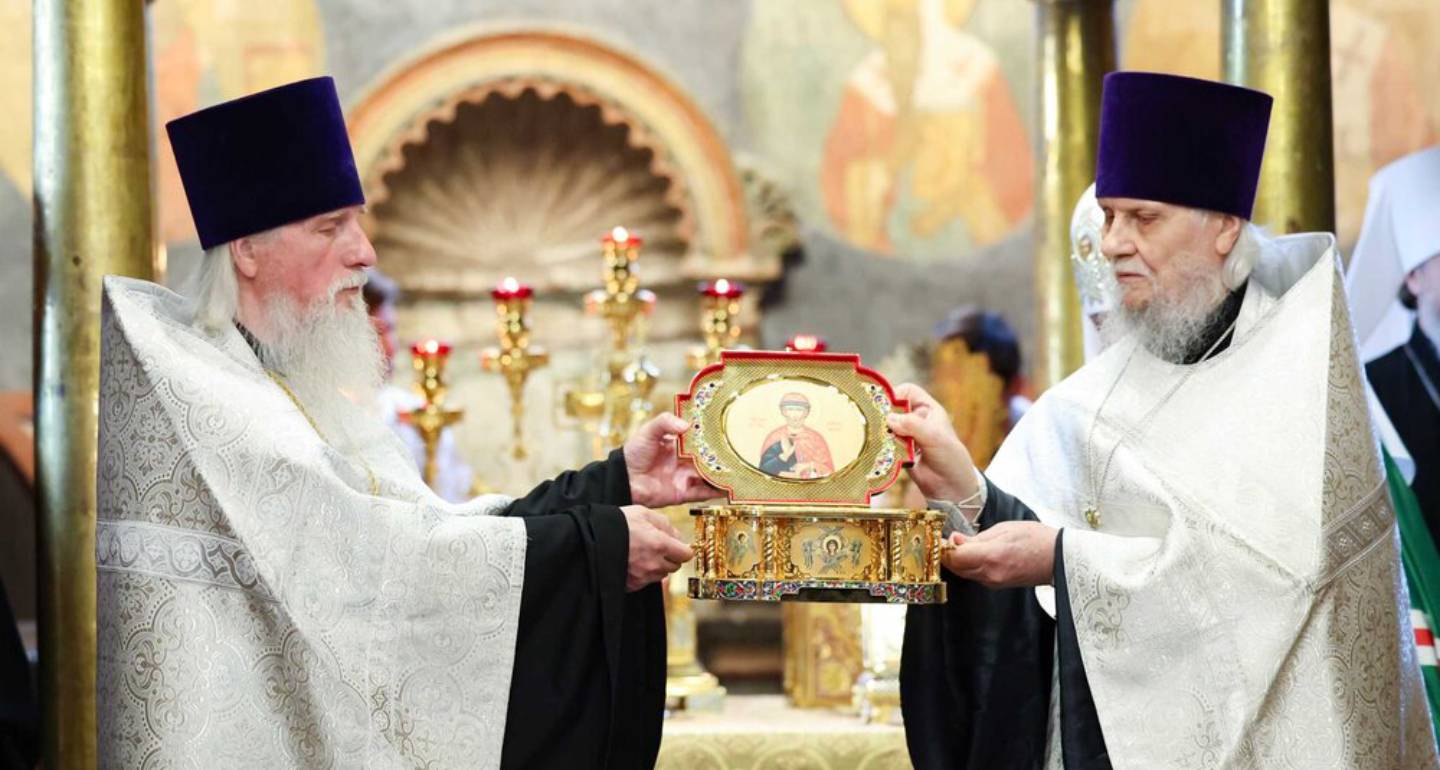
The recent uncovering of Dmitry Donskoy’s relics in the Cathedral of the Archangel is yet another attempt by the Russian Orthodox Church to help the state solve its problems. However, parroting the state’s version of Russian history leaves the Church with no message except “patriotism.”
Alexander Zanemonets

With the growth in points of friction between the great powers, organizations like the SCO will continue to play a role in the strategic adaptation of the smaller powers caught between them.

Temur Umarov