

Commentary
Alexander Gabuev
{
  "authors": [
    "Alexander Gabuev"
  ],
  "type": "legacyinthemedia",
  "centerAffiliationAll": "",
  "centers": [
    "Carnegie Endowment for International Peace",
    "Carnegie Russia Eurasia Center"
  ],
  "collections": [],
  "englishNewsletterAll": "",
  "nonEnglishNewsletterAll": "",
  "primaryCenter": "Carnegie Endowment for International Peace",
  "programAffiliation": "",
  "programs": [],
  "projects": [],
  "regions": [
    "Middle East",
    "Türkiye",
    "Syria",
    "Russia"
  ],
  "topics": [
    "Security",
    "Military",
    "Foreign Policy"
  ]
}
Source: Getty
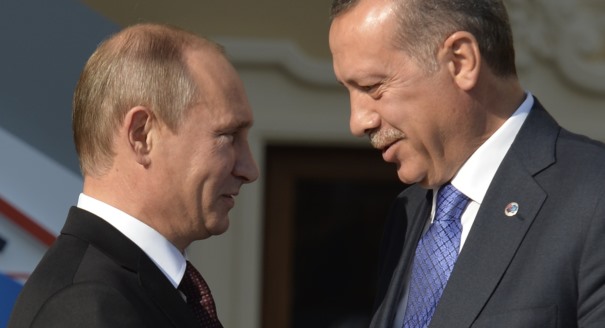
The conflict between Moscow and Ankara may make it difficult to reach an agreement on a future political settlement in Syria and further diminish the chances of a meaningful anti-terrorism alliance between Russia and the West.
Source: Global Times
The most popular picture on the Russian Internet these days is a Photoshopped image of US President Barak Obama calling Russian President Vladimir Putin. "What did you have for Thanksgiving, Vladimir?" "Turkey!" That was one of many ways Russians reacted to the hottest military and political crisis in relations between Moscow and Ankara over two decades and the most dangerous encounter between Russian and NATO forces since the end of the Cold War.
On November 24, the Turkish F-16 fighter jet downed the Russian Su-24 bomber, which was on a mission in northern parts of Syria. Accounts on what has actually happened during the short encounter differ, including whether the plane was warned and whether it violated Turkish airspace for a brief time. What isn't disputed is that one of the pilots was shot by rebels while parachuting out, while the other escaped and was rescued after an operation that cost the life of another Russian marine.
Immediately after the incident was reported many have feared that it may lead to a military escalation.It was the first time since the end of the Cold War that a NATO member country has shot down a Russian military plane. Ankara's initial reaction to call an emergency meeting of NATO only fueled these fears. The risks were most probably overstated. The USSR-NATO relationship saw more dangerous encounters in the air, which didn't end in World War III.
But the complicated regional, geopolitical, and emotional context means the incident has still had a serious impact. The Russian forces in Syria, according to the official Kremlin line, are fighting the Islamic State (IS) and international terrorism.
On the ground the face of terrorism looks much more diverse than just IS. Russia is targeting different radical groups that contain large numbers of Russian citizens (mostly Sunnis from the Northern Caucasus) or pose direct threat to the regime of Syrian President Bashar al-Assad, Moscow's ally.
Turkey is pursuing its own complicated strategy in Syria, which includes supporting the Turkoman minority, fighting Kurds and the Assad regime, countering the growing Iranian influence in the region and trying to maintain a temporary unofficial arrangement with Sunni radicals including IS, under which Turkey won't engage them militarily and allow illegal oil sales through its territory as long as radicals are fighting joint enemies, namely Kurds and Shiites.
The domestic agendas of the leaders are also an important addition to this dangerous mix of contradictions. Turkish President Recep Erdogan promotes strong nationalist agenda at home. For him supporting Turks in Syria is no less important than Putin supporting ethnic Russians in eastern Ukraine.
After the Russian air strike campaign in northern Syria started, Turkey warned Moscow several times, shot down a Russian drone and reprimanded the Russian ambassador, but the Kremlin stayed on course. So Moscow and Ankara were doomed to collide; it was just a question of time.
So far the Russian response to the incident hasn't included any military component. Besides bringing S-400 air defense systems to Syria and plans to add more fighter jets to accompany Russian bombers. The reaction was limited to economic warfare: a ban on imports (mostly food) from Turkey, travel bans, and plans to introduce visa regime and go after Turkish investors and workers in Russia.
The trade volume between the two countries was $44 billion last year, so both will be on the losing side. Considering the irreconcilable contradictions in Moscow's and Ankara's goals in Syria, the importance of domestic support for both Erdogan and Putin and the culture of "political machismo" on both sides, even if the aftermath of the incidents is settled, the relationship between Russia and Turkey is unlikely to return to business as usual.
The West will try not to choose sides. NATO will support Turkey only if it is directly attacked by Russia, otherwise many European leaders openly disapprove Erdogan's domestic course and privately complain about his aggressive handling of the incident. Still the conflict may make it even more difficult to reach an agreement of future political settlement in Syria. Thus the chances of a meaningful anti-terrorism alliance between Russia and the West, which were small from the onset, will get even smaller.

Director, Carnegie Russia Eurasia Center
Alexander Gabuev is director of the Carnegie Russia Eurasia Center. Gabuev’s research is focused on Russian foreign policy with particular focus on the impact of the war in Ukraine and the Sino-Russia relationship. Since joining Carnegie in 2015, Gabuev has contributed commentary and analysis to a wide range of publications, including the Financial Times, the New York Times, the Wall Street Journal, and the Economist.
Recent Work
Alexander Gabuev
Alexander Gabuev
Carnegie does not take institutional positions on public policy issues; the views represented herein are those of the author(s) and do not necessarily reflect the views of Carnegie, its staff, or its trustees.
A leak of Russian gas price data helps establish that China is paying Russia far less than Central Asian countries and Gazprom’s former European customers.

Sergey Vakulenko

Japan’s long-term security policy is driven by concerns about China, and there is little appetite for (or interest in) pursuing a confrontation with Moscow.

James D.J. Brown

The truth of the strategic situation is that Europe and Russia are extremely unlikely to be able to “turn the page” on their confrontation within the next two decades.

Arkady Moshes

Russia spent years building a “sovereign internet,” concentrating web infrastructure exclusively within Russian territory. Ukrainian drone attacks have shown how vulnerable that approach has left the Russian internet.

Maria Kolomychenko

Putin’s conservative staffing policies and search for ever greater control have cemented parliament’s transformation into a bureaucratic appendage of the executive branch.

Andrey Pertsev