

Article
C. Raja Mohan, Darshana M. Baruah
{
  "authors": [
    "C. Raja Mohan"
  ],
  "type": "legacyinthemedia",
  "centerAffiliationAll": "dc",
  "centers": [
    "Carnegie Endowment for International Peace",
    "Carnegie India"
  ],
  "collections": [],
  "englishNewsletterAll": "ctw",
  "nonEnglishNewsletterAll": "",
  "primaryCenter": "Carnegie India",
  "programAffiliation": "SAP",
  "programs": [
    "South Asia"
  ],
  "projects": [],
  "regions": [
    "South Asia",
    "Pakistan",
    "India"
  ],
  "topics": [
    "Foreign Policy",
    "Security"
  ]
}
Source: Getty
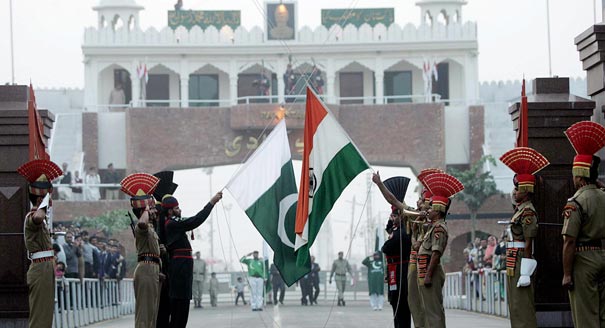
Few thought Prime Minister Modi would put religion and culture into the diplomatic mix with Pakistan. He has sprung a surprise.
Source: Indian Express
Some have called it “dargah diplomacy”; you could also describe it as the trans-border politics of pilgrimage. By whatever name it goes, the welcome emphasis on “religious tourism” is one of the more interesting features of renewed engagement between India and Pakistan. Religious tourism figured explicitly as one of the 12 elements identified in the “comprehensive dialogue” announced by External Affairs Minister Sushma Swaraj during her visit to Pakistan earlier this month. It was also part of the joint statement issued after the talks between Prime Ministers Narendra Modi and Nawaz Sharif in Ufa in July.
Access to holy sites across the borders was not a major issue for the devout millions of the subcontinent in the immediate aftermath of Partition. It became one as the borders began to close after the 1965 and 1971 wars and travel across the divided land became increasingly difficult. Since then, there have been frequent efforts to make it easy for pilgrims to travel as part of a broader commitment to promote people-to-people exchanges. The NDA government led by Atal Bihari Vajpayee and Nawaz Sharif, who was in his second tenure as Pakistan’s PM, contributed by launching the Delhi-Lahore bus service in 1999.Manmohan Singh’s UPA government expanded the list of border crossings with new bus services between Amritsar and Nankana Sahib across the Punjab border and between Srinagar and Muzaffarabad across the Line of Control in Jammu and Kashmir.
Governments in Islamabad, too, were sensitive to the diplomatic possibilities that religious tourism offered. At the height of the peace process between India and Pakistan during 2004-07, Pakistan’s president, Pervez Musharraf, ordered the restoration of the Katasraj temples in Chakwal district of West Punjab.
The most recent Pakistani leader to visit Ajmer Sharif was then President Asif Ali Zardari in 2012. Earlier, former External Affairs Minister Jaswant Singh had travelled to Balochistan to visit the Hinglaj Mata temple in 2006. In May this year, the Pakistan government sent holy water from the Katasraj temple to BJP leader L.K. Advani, probably to remind him of his own visit to these temples in 2005.
The UPA government had negotiated a significant agreement on visa liberalisation in 2012, but its implementation has been held back amid mounting tensions on the border.
For Modi, though, promoting people-to-people contact, especially through pilgrimage, has been at the very centre of his energetic diplomacy in the neighbourhood and beyond. Modi’s unapologetic personal religiosity appears to complement his special devotion to religious tourism. The PM chose the auspicious first Monday of the month of Shravan, in August 2014, to offer prayers at the Pashupatinath temple in Kathmandu. He meditated at a Buddhist temple in Kyoto during his visit to Japan last year and promoted the International Day of Yoga at the United Nations.
Recognising the importance of tourism in boosting economic growth, Modi has sought to develop the Buddhist and Ramayana circuits across the India-Nepal border and with Sri Lanka. Buddhism has figured prominently in India’s engagement with a range of countries from Mongolia to Myanmar and China to Cambodia.
While the Hindu-Buddhist template seemed natural for the PM, few were willing to bet that Modi would put religion and culture into the diplomatic mix with Pakistan. But the PM has surprised his critics, who find it hard to believe that Modi can be a champion of India’s syncretic religious culture.
A news report over the weekend said that the NDA government has cleared an invitation to Shahbaz Sharif, chief minister of Pakistani Punjab and younger brother of premier Nawaz Sharif, to attend the annual Urs celebrations of the 14th-century Sufi saint, Hazrat Nizamuddin Auliya, next month.
In the last few months, Modi has often argued that the Sufi tradition is the best antidote to terrorism and extremism in the subcontinent. In August, he met a group of Muslim scholars and underlined the special role of Sufi saints in building India’s cultural ethos. In his address to the diaspora at Wembley stadium in London last month, Modi talked of the subcontinent’s “Ram-Rahim” culture. In his last trip to Srinagar a few days later, Modi highlighted Kashmir’s special bonds with the Sufi tradition.
Thanks to the work done by previous governments led by Vajpayee and Manmohan Singh, Modi has a good shot at quick cross-border arrangements for expanded religious and cultural contact between India and Pakistan. One hopes that Shahbaz Sharif will accept the invitation from the Nizamuddin Dargah and join the celebrations to mark the union between Delhi’s patron saint and the almighty. Modi and the Sharif brothers need all the blessings they can get to sustain the very accident-prone peace process between India and Pakistan.
Former Nonresident Senior Fellow, Carnegie India
A leading analyst of India’s foreign policy, Mohan is also an expert on South Asian security, great-power relations in Asia, and arms control.
Recent Work

C. Raja Mohan, Darshana M. Baruah


Alexander Gabuev, Paul Haenle, C. Raja Mohan, …
Carnegie does not take institutional positions on public policy issues; the views represented herein are those of the author(s) and do not necessarily reflect the views of Carnegie, its staff, or its trustees.

Cargo traffic through Russia’s Northern Sea Route has increased because of the disruption caused by the conflict in the Middle East, the Ukraine war, and U.S.-China tensions.

Mikhail Korostikov

The European far right might fail to steer EU policy in the direction Russia wants, but they will create enough chaos inside Europe to benefit the Kremlin.

Dimitar Bechev

Minsk clearly expected the dialogue with Washington to yield more results, in particular the lifting of EU sanctions and permission to export potash.

Artyom Shraibman

With the growth in points of friction between the great powers, organizations like the SCO will continue to play a role in the strategic adaptation of the smaller powers caught between them.

Temur Umarov

When faced with fuel shortages in the past, Central Asian governments could always count on additional supplies from Moscow. That safety net no longer exists.

Galiya Ibragimova