

Article
C. Raja Mohan, Darshana M. Baruah
{
  "authors": [
    "C. Raja Mohan"
  ],
  "type": "legacyinthemedia",
  "centerAffiliationAll": "dc",
  "centers": [
    "Carnegie Endowment for International Peace",
    "Carnegie India"
  ],
  "collections": [],
  "englishNewsletterAll": "ctw",
  "nonEnglishNewsletterAll": "",
  "primaryCenter": "Carnegie India",
  "programAffiliation": "SAP",
  "programs": [
    "South Asia"
  ],
  "projects": [],
  "regions": [
    "South Asia",
    "India",
    "Pakistan"
  ],
  "topics": [
    "Foreign Policy",
    "Security"
  ]
}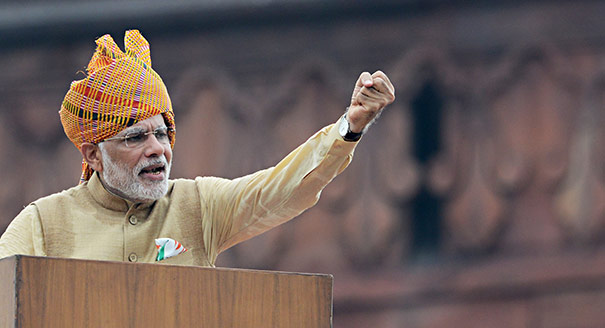
Source: Getty
Although India has increasingly reached out to its overseas community, it has not yet considered the massive stock of South Asian diaspora as a composite entity with many shared interests.
Source: Indian Express
The recent discussion on ‘Akhand Bharat’, or ‘undivided India’ had focused almost entirely on the implications of the idea for the rights of religious minorities in India and Delhi’s relationship with its neighbours. But there is a global dimension to ‘Akhand Bharat’ that hardly figures in the discourse.
If the slogan of ‘Akhand Bharat’ is associated with Hindu nationalism, the idea of the Subcontinent’s cultural unity has a much wider appeal and the hopes for overcoming the bitter consequences of the region’s Partition in 1947 are reinforced by powerful trends of economic globalisation and regional institution building.The different variations on the theme of South Asian unity are complemented by two ideas that are even more expansive — one old and the other new. The older one is the imagination of a ‘Greater India’ that transcends the Subcontinent. As India began to ‘discover’ itself two centuries ago, it also stumbled upon the Subcontinent’s cultural influence that spread through the millennia across the Indian Ocean littoral.
The newer one is the rapidly expanding international footprint of the Subcontinent. The globalisation of India under the British Raj saw the massive movement of labour from the Subcontinent to the far corners of the world in the 19th and 20th centuries. In recent decades, those trends have gathered fresh momentum.
A report issued last week by the United Nations noted the scale and scope of the Subcontinent’s global presence. India’s migrant population, according to the report, has grown at the brisk pace of 60 per cent over the last decade to become the world’s largest stock of migrants. India stood third in 2005 with a migrant population of 9.5 million. In 2015 it rose to the top with 15.5 million.
The picture becomes even more interesting if we put on the South Asian lens. Among the major sources of international migration, Bangladesh stands fifth with 7.2 million, Pakistan sixth with 5.9 million and Afghanistan eleventh with 4.8 million. To complete the frame add the migrant populations of nearly 2 million each from Sri Lanka and Nepal.
While we must discount some intra-regional migration within South Asia, we are talking about a total South Asian migrant population of nearly 38 million. The UN report on migration does not include the people of South Asian origin around the world. It counts only those living outside the country of their birth. If we include all of them, we are staring at nearly fifty million people of South Asian descent outside the Subcontinent.
Although India and its neighbours have increasingly reached out to their respective overseas communities, none of them have viewed the massive stock of South Asian diaspora as a composite entity with many shared interests. In fact, competitive mobilisation of overseas communities by India and Pakistan in pursuit of their foreign policy objectives has often diminished them both, for example in North America and the Anglo-sphere.
Prime Minister Narendra Modi might be in a position to change that by combining two important elements of his diplomacy — the extraordinary emphasis on mobilising the diaspora for national development and the priority for improving relations with the neighbours.
One way of doing it is to include the leaders of diasporas from neighbouring countries in Delhi’s current intensive outreach to its own overseas community. Another is to associate the Subcontinent’s diaspora with the joint economic work and cultural activity of the South Asian Association for Regional Cooperation (SAARC) and other sub-regional forums like the BBIN initiative that brings Bhutan, Bangladesh, India and Nepal together.
As a collective the South Asian diaspora can boost the larger goals that India and its neighbours have set for themselves on improving physical, economic and cultural connectivity within the Subcontinent. One day, in the not too distant future, the ‘Global South Asia’ might even become a force for peace and political reconciliation within the Subcontinent that is hobbled by multiple conflicts. But the first steps must necessarily come from within the region.
Former Nonresident Senior Fellow, Carnegie India
A leading analyst of India’s foreign policy, Mohan is also an expert on South Asian security, great-power relations in Asia, and arms control.
Recent Work

C. Raja Mohan, Darshana M. Baruah

Alexander Gabuev, Paul Haenle, C. Raja Mohan, …
Carnegie does not take institutional positions on public policy issues; the views represented herein are those of the author(s) and do not necessarily reflect the views of Carnegie, its staff, or its trustees.

The new Serbian leadership may have promised to keep on cooperating with Russia, but soon they will have to make a choice between fighting corruption and sealing lucrative deals with Moscow. The two are mutually exclusive, even if the new leaders in Belgrade haven’t yet realized it.
Maksim Samorukov
Japan’s long-term security policy is driven by concerns about China, and there is little appetite for (or interest in) pursuing a confrontation with Moscow.

James D.J. Brown
The truth of the strategic situation is that Europe and Russia are extremely unlikely to be able to “turn the page” on their confrontation within the next two decades.
Arkady Moshes

Russia’s AI-driven propaganda campaigns operate in a fragmented, chaotic, and often illogical manner. That’s not necessarily a problem for the Kremlin, though: It’s much easier to mimic genuine public debate that way.

Ilya Klishin
Without a ceasefire with Ukraine on attacking each other’s energy infrastructure—to which the Kremlin is unlikely to agree—the diesel agreement between Putin and Trump is largely for show, rather than representing a genuine increase in the volumes of Russian diesel on the global market.

Sergey Vakulenko