

Research
- +5
Alper Coşkun, Fatih Ceylan, Tacan İldem, …
{
  "authors": [
    "Sinan Ülgen"
  ],
  "type": "legacyinthemedia",
  "centerAffiliationAll": "dc",
  "centers": [
    "Carnegie Endowment for International Peace",
    "Carnegie Europe"
  ],
  "collections": [
    "Turkey’s Transformation",
    "EU Integration and Enlargement"
  ],
  "englishNewsletterAll": "ctw",
  "nonEnglishNewsletterAll": "",
  "primaryCenter": "Carnegie Europe",
  "programAffiliation": "EP",
  "programs": [
    "Europe"
  ],
  "projects": [],
  "regions": [
    "Europe",
    "Türkiye",
    "Middle East",
    "Western Europe",
    "Iran"
  ],
  "topics": [
    "EU",
    "Foreign Policy"
  ]
}
Source: Getty
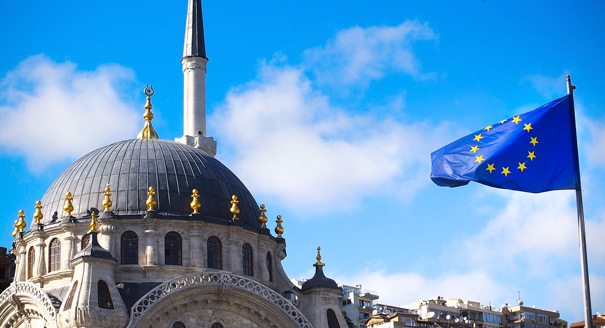
There is an acute need for a new European narrative for Turkey. Such a framework should create a new platform of cooperation and complement the country’s EU accession path.
Source: Anadolu Agency
The botched coup of July was a turning point for Turkey’s democracy. A rapid and united stance against military intervention saved the country’s democratic future. Unlike in such past tragedies, Turks were able to witness a massive majority standing up against the coup attempt.
This moment of unity was then translated into a political coalition to jointly address the threat emanating from the infiltration of the state and the military by the Fetullah Gulen network.
Yet the perceived lack of Western support and empathy in the face of this genuine threat to Turkey’s domestic order and stability threatens to erode mutual trust in a way that could have significant implications for Turkey’s relationship with its partners in the West.
Since the coup attempt, President Recep Tayyip Erdogan has met with only two of his counterparts, the presidents of Kazakhstan and Russia. No high-level Western leader decided to travel to Turkey to demonstrate solidarity with the Turkish body politic.
Even parliamentary diplomacy was at a loss. At a time when the Turkish parliament was directly targeted by the coup-makers, inter-parliamentary solidarity was conspicuously absent. Even the normally more pro-active European Parliament failed to set up a delegation to visit their embattled Turkish counterparts.
Turkish people definitely expected and deserved more than this demonstration of apathy.
They expected a principled stance against a clear military intervention threatening the rule of a democratically elected government. Having failed this test, Western states and institutions will inevitably and justifiably be exposed to claims of hypocrisy.
Their possibly quite legitimate criticism about the erosion of checks and balances and democratic standards will fall on deaf ears. In a way, by failing this test of sincerity, the West has eroded its ability to gain influence in Turkey at a time when this leverage is possibly more important than ever.
The lessons from Turkey’s democratic advancement in the past decade are clear. The most ambitious reforms were carried out in a political environment where the incentive to join the EU were tangible.
The growing frustration and disillusionment with the European project has certainly been detrimental to Turkey’s democratic progress.
This does not mean that Turkey has been or shall be unable to improve its democratic standards without the carrot of EU membership. But it means that the Turkish political class was more able to overcome the vested interests and atavistic alliances blocking the path to a better democracy when the EU membership goal was tangible.
Against the backdrop of the recent events, the question that may indeed determine the shape of Turkey’s relations with Europe in particular is whether the relationship can be revitalized at a time when the accession objective has fully become devoid of credibility.
We have certainly moved beyond the point where apportioning blame for this failure would be relevant for policy making. It is time for Turkish as well as European leaders to acknowledge this failure.
For instance, a European country that wants to introduce capital punishment should rightly be criticized but the threat to suspend EU negotiations with Turkey is not the right message at a time when the accession goal seems beyond rescue.
There is an acute need for recreating a European narrative for Turkey.
This is the only way forward to keep a Turkey that is facing a multiplicity of domestic and security challenges well anchored in the Western community of nations. The new narrative should not necessarily come in lieu of the accession objective. But it should create a new platform of cooperation that would complement the accession path.
It should also be reasonably ambitious and comprehensive to provide for a convergence of norms and interests. The refugee deal, provided that it can be maintained, can, for instance, become a key component of this new collaborative endeavor.
Economic integration, counter-terrorism cooperation and a broader participation in joint European programs may constitute other important pillars of this framework of “virtual” membership.
Paradoxically, Brexit may have opened a window to this type of future. In a post-Brexit world, the U.K. and the EU will need to devise a new relationship that will strive to combine single market access for the U.K. with sustainable and politically acceptable decision-shaping rules.
To the extent that London and Brussels are able to devise such a framework, Ankara may be the first external beneficiary of this novel paradigm.
The emergence of this more realistic prospect of convergence with Europe would also fulfill an important domestic objective.
It can be used to sustain the current moment of political unity. Just like in the early years of the Justice and Development (AK) Party government, a more inclusive political agenda can be shaped on the basis of this reformed approach to Europe, allowing for a faster transition to normalcy and stability in this key member of the transatlantic community.

Senior Fellow, Carnegie Europe
Sinan Ülgen is a senior fellow at Carnegie Europe in Brussels, where his research focuses on Turkish foreign policy, transatlantic relations, international trade, economic security, and digital policy.
Recent Work

Alper Coşkun, Fatih Ceylan, Tacan İldem, …
Carnegie does not take institutional positions on public policy issues; the views represented herein are those of the author(s) and do not necessarily reflect the views of Carnegie, its staff, or its trustees.

If the Russian-speaking community in Latvia cannot articulate their interests without being seen as disloyal, they could end up embracing a pro-Kremlin agenda.

Sergejs Potapkins

With the growth in points of friction between the great powers, organizations like the SCO will continue to play a role in the strategic adaptation of the smaller powers caught between them.

Temur Umarov

When faced with fuel shortages in the past, Central Asian governments could always count on additional supplies from Moscow. That safety net no longer exists.

Galiya Ibragimova

Andrey Melnichenko’s essay offers no answer to the fundamental question of how, under any kind of negotiated settlement, Europe can protect itself from the Russian ressentiment that is inevitable in all scenarios except for an outright victory for Putin.

Leonid Bershidsky

Despite unhappiness on the ground, Moscow is determined to use both carrot and stick to ensure there is record support for United Russia in occupied Ukraine.

Konstantin Skorkin