

Paper
Constantino Xavier
{
  "authors": [
    "Constantino Xavier"
  ],
  "type": "other",
  "centerAffiliationAll": "dc",
  "centers": [
    "Carnegie Endowment for International Peace",
    "Carnegie India"
  ],
  "collections": [],
  "englishNewsletterAll": "ctw",
  "nonEnglishNewsletterAll": "",
  "primaryCenter": "Carnegie India",
  "programAffiliation": "SAP",
  "programs": [
    "South Asia"
  ],
  "projects": [],
  "regions": [
    "South Asia",
    "India"
  ],
  "topics": [
    "Foreign Policy",
    "Security"
  ]
}
Source: Getty
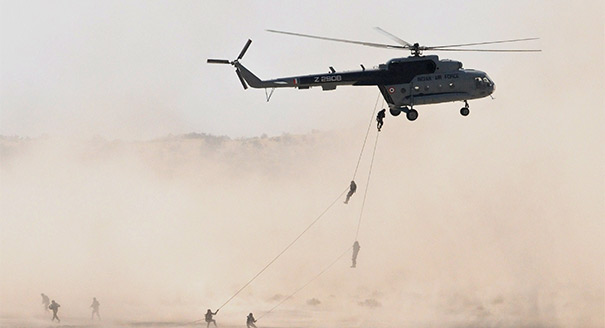
To ensure the safety of Indians abroad, the Indian armed forces will have to develop specific doctrines, procedures and capabilities to deploy expeditionary forces in coordination with civilian authorities.
Source: Force
Over the last few decades, the Indian government conducted dozens of emergency operations to protect and evacuate its distressed citizens abroad. When the lives and assets of overseas Indians are threatened due to war, natural calamities or discriminatory policies, New Delhi is expected to act swiftly and decisively.
As the Indian Diaspora grows in size, dispersion and complexity, and areas of major concentration like the Gulf region witness large-scale destabilisation, the government will have to expand its capacity and expertise to execute such missions. Most importantly, these missions cannot remain an almost exclusively civilian prerogative. While the ministry of external affairs (MEA) will continue to play a lead role, the Indian military must be roped in as a key stakeholder.
To ensure the safety of Indians abroad, the Indian armed forces will have to develop specific doctrines, procedures and capabilities to deploy expeditionary forces in coordination with civilian authorities. Especially in hostile and conflict environments, the Indian military will have to be prepared to use lethal power, including Special Forces, to protect and extricate emigrants....
Former Fellow, Carnegie India
Constantino Xavier was a fellow at Carnegie India, based in New Delhi. His research focus is on India’s foreign policy, with emphasis on relations with its neighboring countries and South Asian regional security.
Recent Work
Constantino Xavier
Constantino Xavier
Carnegie does not take institutional positions on public policy issues; the views represented herein are those of the author(s) and do not necessarily reflect the views of Carnegie, its staff, or its trustees.

With the growth in points of friction between the great powers, organizations like the SCO will continue to play a role in the strategic adaptation of the smaller powers caught between them.

Temur Umarov

When faced with fuel shortages in the past, Central Asian governments could always count on additional supplies from Moscow. That safety net no longer exists.

Galiya Ibragimova

Two divergent trends—Putin’s hardline vision of how to prosecute the war in Ukraine, and a growing desire for change in Russia—could tear the regime apart.

Tatiana Stanovaya
Andrey Melnichenko’s essay offers no answer to the fundamental question of how, under any kind of negotiated settlement, Europe can protect itself from the Russian ressentiment that is inevitable in all scenarios except for an outright victory for Putin.

Leonid Bershidsky

Despite unhappiness on the ground, Moscow is determined to use both carrot and stick to ensure there is record support for United Russia in occupied Ukraine.

Konstantin Skorkin