

Q&A
- +1
Sheena Chestnut Greitens, Oriana Skylar Mastro, Yukon Huang, …
{
  "authors": [
    "Yukon Huang"
  ],
  "type": "legacyinthemedia",
  "centerAffiliationAll": "dc",
  "centers": [
    "Carnegie Endowment for International Peace",
    "Carnegie China"
  ],
  "collections": [],
  "englishNewsletterAll": "asia",
  "nonEnglishNewsletterAll": "",
  "primaryCenter": "Carnegie China",
  "programAffiliation": "AP",
  "programs": [
    "Asia"
  ],
  "projects": [],
  "regions": [
    "East Asia",
    "China"
  ],
  "topics": [
    "Economy",
    "Political Reform",
    "Domestic Politics"
  ]
}
Source: Getty
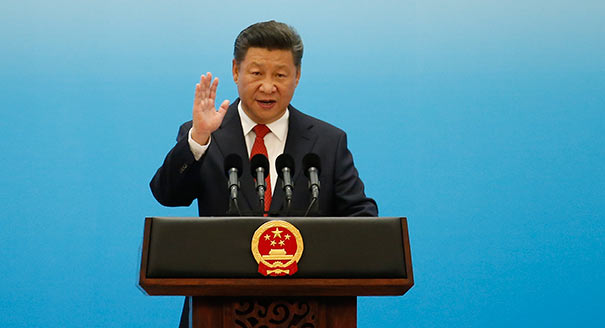
At the 19th Party Congress, Xi Jinping explained how China will move to the center to the world stage through modernization. Yet how Xi defines the roles of the state and the market remains unclear.
Source: Financial Times
As widely expected, China’s 19th Party Congress showcased Xi Jinping as the country’s most powerful leader since Mao Zedong and Deng Xiaoping. Of those two transformative leaders, one unified China and the other opened it to market forces. President Xi seeks to join their ranks through modernisation.
In his opening statement, Mr Xi elaborated on his vision of an increasingly prosperous China that is led by the party and moves to the centre of the world stage by following a two-stage modernisation process lasting to the middle of the century. This would reach further than just gross domestic product growth, incorporating greater concern for social wellbeing, regional balance, national security and political cohesion — done in a uniquely Chinese way.
The process would be guided by Mr Xi’s “Thought on Socialism with Chinese Characteristics for a New Era”, putting his ideological blueprint on the same pedestal as Mao’s and Deng’s, but with an externally oriented vision.
His concept of the “China or Asian Dream” signals that the country will no longer follow Deng’s admonition to “bide its time” but will take a more active role in global affairs. This is exemplified by his ambitious One Belt and One Road initiative launched in 2013, and more recently by Beijing assuming a leadership role on climate change and globalisation in response to America’s realigned priorities.
But on the domestic policy front, Mr Xi’s path is still being defined. His speech broadly reaffirmed a key message made in his 2013 third plenum policy statement that the market should play the “decisive” role in allocating resources but the state would take the “leading role” in the economy.
For outsiders, these two statements seem contradictory but not to the leadership. Such nuances mattered less when the economy was growing rapidly and the nation’s financial situation was judged to be stellar on global standards. But with the growth slowdown and S&P’s and Moody’s recent ratings downgrades, some observers — like the International Monetary Fund — have become nervous.
China’s aspirations to become a “moderately prosperous society” will be difficult to realise without tapping into new sources of productivity growth. Modernisation without continued material progress may not satisfy a rising middle class. In this respect, the 19th Party Congress statements did not offer much that was new from the reform statements of recent years.
This leaves unaddressed how China will deal with the ambiguities regarding the role of the state and the market in three important areas where growth is significantly affected: state-owned enterprises, urbanisation and corruption.
The slow haemorrhaging of the economy has been partly due to the sharp decline in profitability of SOEs. Mr Xi’s statement calls for more support for private firms but also for stronger and bigger state companies. This reinforces the view of many of the largest SOEs as national champions.
Thus far, Beijing has been pushing for the “soft” reform option in the form of diversifying SOE ownership. But more clarity is required on the sectors where there is no strong rationale for continued state involvement while preserving or even enhancing the role of the state in other areas.
A major growth driver in recent decades has been the movement of some 400m rural inhabitants to urban areas. Another 150m are likely to move over the next 10 years but the process needs to be more efficient and socially equitable.
The problem originates from the state’s control over labour migration through draconian residency requirements rather than allowing market forces and personal choice to shape such decisions. This has created a sub-class of migrant families lacking access to social services, and also reduced the potential growth benefits from urbanisation.
China’s planners believe that migrants should be channelled to small and medium-sized cities and barred from the largest ones. Some such initiatives have succeeded spectacularly, as with Shenzhen, but the economic rationale for this approach now is more questionable. As a recent World Bank report points out, this bias has an adverse impact on economic growth and works against the party’s vision of a more harmonious society.
Mr Xi’s opening statement highlighted his personal commitment to eradicating corruption — a necessary focus to restore a sense of social justice for the average citizen. He sees this as critical to preserving the legitimacy of the Communist party and sustaining growth. But these twin goals may be contradictory.
Conventional wisdom says corruption impedes growth because it dampens investment incentives. But China is different. The state controls all the major resources but rates of return are much lower for state-operated assets than for the private sector. Corruption has been the means informally to transfer the use rights of resources from state to private sector, since privatisation of ownership is not politically acceptable.
Curtailing corruption and sustaining growth might require removing the state from its dominant role in controlling certain economic activities. This explains why strengthening the rule of law over the behaviour of the state is given so much prominence in Congress statements.
To become China’s next transformative leader, Xi Jinping needs to find the right balance in allowing the market to play the “decisive” role envisaged in the statements while defining a different but still “leading” role for the party.
This article was originally published in the Financial Times.

Senior Fellow, Asia Program
Huang is a senior fellow in the Carnegie Asia Program where his research focuses on China’s economy and its regional and global impact.
Recent Work


Sheena Chestnut Greitens, Oriana Skylar Mastro, Yukon Huang, …


Yukon Huang, Isaac B. Kardon, Matt Sheehan
Carnegie does not take institutional positions on public policy issues; the views represented herein are those of the author(s) and do not necessarily reflect the views of Carnegie, its staff, or its trustees.
Russia spent years building a “sovereign internet,” concentrating web infrastructure exclusively within Russian territory. Ukrainian drone attacks have shown how vulnerable that approach has left the Russian internet.

Maria Kolomychenko

Putin’s conservative staffing policies and search for ever greater control have cemented parliament’s transformation into a bureaucratic appendage of the executive branch.

Andrey Pertsev

Russian strikes are weakening the economy sustaining Ukraine’s war effort. Closing the growing funding gap will require more European support and politically contentious reforms in Kyiv.

Balázs Jarábik

Ex-president Gurbanguly Berdimuhamedov remains interested in politics, but his son Serdar, Turkmenistan’s current president, is becoming increasingly independent and willing to break with his father’s legacy. If their covert rivalry goes too far, both risk losing power.

Galiya Ibragimova

For every ruble allocated to social policy, health, and education in 2027, double that amount is earmarked for the army, the police, and the security services.

Alexandra Prokopenko