

Report
- +2
George Perkovich, Jessica Tuchman Mathews, Joseph Cirincione, …
{
  "authors": [
    "Jon Wolfsthal"
  ],
  "type": "other",
  "centerAffiliationAll": "dc",
  "centers": [
    "Carnegie Endowment for International Peace"
  ],
  "collections": [
    "Korean Peninsula"
  ],
  "englishNewsletterAll": "ctw",
  "nonEnglishNewsletterAll": "",
  "primaryCenter": "Carnegie Endowment for International Peace",
  "programAffiliation": "NPP",
  "programs": [
    "Nuclear Policy"
  ],
  "projects": [],
  "regions": [
    "East Asia",
    "North Korea"
  ],
  "topics": [
    "Nuclear Policy"
  ]
}
Source: Getty
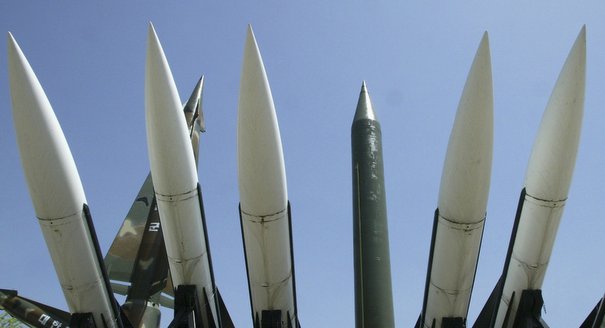
Despite spending tens of billions of dollars on missile defense over the last 30 years, the United States remains unable to shoot down North Korean ICBMs.
Source: Foreign Policy
I usually write longer, detailed essays for this column but today’s submission is simpler. And it has a simple message. Missile defense will not protect the United States from North Korean missiles. I know a lot of people think the opposite is true. Even President Donald Trump has asserted we have a 97 percent chance of shooting down a North Korean intercontinental ballistic missile (ICBM). But, as they say, “um, no.”
It would make sense for you to scratch your head and ask how can we have spent tens of billions of dollars over 30 years and still not be able to shoot down a couple of North Korea missiles. But, sorry, we can’t.
This is true for a whole host of reasons, but let’s get right to the chase. Our missile defenses don’t work all that well (better than they used to, but far from reliable and very far from perfect) and we don’t have very many of them. It is like the old joke about the married couple. The wife complains “the food at this restaurant is terrible!” To which her husband responds: “Yeah, and the portions are small, too.”
Current U.S. military planning would shoot four ground-based interceptors (GBIs) in Alaska or California at each incoming North Korean ICBM. Do the math. We shoot four at each incoming missile because each interceptor has about a 25 percent chance of working: i.e. hitting its target. And that assumes everything goes right. So far, however, little goes right for our GBIs and none have ever taken down an ICBM in a realistic, real-time, no-notice test. In fact, the reason the United States purchased so few GBIs in the Obama years is because the ones we had already purchased did not work all that well. Time and money were needed to fix major systemic problems. They’re better now, but still far from perfect.
This article was originally published in Foreign Policy

Former Nonresident Scholar, Nuclear Policy Program
Jon Wolfsthal was a nonresident scholar with the Nuclear Policy Program.
Recent Work



George Perkovich, Jessica Tuchman Mathews, Joseph Cirincione, …
Jon Wolfsthal
Carnegie does not take institutional positions on public policy issues; the views represented herein are those of the author(s) and do not necessarily reflect the views of Carnegie, its staff, or its trustees.

Tokyo would have to surmount a lot of obstacles—not least Western sanctions—if it wanted to return Russian oil imports to even modest pre-2022 volumes.

Vladislav Pashchenko
Troubled by the growing salience of nuclear debates in East Asia, Moscow has responded in its usual way: with condemnation and threats. But by exacerbating insecurity, Russia is forcing South Korea and Japan to consider radical security options.

James D.J. Brown
For Putin, upgrading Russia’s nuclear forces was a secondary goal. The main aim was to gain an advantage over the West, including by strengthening the nuclear threat on all fronts. That made growth in missile arsenals and a new arms race inevitable.

Maxim Starchak
The Kremlin will only be prepared to negotiate strategic arms limitations if it is confident it can secure significant concessions from the United States. Otherwise, meaningful dialogue is unlikely, and the international system of strategic stability will continue to teeter on the brink of total collapse.
Maxim Starchak
The collapse of the Budapest summit is an inevitable result of the Russian system of artificially creating foreign policy crises in order to achieve a desired outcome.

Alexander Baunov