

Q&A
Eugene Rumer
{
  "authors": [
    "Eugene Rumer"
  ],
  "type": "legacyinthemedia",
  "centerAffiliationAll": "dc",
  "centers": [
    "Carnegie Endowment for International Peace",
    "Carnegie Russia Eurasia Center"
  ],
  "collections": [],
  "englishNewsletterAll": "ctw",
  "nonEnglishNewsletterAll": "",
  "primaryCenter": "Carnegie Endowment for International Peace",
  "programAffiliation": "russia",
  "programs": [
    "Russia and Eurasia"
  ],
  "projects": [],
  "regions": [
    "North America",
    "United States",
    "Russia"
  ],
  "topics": [
    "Political Reform",
    "Foreign Policy"
  ]
}
Source: Getty
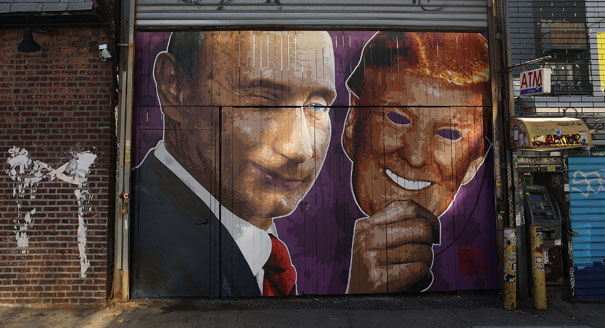
The national conversation about Russia in the United States has barely advanced. The more hysterical Americans get, the harder it will be for them to have that conversation.
Source: Los Angeles Times
We have developed a national obsession with Russia. Hardly a day goes by without many column inches and much airtime being devoted to yet another Russian transgression.
Our government has imposed sanctions on Russia, dispatched troops to its borders and sent weapons to Ukraine and Georgia. More sanctions are on the way, intended to punish those in the Russian elite who support President Vladimir Putin.
For all this, our national conversation about Russia — what we want from the debate, how to achieve it — has barely advanced. The more hysterical we get, the harder it will be for us to have that conversation.
We know that the Russian government and its agents interfered in our 2016 presidential election. The intelligence community has confirmed it, and there is plenty of unclassified evidence of the Kremlin's intent and actions: The anti-Clinton, pro-Trump bias in Russian state-sponsored media, including the RT television network, which was recently ordered by the U.S. government to register as a foreign agent; the Wikileaks releases of damaging, stolen information about the Clinton campaign; and Putin's positive comments about then-candidate Donald Trump and widely known dislike of Hillary Clinton.
We know about numerous contacts between the Trump camp and various Russian actors. Donald Trump Jr., Jared Kushner and former national security advisor Michael Flynn are just the most prominent Trump associates to have had contact with Russian representatives. Some of this contact may have been illegal, but that is for the investigators and, ultimately, the courts to determine.
And while our media deserve respect for covering the Trump campaign and presidency, most of what we know today has been known for the better part of a year. There is an occasional scintillating detail about the Trump camp, but these details add little to the overall picture the public has had for a long time.
In the meantime, our understanding of other, arguably more important aspects of Russian interference in the 2016 election has barely progressed.
We really don't know what actual effect all this Russian activity had on our election. To find out, we would need to do a comprehensive survey of all who voted and all who did not vote. Even if such a survey were possible, it would be difficult to get an accurate reading of 2016 voter attitudes now, especially considering the endless telling and retelling of the election story the public has been subjected to. The odds are we'll never know.
It's unclear, then, if Russia is even worth obsessing about in this manner. If Clinton could not prevail over a vulgar, dishonest, misogynist, ignorant political novice running a campaign full of racism, xenophobia and patently unrealizable promises, all of which were widely covered by the media throughout 2016, perhaps the Russian meddling really didn't make that much of a difference on the election outcome.
Resilience has become a buzzword; it's included in countless task force reports and policy papers on Russian cyberintrusions and information warfare. But we don't know whether we are better prepared today than we were a year ago to withstand future meddling in our elections.
We don't know whether our cyberdefenses, which were reportedly almost nonexistent at the state level, where our voting machinery resides, are any stronger today.
We don't appear to have made our public discourse more impervious to fake and distorted news. That is a long-term goal, one that will require better education and a far more sophisticated and nuanced national conversation about our place in the world, about Russia, and about our policy toward Russia.
We need to understand how we ended up in a new Cold War with Russia after declaring it our partner on many occasions over the last quarter-century. We should look at our record and ask ourselves whether we have done everything right, whether we have made any mistakes and how we might avoid repeating them in the future.
Russia is not going away. The country is not dying, as was often claimed in the 1990s and early 2000s. Its economy is not collapsing. Russia's military has made a comeback, and the Kremlin has employed it with skill and determination.
Russia is an important actor on the world stage with interests and capabilities that we have yet to fully appreciate. Putin is poised to be reelected in March for another six-year term. Even if he departs the scene before 2024, we should not count on his successor to become our friend. Sanctions are no substitute for effective policy.
A few decades ago, when Russia was weak, it was fashionable to think that Russia did not matter. Clearly, this is no longer the case. That's what our national conversation should be about. Let's leave the 2016 election to the investigators.
This article was originally published by the Los Angeles Times.
Director and Senior Fellow, Russia and Eurasia Program
Rumer, a former national intelligence officer for Russia and Eurasia at the U.S. National Intelligence Council, is a senior fellow and the director of Carnegie’s Russia and Eurasia Program.
Recent Work
Eugene Rumer
Eugene Rumer
Carnegie does not take institutional positions on public policy issues; the views represented herein are those of the author(s) and do not necessarily reflect the views of Carnegie, its staff, or its trustees.

Russia spent years building a “sovereign internet,” concentrating web infrastructure exclusively within Russian territory. Ukrainian drone attacks have shown how vulnerable that approach has left the Russian internet.

Maria Kolomychenko

Putin’s conservative staffing policies and search for ever greater control have cemented parliament’s transformation into a bureaucratic appendage of the executive branch.

Andrey Pertsev

Russia’s AI-driven propaganda campaigns operate in a fragmented, chaotic, and often illogical manner. That’s not necessarily a problem for the Kremlin, though: It’s much easier to mimic genuine public debate that way.

Ilya Klishin

Without a ceasefire with Ukraine on attacking each other’s energy infrastructure—to which the Kremlin is unlikely to agree—the diesel agreement between Putin and Trump is largely for show, rather than representing a genuine increase in the volumes of Russian diesel on the global market.

Sergey Vakulenko

Russian strikes are weakening the economy sustaining Ukraine’s war effort. Closing the growing funding gap will require more European support and politically contentious reforms in Kyiv.

Balázs Jarábik