

Commentary
Cornelius Adebahr
{
  "authors": [
    "Cornelius Adebahr"
  ],
  "type": "legacyinthemedia",
  "centerAffiliationAll": "dc",
  "centers": [
    "Carnegie Endowment for International Peace",
    "Carnegie Europe"
  ],
  "collections": [
    "Europe’s Southern Neighborhood"
  ],
  "englishNewsletterAll": "ctw",
  "nonEnglishNewsletterAll": "",
  "primaryCenter": "Carnegie Europe",
  "programAffiliation": "EP",
  "programs": [
    "Europe"
  ],
  "projects": [],
  "regions": [
    "Middle East",
    "Europe",
    "North America",
    "United States",
    "Iran"
  ],
  "topics": [
    "Foreign Policy"
  ]
}
Source: Getty
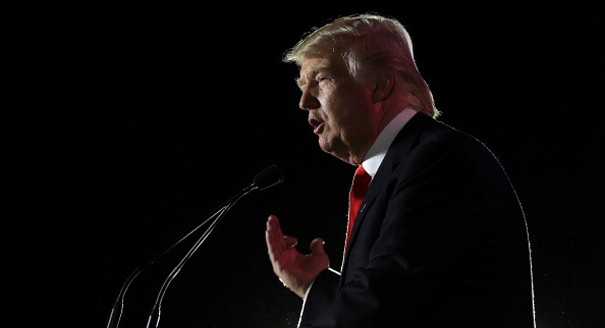
Policy watchers have to understand that their traditional methods of analysis do not count anymore. Whatever the issue, the U.S. president’s response is: me.
Source: Global Policy Journal
Whatever the issue, the US president’s response is: me. Whether it is about Iran or North Korea, trade with China or Mexico – policy watchers have to understand that their traditional methods of analysis do not count anymore. The vanity and business interests of the man at the top have taken over the national interest (always hard to define), institutional infighting, and partisan politics.
More than at any time in history, the world’s fate hinges on the decisions of a single person, and a very bullish one at that. He certainly enjoys this fact, as do his supporters in the United States, to whom he appears as a savior. No matter that, to the rest of the world, he looks more like a savage.Iran is a case in point, even though one could pick any foreign policy issue and run it through the egomaniac formula with the same result. Here’s the beef: It does not matter that the nuclear deal of 2015 is working to prevent Iran from acquiring a bomb for as long as it is in place; what counts is that the US president hates it for very personal – not even domestic – reasons. Whatever else happens, whether Tehran provides missiles to the Houthis in Yemen or Iran’s ally Assad gasses his own people, hardly gets addressed in its own right. It mostly serves to strengthen his views and that of the people around him.
This makes it so hard for America’s partners to actually pursue a policy. Taking the issues seriously that he raised in his January ultimatum in order to find a workable compromise is futile when his final decision depends on his disposition of the day or whomever he spoke to last. Prime Minister Netanyahu of Israel demonstrated his understanding of this when he presented well-known, warmed up evidence of Iran’s nuclear program to the world as ‘breaking news’ of Iranian cheating – trying to swing the mood of his intended audience-of-one.
The Europeans are particularly bad at playing this game. First, because they do not see it as a game to play, but as something serious. They are not only concerned with the security situation around the Persian Gulf and the Levant, which has more immediate effects on life in Europe than in the United States – witness how the continent is still struggling with the consequences of the 2003 invasion of Iraq. They also believe in diplomatic – i.e. commonly agreed, multilateral – solutions to violent conflict. That is what you do when you no longer have the might to rule empires in far-flung places and instead depend on other superpowers being tamed by binding rules.
Oh, and the European Union still consists of 28 member states that have to agree on foreign policy issues. This can be difficult on any given issue, say, crisis management in the Sahel or arms exports to Saudi Arabia. Yet it gets entirely vexed when each country’s perceived ‘special relationship’ with Washington is at stake. Do not expect them to take a forceful stance – collectively, that is, not just by their chief diplomat, Federica Mogherini – unless they really have to (i.e. not before May 12). Any even then, it is far from assured.
Still, there is hope. More than one year into his first term, President Trump has not taken the fateful, consequential decisions many have feared. He still may do so any day, no doubt, but here is another catch: We really cannot know how to prevent this. Or why exactly did he extend the tariff waivers to Europeans by another month? Instead, his pattern seems to be the opposite of Roosevelt’s maxim: He speaks loudly to hide the fact that his stick is so small.
So what to do? Do what you would do with a bully at school: Mind your own business and ignore him as much as you can. (Alas, US citizens cannot do that in the same way.) This means policy makers – and analysts – should shed their indignation and focus on their (country’s) interests.
By giving him attention, we are all feeding the egomaniac. Instead, we ought to prepare to deal with the problems ourselves. For the Europeans, this is a hard lesson to learn. Their Iran policy is a good place to start.
Former Nonresident Fellow, Carnegie Europe
Cornelius Adebahr was a nonresident fellow at Carnegie Europe. His research focuses on foreign and security policy, in particular regarding Iran and the Persian Gulf, on European and transatlantic affairs, and on citizens’ engagement.
Recent Work
Cornelius Adebahr

Cornelius Adebahr, Barbara Mittelhammer
Carnegie does not take institutional positions on public policy issues; the views represented herein are those of the author(s) and do not necessarily reflect the views of Carnegie, its staff, or its trustees.

Cargo traffic through Russia’s Northern Sea Route has increased because of the disruption caused by the conflict in the Middle East, the Ukraine war, and U.S.-China tensions.

Mikhail Korostikov

Trump has promised Belarus a massive potash deal. But Minsk is seeking something greater: restored Western transit and greater room for maneuver from Russia.

Balázs Jarábik

The European far right might fail to steer EU policy in the direction Russia wants, but they will create enough chaos inside Europe to benefit the Kremlin.

Dimitar Bechev

Minsk clearly expected the dialogue with Washington to yield more results, in particular the lifting of EU sanctions and permission to export potash.

Artyom Shraibman

If the Russian-speaking community in Latvia cannot articulate their interests without being seen as disloyal, they could end up embracing a pro-Kremlin agenda.

Sergejs Potapkins