

Article
C. Raja Mohan, Darshana M. Baruah
{
  "authors": [
    "C. Raja Mohan"
  ],
  "type": "legacyinthemedia",
  "centerAffiliationAll": "",
  "centers": [
    "Carnegie Endowment for International Peace",
    "Carnegie India"
  ],
  "collections": [],
  "englishNewsletterAll": "",
  "nonEnglishNewsletterAll": "",
  "primaryCenter": "Carnegie India",
  "programAffiliation": "",
  "programs": [],
  "projects": [],
  "regions": [
    "India",
    "East Asia",
    "Indo-Pacific",
    "South Asia",
    "South Korea"
  ],
  "topics": [
    "Foreign Policy"
  ]
}
Source: Getty
New Delhi and Seoul should focus on building flexible middle power coalitions in Asia to limit the impact of the current volatility in the relations between the United States and China.
Source: Indian Express
American diplomacy on denuclearising the Korean Peninsula hit an air pocket over the weekend as talks between US Secretary of State Mike Pompeo and his hosts in Pyongyang ended in recrimination. Few had any doubts that synchronising the implementation of the American technical demands for a quick and comprehensive denuclearisation and the North Korean agenda on political and military trust building was going to be immensely difficult.
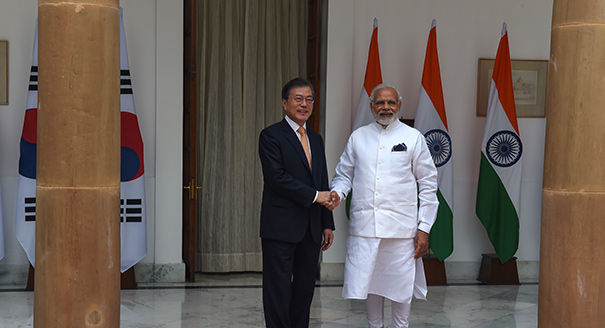
But President Donald Trump and the North Korean leader have invested far too much political capital to walk away from the historic agreement at the first sign of turbulence. The problems of translating the very broad framework outlined at the Singapore summit last month into concrete outcomes does not reduce its significance. The one man who made the Korean diplomatic miracle possible, and who could continue to shape it, is in Delhi this week. He is the South Korean President, Moon Jae-in.
It was Moon’s long-standing conviction that there was room to engage Kim and his willingness to embark on a risky peace process that provided the basis for rapid diplomatic moves — between the North and South from the beginning of this year. President Trump’s surprising buy-in opened the possibilities for unfreezing the geopolitics of the Korean Peninsula, which have been on ice for nearly seven decades.
Moon’s visit offers the possibility of strengthening India’s role and relevance to the Korean Peninsula. Independent India played an interesting role in the Korean Peninsula in the immediate aftermath of the Second World War. India was also among the few countries that maintained diplomatic relations with the North and South during the Cold War.
As India opened up its economy in the early 1990s, South Korea became an important participant in India’s economic rejuvenation. As post-Soviet Russia and China stepped up their collaboration with the economic powerhouse that South Korea had become, the socialist North was increasingly isolated.
If North Korea focused on developing a nuclear capability as an insurance against the loss of old communist allies — the Subcontinent became an unexpected part of the strategy. North Korea’s atomic quest found important convergences with that of Pakistan. As Pyongyang and Rawalpindi stepped up their nuclear and missile cooperation, India’s relationship with the North went into a deep chill.
Today, India is in a position to develop a more strategic view of the Korean Peninsula, as Moon seeks reconciliation with the North. At a moment when there is much international scepticism about the prospects for peace, strong public Indian support for Korean reconciliation would be of immediate political value to Moon.
Even more important, it will align Delhi with the long-term interests of the Korean people. For all the troubles in the divided peninsula over the last seven decades, the dream of Korean unity has survived. While the “unification” of the Peninsula is a formal goal that both North and South are committed to, it has rarely been seen as a practical objective.
Thanks to Moon’s bold initiatives, there is a new prospect today for a more modest but profoundly consequential agenda between the North and the South — relaxation of political tension, de-escalation of military confrontation and expanded economic cooperation along with an incremental advance towards the denuclearisation of the Korean Peninsula.
Modi and Moon are conscious that the familiar markers of post-Cold War Asian landscape are shifting. The relations between the major powers — the US, Russia, China and Japan — have acquired a level of tension that Asia has not had to deal with in decades. Meanwhile, globalisation — which has brought so much prosperity to Asia over the recent decades — is under stress as the Western leaders cope with the domestic political backlash against free trade and open borders.
That presents three priorities for Modi and Moon. First is to end the long-standing mutual political neglect. Although Korea has emerged as a large economy and a member of the developed nations, its world view has remained largely riveted on North East Asia. For India, which has begun to adopt the notion of an Indo-Pacific, Korea has not been at top of its regional priorities in Asia.
Despite the formal announcement of a strategic partnership a decade ago, Delhi and Seoul have struggled to impart some real content into it. Modi and Moon have an opportunity to change that. On his part, Moon has announced a “New Southern Policy” that looks beyond Northeast Asia to focus on Southeast Asia, Australia and India. Modi’s Act East policy now has a much wider theatre — the Indo-Pacific.
Second is the urgent need to strengthen economic partnership. As a trade war unfolds between between the world’s major economies, Delhi and Seoul have an urgent need to liberalise their own bilateral trade relations. Amidst the unfolding technological disruption of the global economy, South Korea and India have a stake in binding the innovation ecosystems of the two countries.
Finally, the two sides also need to focus on expanding bilateral security and defence cooperation and working together with other countries to promote a stable Asian balance of power system. Delhi and Seoul should focus on building flexible middle power coalitions in Asia to limit the impact of the current volatility in the relations between US and China.
This article was originally published in the Indian Express.
Former Nonresident Senior Fellow, Carnegie India
A leading analyst of India’s foreign policy, Mohan is also an expert on South Asian security, great-power relations in Asia, and arms control.
Recent Work

C. Raja Mohan, Darshana M. Baruah


Alexander Gabuev, Paul Haenle, C. Raja Mohan, …
Carnegie does not take institutional positions on public policy issues; the views represented herein are those of the author(s) and do not necessarily reflect the views of Carnegie, its staff, or its trustees.

Japan’s long-term security policy is driven by concerns about China, and there is little appetite for (or interest in) pursuing a confrontation with Moscow.

James D.J. Brown

Without a ceasefire with Ukraine on attacking each other’s energy infrastructure—to which the Kremlin is unlikely to agree—the diesel agreement between Putin and Trump is largely for show, rather than representing a genuine increase in the volumes of Russian diesel on the global market.

Sergey Vakulenko

Despite a new textbook, an influx of Russian teachers and managers, and an end to the teaching of Ukrainian, the Kremlin is unlikely to have “reprogrammed” locals.

Konstantin Skorkin

Cargo traffic through Russia’s Northern Sea Route has increased because of the disruption caused by the conflict in the Middle East, the Ukraine war, and U.S.-China tensions.

Mikhail Korostikov

Minsk clearly expected the dialogue with Washington to yield more results, in particular the lifting of EU sanctions and permission to export potash.

Artyom Shraibman