

Commentary
Andrei Kolesnikov
{
  "authors": [
    "Andrei Kolesnikov"
  ],
  "type": "legacyinthemedia",
  "centerAffiliationAll": "",
  "centers": [
    "Carnegie Endowment for International Peace",
    "Carnegie Russia Eurasia Center"
  ],
  "collections": [],
  "englishNewsletterAll": "",
  "nonEnglishNewsletterAll": "",
  "primaryCenter": "Carnegie Endowment for International Peace",
  "programAffiliation": "",
  "programs": [],
  "projects": [],
  "regions": [
    "Russia"
  ],
  "topics": [
    "Political Reform"
  ]
}
Source: Getty
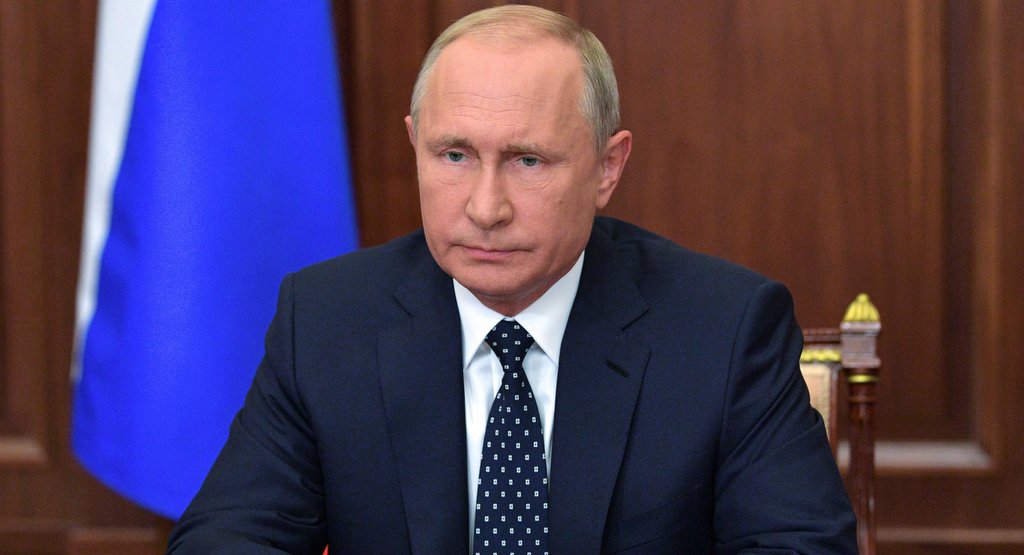
Putin’s formula for pension reform might allow him to stem his political losses. Even if his ratings don’t grow, they might at least stop falling. But the cost of saving Colonel Putin will turn out to be exorbitantly high for the budget and the economy.
Source: Moscow Times
A crisis on President Vladimir Putin’s doorstep has forced him to assume the role of Father of the Nation. His approval ratings fell from 79 percent in May to 67 percent in July with a small rebound to 70 percent in August. The reason? The announcement government’s plans to increase the retirement age.
For the first time since early 2014, when Russia’s annexation of Crimea sent Putin’s ratings soaring, the president very nearly lost his status a national symbol akin to the flag or the anthem.
Rather, with the announcement of the pension reforms, Putin was relegated in the public eye to a mere representative of the authorities — one, who, just like the government, parliament, key politicians and officials, was seen as ultimately responsible the unpopular plan. People really didn’t believe the insistence of Putin’s spokesman that the president was not involved in the reform plan.
And lo and behold, more than two months after the government initiative was announced, the Father of the Nation is rectifying a mistake that supposedly had nothing to do with him — even though he approves of the overall idea and can even explain the demographic and economic motives for increasing the retirement age.
His televised address to the nation on Wednesday was not an admission that mistakes had been made. Instead, Putin’s appearance was presented as a good deed in and of itself: the nation’s uppermost arbitrator intervening to propose the least painful and most reasonable solution possible.
Explaining in detail why the reform is necessary, Putin took a friendly, fatherly tone. That tone might have looked like an expression of composure and confidence, but it betrayed his fear of losing the nation’s trust. The president went to great pains to explain demographic dips and the heavy financial burden on working people who are forced to support an ever-growing number of pensioners.
But he failed to mention that it was he and his government who stopped contributions to the pension fund and instead used that money to pay for the annexation of Crimea. Nor did Putin — a retired military officer himself — say anything about the fact that security service and military personnel will still be entitled to early retirement and other benefits.
Putin accused the opposition, which has criticized the pension reform, of doing so for their own political gains. Yet isn’t that precisely what he himself did this week, prioritizing his own ratings and those of the government at the expense of the reform?
Putin’s proposal is that for women, the retirement age will be raised from the current age of 55 to 60, not 63 as originally proposed, despite the fact that women live longer. The president’s address increased the number of people eligible for benefits and early retirement and that means that the pension reform, which was aimed at saving money, just got a lot more expensive.
The same evening, Finance Minister Anton Siluanov calculated that the president’s initiatives to rescue his ratings would cost the country 500 billion rubles ($7.3 billion) over six years. And this is all amid the state’s frantic search for money to implement Putin’s May edict to increase social spending: i.e., further efforts to buy people’s loyalty.
For this purpose, the state is prepared to reduce the rate of economic growth by withdrawing money from the economy, having increased VAT from 18 percent to 20 percent. Additionally, the state is prepared to announce the need to confiscate superprofits from metallurgy and chemical enterprises.
Meanwhile, it is providing the oil giant Rosneft, run by Putin ally Igor Sechin, with tax breaks worth 380 billion rubles simply because one of its oil deposits happens to be flooded. Compare those figures.
The costly reform is becoming even more expensive for employers, who, under a proposal by Deputy Prime Minister Tatyana Golikova, will have to pay fines if they terminate employment contracts with people who are within five years of the retirement age. The labor market, flooded with workers it doesn’t need, will be skewed, ineffective and even less productive, while legal repression will be used to ensure a formally low level of unemployment among older people.
Putin’s formula for pension reform might allow him to stem his political losses. Even if his ratings don’t grow, they might at least stop falling. But the cost of saving Colonel Putin will turn out to be exorbitantly high for the budget and the economy.
Former Senior Fellow, Carnegie Russia Eurasia Center
Kolesnikov was a senior fellow at the Carnegie Russia Eurasia Center.
Recent Work
Andrei Kolesnikov
Andrei Kolesnikov
Carnegie does not take institutional positions on public policy issues; the views represented herein are those of the author(s) and do not necessarily reflect the views of Carnegie, its staff, or its trustees.
The issue is not that the president only has selective information at his disposal, but that the decision-making process consists of one person with an unshakeable vision of how the world works.

Tatiana Stanovaya
By fueling the arguments of both supporters and opponents of Armenian Prime Minister Nikol Pashinyan, Azerbaijan wants to ensure he is re-elected with a weaker mandate.

Bashir Kitachaev
A much-discussed disagreement over internet restrictions in Russia was never an existential threat for Putin: It was about elite groups protecting their interests.

Alexandra Prokopenko
By reminding the world that Lukashenko is a threat to NATO and Ukraine, Kyiv is trying to return the focus to why the Belarusian regime needs to be contained rather than rewarded.

Artyom Shraibman
The demands of the Kremlin’s war in Ukraine, demographic problems, and public hostility toward Central Asians mean Russia does not have enough workers.
Salavat Abylkalikov