

Article
Frederic Wehrey, Charles H. Johnson
{
  "authors": [
    "Frederic Wehrey"
  ],
  "type": "legacyinthemedia",
  "centerAffiliationAll": "",
  "centers": [
    "Carnegie Endowment for International Peace",
    "Malcolm H. Kerr Carnegie Middle East Center"
  ],
  "collections": [],
  "englishNewsletterAll": "",
  "nonEnglishNewsletterAll": "",
  "primaryCenter": "Malcolm H. Kerr Carnegie Middle East Center",
  "programAffiliation": "",
  "programs": [],
  "projects": [],
  "regions": [
    "Middle East",
    "Türkiye",
    "North Africa",
    "Libya",
    "Syria",
    "Levant"
  ],
  "topics": [
    "Political Reform",
    "Security",
    "Foreign Policy"
  ]
}
Source: Getty
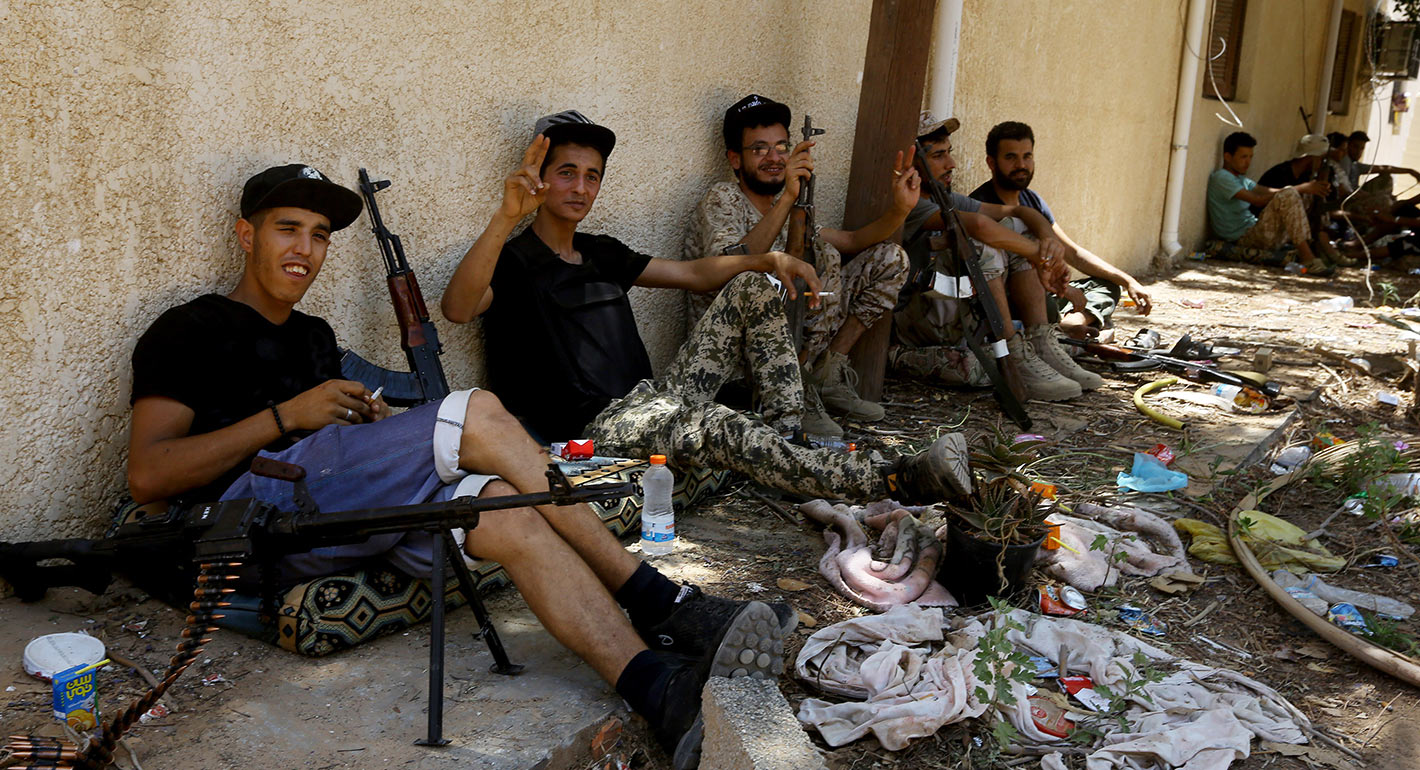
Turkey’s military intervention in Libya, involving the deployment of Syrian fighters, is the latest chess move in a long-running civil war that followed the 2011 revolution, the NATO-led intervention, and the overthrow of the dictator Muammar Qaddafi.
Source: New York Review of Books
Tripoli, Libya—At a mud-caked intersection this month, some hundred-and-fifty feet from the front line, a lanky militia fighter approached and then abruptly turned around when he saw me, a Westerner. I’ve been covering Libya’s conflicts for years and noticed some minor but distinctive details about his appearance: a do-rag tied around his head, an olive green tactical vest, and perhaps a certain military bearing. The Libyan commander I was with confirmed it, with a chuckle: “That’s not a Libyan look.”
Fifteen minutes later, I was inside a poured-concrete villa that served as the living quarters for a group of war-hardened Syrian fighters. Seated before me on a plush purple couch, behind a coffee table strewn with ash-trays and blown-glass decanters, was the Syrians’ leader, a thirty-four-year-old former Syrian military officer named Ahmed, and two other Syrian fighters. Numbering roughly five hundred on this section of the front, they told me they’d been in Libya several days and were part of a larger contingent of roughly two thousand Syrian militiamen that started arriving a month ago, along with Turkish military personnel. There are plans, they said, for an additional six thousand Syrian fighters.
Turkey’s military intervention in Libya, involving the deployment of Syrian fighters, is the latest chess move in a long-running civil war that followed the 2011 revolution, the NATO-led intervention, and the overthrow of the dictator Muammar Qaddafi. Since then, this oil-rich country has disintegrated into a patchwork of regions, towns, and militias sparring over power and wealth.
This article was originally published in the New York Review of Books.

Senior Fellow, Middle East Program
Frederic Wehrey is a senior fellow in the Middle East Program at the Carnegie Endowment for International Peace, where his research focuses on governance, conflict, and security in Libya, North Africa, and the Persian Gulf.
Recent Work
Frederic Wehrey, Charles H. Johnson
Frederic Wehrey, Charles H. Johnson
Carnegie does not take institutional positions on public policy issues; the views represented herein are those of the author(s) and do not necessarily reflect the views of Carnegie, its staff, or its trustees.

Russian strikes are weakening the economy sustaining Ukraine’s war effort. Closing the growing funding gap will require more European support and politically contentious reforms in Kyiv.

Balázs Jarábik

Ex-president Gurbanguly Berdimuhamedov remains interested in politics, but his son Serdar, Turkmenistan’s current president, is becoming increasingly independent and willing to break with his father’s legacy. If their covert rivalry goes too far, both risk losing power.

Galiya Ibragimova

Despite a new textbook, an influx of Russian teachers and managers, and an end to the teaching of Ukrainian, the Kremlin is unlikely to have “reprogrammed” locals.

Konstantin Skorkin

Cargo traffic through Russia’s Northern Sea Route has increased because of the disruption caused by the conflict in the Middle East, the Ukraine war, and U.S.-China tensions.

Mikhail Korostikov

Sergei Kiriyenko used Russia’s parliamentary vote to further hone his strategy of corporate mobilization that is designed to maximize votes for United Russia.

Andrey Pertsev