

Commentary
Bader Al-Saif
{
  "authors": [
    "Bader Al-Saif"
  ],
  "type": "commentary",
  "centerAffiliationAll": "dc",
  "centers": [
    "Carnegie Endowment for International Peace",
    "Malcolm H. Kerr Carnegie Middle East Center"
  ],
  "collections": [
    "Coronavirus"
  ],
  "englishNewsletterAll": "menaTransitions",
  "nonEnglishNewsletterAll": "",
  "primaryCenter": "Malcolm H. Kerr Carnegie Middle East Center",
  "programAffiliation": "MEP",
  "programs": [
    "Middle East"
  ],
  "projects": [],
  "regions": [
    "Gulf",
    "Saudi Arabia",
    "United Arab Emirates",
    "Kuwait",
    "Middle East",
    "Bahrain",
    "Qatar"
  ],
  "topics": [
    "Political Reform",
    "Religion"
  ]
}
Source: Getty
Divisions dating to the June 2017 split among Gulf Cooperation Council states have shaped the region’s contrasting approaches to political messaging and public health in a time of observance.
Ramadan and other religious events around the world have been transformed by the coronavirus pandemic. While upending daily life across the Middle East, the pandemic’s impact during the Muslim holy month has also amplified policy divergences among the six Gulf Cooperation Council (GCC) states, exacerbating a three-way split that dates to the summer of 2017. Religious policy has become the latest arena for GCC states to reaffirm their affinities. Ramadan and the pandemic could have offered opportunities to reconcile, yet neither has brought the clashing parties closer together in a conflict now entering its fourth year.
Ramadan has proven to be an opportune time for Bahrain, Saudi Arabia, and the United Arab Emirates to continue using Islam to advance their soft power. Of the three states, only the UAE has kept mosques closed during the holy month. However, its two-year-old Emirates Fatwa Council flexed its muscles by issuing five fatwas, ranging from exempting medical workers from the fast to calling for prayers at home. The UAE has also tied its Ramadan pandemic policy to its recent focus on tolerance and interreligious dialogue. Capitalizing on the historic first visit of a pope to Abu Dhabi and the region in February 2019, the Higher Committee on Human Fraternity tasked with following up on the visit declared that May 14 was a global day of prayer. The event was endorsed and attended by Pope Francis and representatives of several international organizations, scoring yet another win for the UAE by reinforcing its global religious outreach.
Other combined Ramadan-pandemic events connect to the country’s humanitarian and happiness policies. Sheikha Fatima, the “Mother of the Nation,” launched an online Ramadan “optimism campaign” to support those stressed by the pandemic. The UAE’s vice president announced a campaign that aims to deliver 10 million meals to the needy, bringing home the UAE’s global humanitarian diplomacy.The UAE has also dropped contentious Ramadan programming such as that of the late Syrian scholar Mohammed Shahrour. Yet Saudi Arabia has improved on this strategy by holding up a less controversial religious figure, Mohammed al-Issa, who in 2016 was appointed to the Muslim World League, alongside his reappointment to the Council of Senior Scholars. Issa’s daily program, Billati Hiya Ahsan (“Righteous Deeds”), airs on Saudi broadcaster MBC and promulgates Saudi Arabia’s revamped religious message. He has spoken on the show about the brotherhood of Sunnis and Shiites and the need to open up to other religions—messages that reflect the resolve of Saudi leadership to carry this message forward, even through the challenging conditions of the pandemic and economic recession.
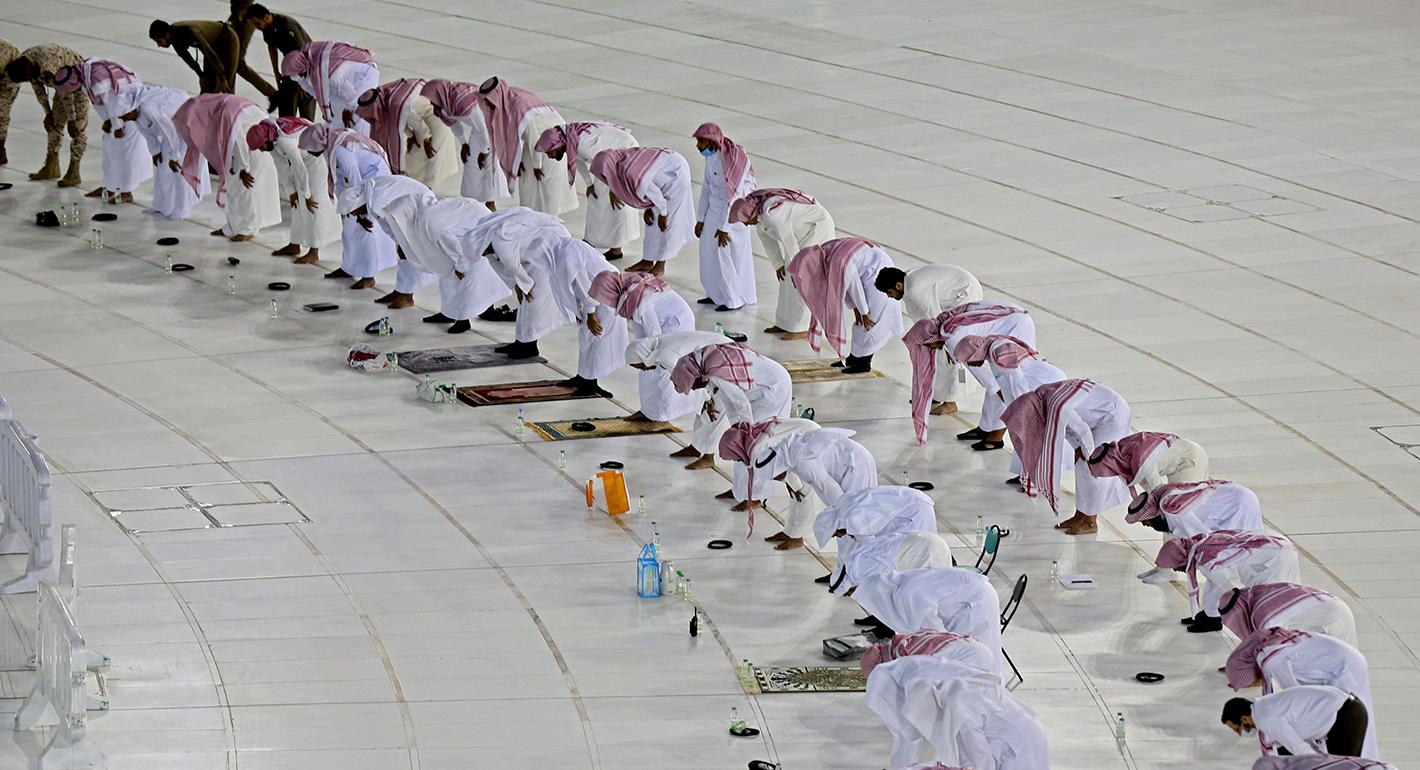
Saudi Arabia has also increased its budget to fund the annual breaking of the fast for 1 million Muslims in eighteen countries. Saudi Arabia initially mandated closures of mosques, as had the UAE. But a few days later King Salman reversed course, announcing that Mecca and Medina’s mosques would officially remain open for the seasonal Ramadan tarawih prayer, though with severely limited access. The change in policy indicates the kingdom’s overriding concern about its leadership of the two holy mosques and its image as their most proper custodian.
Bahrain distinguished itself by being the first Arab state to declare the opening of its Al-Fateh Grand Mosque during Ramadan for evening, tarawih, and Friday prayers, while maintaining social distancing and limiting worship to five people at a time. Continuing services in the state’s official mosque—a Sunni institution in a Shiite-majority country—allows the kingdom to reinforce its official Sunni stamp. This is a safe strategy to follow because Shiites do not conduct tarawih prayers, thereby muting the potential criticism of opening a Sunni mosque but not Shiite equivalents, which went virtual for Ramadan events.
Among the region’s countries taking the hardest economic hit from the pandemic, Bahrain eased its restrictions on retail and industry during Ramadan and into Eid al-Fitr, with the hope of speeding its economic recovery. Similarly, Saudi and Emirati authorities have relaxed curfew hours and allowed select stores to reopen during Ramadan, even as infections are on the rise.
Oman and Kuwait, neutral states during the Gulf rift, have taken a more cautious approach to the pandemic throughout Ramadan than Bahrain, Saudi Arabia, and the UAE. They have kept mosques closed and declined to loosen curfews to accommodate the holy month. Rather, restrictions increased. Kuwait’s Religious Endowments and Islamic Affairs Ministry innovated by creating a free mobile app, Ramadan in Your Home, to ensure that people remain engaged under the curfew. Oman has also continued religious programming across its traditional media outlets.
At the heart of the Gulf rift is Qatar, whose tensions with its neighbors in many ways boil down to their similarities. Qatar has its own strategy for putting itself on the global map, however, just as it has for Ramadan during the pandemic—one that combines elements of Kuwait and Oman’s approach with those of the other GCC states. Like Bahrain, Qatar has kept its state mosque open for select prayers. Like similar programs in Saudi Arabia and the UAE, Qatar Charity launched a nearly $3 million Ramadan campaign that targets over 2 million people, both within Qatar and abroad. But Qatar’s religious soft power has not been able to compete with that of its neighbors during Ramadan, especially with the retirement of Sunni reformist theologian Yusuf al-Qaradawi due to old age and the receding popularity of Qatar-sponsored Islamic scholar Tariq Ramadan amid several rape allegations.
Like Kuwait and Oman, Qatar has not used Ramadan as an opportunity to reopen its economy. But it has used the moment to mark the third anniversary of the GCC rift and to celebrate its resilience. Countries on both sides have kept up their war of words, with the Qataris fomenting anti-Saudi sentiment on Al-Jazeera after the death in Saudi custody of imprisoned academic Abdullah al-Hamid and Saudi Arabia organizing a disinformation campaign about a coup in Qatar.
Crises and spiritual events have long been a platform for the GCC states to advance their interests and public relations campaigns. The combination of the two during Ramadan and the coronavirus pandemic has in some ways been a blessing for those missions.
Former Nonresident Fellow, Malcolm H. Kerr Carnegie Middle East Center
Bader Mousa Al-Saif was a nonresident fellow at the Malcolm H. Kerr Carnegie Middle East Center in Beirut, where his research focuses on the Gulf and Arabian Peninsula.
Recent Work
Bader Al-Saif
Bader Al-Saif
Carnegie does not take institutional positions on public policy issues; the views represented herein are those of the author(s) and do not necessarily reflect the views of Carnegie, its staff, or its trustees.

Putin’s conservative staffing policies and search for ever greater control have cemented parliament’s transformation into a bureaucratic appendage of the executive branch.

Andrey Pertsev

Ex-president Gurbanguly Berdimuhamedov remains interested in politics, but his son Serdar, Turkmenistan’s current president, is becoming increasingly independent and willing to break with his father’s legacy. If their covert rivalry goes too far, both risk losing power.

Galiya Ibragimova

Sergei Kiriyenko used Russia’s parliamentary vote to further hone his strategy of corporate mobilization that is designed to maximize votes for United Russia.
Andrey Pertsev

The European far right might fail to steer EU policy in the direction Russia wants, but they will create enough chaos inside Europe to benefit the Kremlin.

Dimitar Bechev

If the Russian-speaking community in Latvia cannot articulate their interests without being seen as disloyal, they could end up embracing a pro-Kremlin agenda.

Sergejs Potapkins