

Commentary
James D.J. Brown
{
  "authors": [
    "James D.J. Brown"
  ],
  "type": "commentary",
  "centerAffiliationAll": "",
  "centers": [
    "Carnegie Endowment for International Peace",
    "Carnegie Russia Eurasia Center"
  ],
  "collections": [],
  "englishNewsletterAll": "",
  "nonEnglishNewsletterAll": "",
  "primaryCenter": "Carnegie Russia Eurasia Center",
  "programAffiliation": "",
  "programs": [],
  "projects": [],
  "regions": [
    "East Asia",
    "Japan",
    "Russia"
  ],
  "topics": [
    "Economy"
  ]
}
Source: Getty
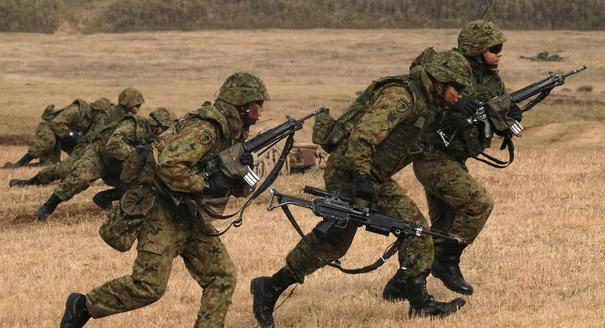
If Japan’s quiet military revolution is indeed aimed against a specific threat, then that threat issues not from Russia but from China.
On May 24, a joint defense panel of Japan’s ruling Liberal Democratic Party approved a draft proposal to sharply increase military spending. This comes on top of nine consecutive years in which Japan’s defense budget has increased, reaching a record $52 billion in 2021. Japan is actively developing and buying new categories of military technology, while removing long-standing restrictions on the use of its Self-Defense Forces.
The relative decrease in U.S. military strength in the region, especially compared with China’s burgeoning power, is forcing Japan to become a leading military power in the Asia-Pacific. This is inevitably causing alarm in Russia, which never signed a peace treaty with Japan at the end of World War II, and which has a long-running territorial dispute with its neighbor over the Kuril Islands.
For many decades now, Japan has had a reputation as a pacifist country that relies entirely on the United States in matters of national security. This position is enshrined in two key documents. Firstly, Article 9 of the 1947 Japanese constitution states unequivocally that “the Japanese people forever renounce war as a sovereign right of the nation and the threat or use of force as a means of settling international disputes.”
Secondly, the 1960 Treaty of Mutual Cooperation and Security between the United States and Japan is understood to guarantee U.S. protection from any attack on Japanese territory in exchange for Japan hosting U.S. military bases. Accordingly, the focus of the Japanese armed forces has been on defense, rather than on attacking foreign targets.
Now, however, military spending is—at $52 billion—comparable to that of European powers such as France, Germany, and the UK. In 2020, Japan’s military expenditure was the ninth biggest in the world, according to SIPRI.
The additional spending is being used to develop Japan’s military potential in new areas, such as an amphibious rapid deployment brigade established in 2018. This elite unit of marines is tasked with regaining control over Japanese islands in the event of their seizure.
The Japanese government also took the decision in 2018 to convert two Izumo-class destroyers into light aircraft carriers. In addition, Tokyo has agreed to buy forty-two F-35B fighter jets from the United States, and is developing new standoff missiles with a range of 1,000 kilometers. Legislative changes have also been made: in 2014, Japan lifted a ban on weapons exports, allowing (in theory) revenues from arms sales to be pumped into making the Japanese defense complex more competitive, and in 2015, the law was changed to allow the Self-Defense Forces to fight in the event of an attack on an ally’s forces, as well as on Japan itself.
These large-scale changes in Japan’s defense policy amount to nothing less than a quiet revolution, so it’s no surprise that they have sparked concern in Moscow.
In January, Russian Foreign Minister Sergey Lavrov spoke out strongly against the prospect of Japan hosting new short- and medium-range ground-based missiles on its territory. Locating the missiles on ships rather than land would change little as well, added Lavrov, “because basing them in the Sea of Japan… will mean that those missiles can reach a significant proportion of Russia’s territory.”
Others have gone even further. In December 2020, Major General Mikhail Makaruk, a member of the executive committee of the Officers of Russia organization, said that the purpose of Japan’s new weapons was to seize the Southern Kuril Islands.
Such reactions are not unexpected, but the fact that Tokyo is pushing through major changes in its defense policy does not automatically constitute a threat to Russia. First, the scale of Japan’s military might should not be exaggerated. Even its record military spending doesn’t yet exceed 1 percent of GDP, compared to the United States, which spent 3.7 percent of its GDP on defense in 2020, and Russia, which spent 4.3 percent.
Second, Japan’s new military capability is not aimed at Russia. On the contrary: in recent years, Tokyo has shown considerable restraint where Russia is concerned, and often does not even react to clear provocations by Moscow, such as sending strategic bombers to fly close to and, in some cases, violate Japan’s airspace. (Japanese fighter jets were scrambled 206 times from April to December 2020 because of approaching Russian military planes.) Nor has Japan used Russia’s deployment of anti-ship missile systems to the contested islands as a pretext for a military build-up close to Russia’s borders.
It is also ludicrous to suggest that the Japanese government is planning to seize the Kuril Islands. The use of military force for anything other than self-defense is unacceptable to both the Japanese leadership and public. In any case, despite Russia’s fears, in the last decade Japan has actually been redeploying its armed forces away from the Russian border: from the north to the southwest. The new amphibious brigade, for example, is based in the city of Sasebo on the southwestern island of Kyushu—a full 1,700 kilometers from the disputed islands.
The reason for basing the brigade here is clear: to counteract the potential threat from China, whose military spending has grown from $76.5 billion in 2010 to $209 billion in 2021, according to CSIS China Power data. China has started behaving far more aggressively in the dispute over the Senkaku Islands, which Beijing claims as the Diaoyu Islands, and which have been under Tokyo’s administration since the 1970s.
This year, Chinese vessels have entered Japanese territorial waters around the islands several times, and in February this year, the Chinese leadership passed a law expanding the Chinese coast guard’s rights to use armed force against foreign vessels.
In other words, if Japan’s quiet military revolution is indeed aimed against a specific threat, then that threat issues not from Russia but from China.
Japan’s military modernization program of recent years is also linked to the relative weakening of the U.S. military presence in the region. Before, there was no doubt that Washington was capable of protecting Japan from any threat. Now, however, with China challenging the U.S. military dominance of the region, Tokyo understands that it cannot rely solely on Washington.
These fears have long existed in the background, but were brought into sharp focus under former U.S. president Donald Trump and his “America First” policy. This is not to say that the Japanese-American alliance is in any kind of jeopardy: far from it. It simply means that for the first time in many years, Japan feels the need to become more self-sufficient in its defense policy.
Regardless of the scale of the military reforms taking place in Japan, they are not an indicator that Tokyo has new ambitions in the region. The Japanese government, having perceived a threat from China and decreased U.S. involvement in its problems, has decided for the first time in modern history to significantly boost the capacity of its defense forces.
Russia cannot, of course, ignore such a rapid development of military capabilities among its neighbors. But in Japan’s case, these changes do not target Russian interests in the region. The Japanese public and leadership are strongly against the use of military force to resolve conflicts with their neighbors, and have no immediate intention of eliminating Article 9 of the constitution.
This article was published as part of the “Relaunching U.S.-Russia Dialogue on Global Challenges: The Role of the Next Generation” project, implemented in cooperation with the U.S. Embassy to Russia. The opinions, findings, and conclusions stated herein are those of the author and do not necessarily reflect those of the U.S. Embassy to Russia.

Professor of Political Science at Temple University
Recent Work
James D.J. Brown
James D.J. Brown

When faced with fuel shortages in the past, Central Asian governments could always count on additional supplies from Moscow. That safety net no longer exists.

Galiya Ibragimova
Reading the purported correspondence of celebrity Ksenia Sobchak sheds light on her role within the system, and how journalism and politics function in Putin’s Russia.

Vladislav Gorin

When political power is concentrated in the hands of a small circle of people, a country invariably ends up with technological stagnation.

Aleksei Kiselev
Two divergent trends—Putin’s hardline vision of how to prosecute the war in Ukraine, and a growing desire for change in Russia—could tear the regime apart.

Tatiana Stanovaya
Official discussions about mini oil refineries are unlikely to come to anything—but the mere fact they’re happening reveals the regime is failing to deliver a functioning economy.

Sergey Vakulenko