

Research
- +5
Alper Coşkun, Fatih Ceylan, Tacan İldem, …
{
  "authors": [
    "Alper Coşkun"
  ],
  "type": "commentary",
  "centerAffiliationAll": "dc",
  "centers": [
    "Carnegie Endowment for International Peace"
  ],
  "collections": [
    "Türkiye and the World"
  ],
  "englishNewsletterAll": "ctw",
  "nonEnglishNewsletterAll": "",
  "primaryCenter": "Carnegie Endowment for International Peace",
  "programAffiliation": "EP",
  "programs": [
    "Europe"
  ],
  "projects": [],
  "regions": [
    "United States",
    "Türkiye",
    "Western Europe",
    "Iran"
  ],
  "topics": [
    "Security",
    "Military",
    "Foreign Policy"
  ]
}
Source: Getty
Turkey, Finland, and Sweden must now act in good faith and move beyond lingering resentments.
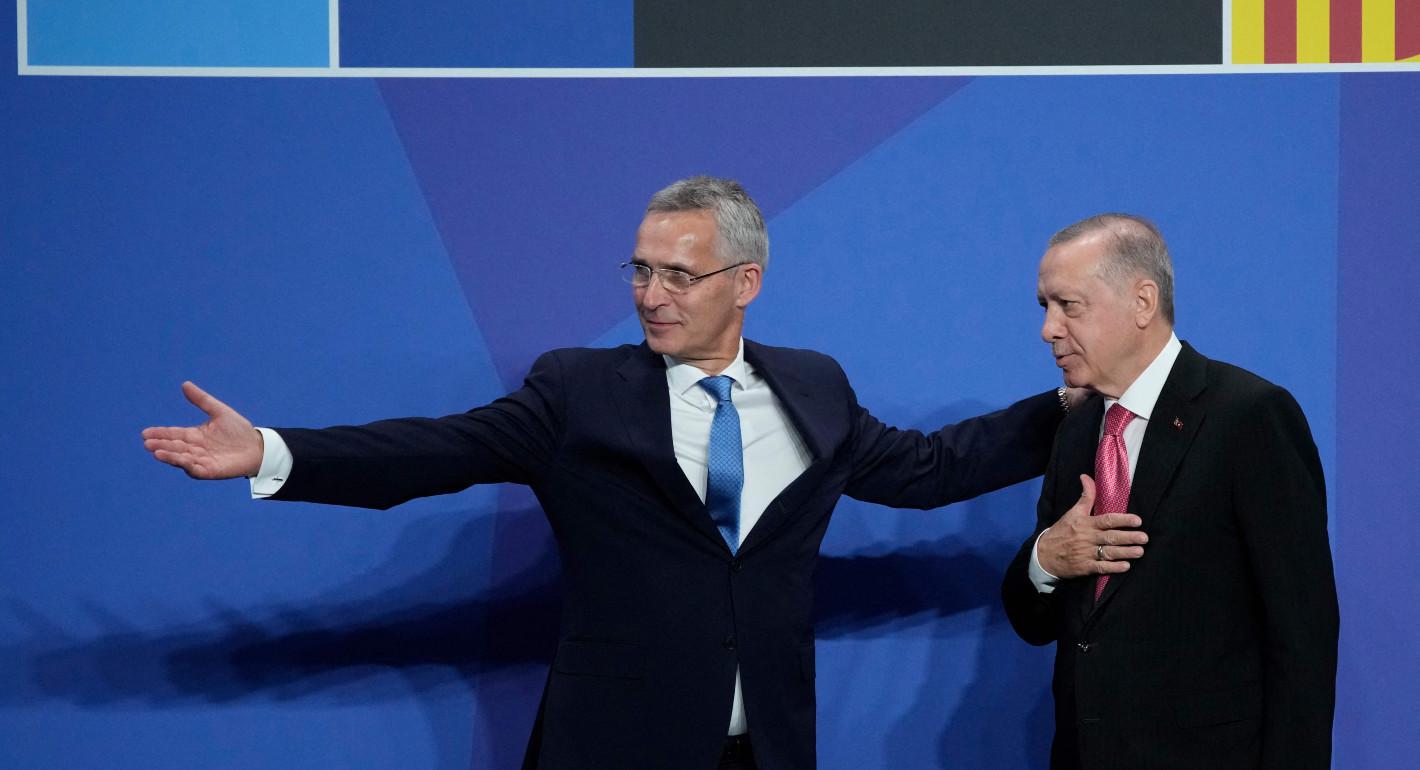
Turkish President Recep Tayyip Erdoğan’s brinkmanship has paid off for Ankara. In a last-minute deal on Tuesday before the NATO summit, Finland and Sweden committed to addressing Turkey’s concerns on terrorism and arms sales, and Turkey lifted its objections to the duo’s NATO membership bids. The agreement is a positive turn of events for all three countries, as well as for NATO.
“Turkey got what it wanted” extolled pro-government headlines in Turkey. This was not an unwarranted victory lap, given the concessions Ankara was able to extract from Helsinki and Stockholm. And although Finns and Swedes have lingering resentment about Erdoğan’s not-so-gentle push to get his way, the truth is that the ordeal ended well for all. Any lack of agreement would have seriously overshadowed the NATO summit, further burdened Turkey’s image as a NATO ally, and left Finland and Sweden in a dangerously vulnerable state of flux for an extended period. Russia is the only country that would have benefited from a continued stalemate.
No matter which way you look at it, Erdoğan succeeded in dragging Finland and Sweden to the negotiating table on his own terms. Among other commitments, Finland and Sweden agreed to deny support to the YPG/PYD, the Syrian branch of the Kurdistan Workers’ Party (PKK)—which is a designated terrorist organization in Turkey, the EU, the UK, and the United States—as well as the Fethullah Terror Organization (FETO), which Turkey blames for the failed 2016 coup attempt. Although Finland and Sweden did not agree to refer to these actors as terrorist organizations, their commitments were still a groundbreaking achievement for Turkey—something unprecedented in an international document. The two countries referenced the YPG/PYD and FETO in the same paragraph as they affirmed their rejection of all forms of terrorism, which was enough of a link to satisfy Ankara’s concerns. Turkish officials will point to this template in the future while trying to dissuade other allies, most notably the United States, from continuing their engagement with the YPG in northern Syria, as well as in their efforts to curb FETO activities in third countries.
A carefully crafted memorandum that is open to interpretation gave each of the three countries involved what they needed and paved the way for a breakthrough. The drawback, however, is that some of the document’s compromise wordings are already leading to diverging narratives. In contrast to Turkish claims, Finland and Sweden are playing down the nature of their commitments and presenting them as nothing more than a natural continuation of their existing international responsibilities or of their national policies and legislation.
Such discrepancies in interpretation are not unusual after complex negotiations with compromise solutions. But they also imply that expectations between the parties differ and that problems in implementation could arise in the future. This is the soft spot of the deal that was struck in Madrid. Moving forward, Turkey, Finland, and Sweden must be responsible and act in good faith toward one another, and temptations will need to be tamed.
For example, Erdoğan must not succumb to the allure of showcasing his success for domestic political gains in a manner that would be distasteful for Finland and Sweden and make it politically prohibitive for them to deliver on commitments. Finland and Sweden, on the other hand, should set aside any sense of resentment, turn the page on this difficult experience, and engage with Turkey in earnest while fulfilling their commitments—something Ankara will be watching with a critical eye pending its ratification of the two candidate countries’ NATO accession protocols. A mechanism in the memorandum that is designed as a platform for continuous dialogue among the three countries’ relevant security agencies and to oversee implementation of the agreement will likely be useful in this regard.
Erdoğan’s mission in Madrid was mostly accomplished even before the NATO summit began. The missing element was completed when he met with U.S. President Joe Biden, who went so far as to praise Erdoğan for lifting his objections to NATO expansion. This came amid signs that the Biden administration was supportive of Turkey’s desire to purchase F-16 fighter jets, raising hopes that it might be possible to break the ice between Turkey and the United States after all.
Erdoğan and his team left Madrid with a strong sense of achievement. But the results have not come without cost. Finland and Sweden will not easily forget this difficult experience that came at a critical point in their recent histories, and it will likely erode their support for Turkey’s European vocation. As a country that often complains about the lack of empathy it receives, Turkey should accord Finland and Sweden the same understanding and do its best to mend the damaged relationships with these two prospective NATO allies. If Helsinki and Stockholm are able to understand the deep frustration Ankara has felt with its allies and others in its fight against terrorism, it might be possible to hasten the healing process.
While NATO recalibrates its role in a new era of geopolitical competition, including by strengthening its deterrence and defense posture, rebuilding trust should be at the top of the agenda for Turkey, Finland, and Sweden.

Senior Fellow, Europe Program
Alper Coşkun is a senior fellow in the Europe Program and leads the Türkiye and the World Project at the Carnegie Endowment for International Peace in Washington, DC.
Recent Work
Alper Coşkun, Fatih Ceylan, Tacan İldem, …

Sophia Besch, Alper Coşkun, Nate Reynolds, …
Carnegie does not take institutional positions on public policy issues; the views represented herein are those of the author(s) and do not necessarily reflect the views of Carnegie, its staff, or its trustees.

Despite a new textbook, an influx of Russian teachers and managers, and an end to the teaching of Ukrainian, the Kremlin is unlikely to have “reprogrammed” locals.

Konstantin Skorkin

Cargo traffic through Russia’s Northern Sea Route has increased because of the disruption caused by the conflict in the Middle East, the Ukraine war, and U.S.-China tensions.

Mikhail Korostikov

Trump has promised Belarus a massive potash deal. But Minsk is seeking something greater: restored Western transit and greater room for maneuver from Russia.

Balázs Jarábik

The European far right might fail to steer EU policy in the direction Russia wants, but they will create enough chaos inside Europe to benefit the Kremlin.

Dimitar Bechev

Minsk clearly expected the dialogue with Washington to yield more results, in particular the lifting of EU sanctions and permission to export potash.

Artyom Shraibman