

Paper
Christopher S. Chivvis, Rohan Mukherjee, Milan Vaishnav
{
  "authors": [
    "Christopher S. Chivvis"
  ],
  "type": "commentary",
  "centerAffiliationAll": "dc",
  "centers": [
    "Carnegie Endowment for International Peace"
  ],
  "collections": [
    "U.S. Democracy in Comparative Perspective"
  ],
  "englishNewsletterAll": "americanStatecraft",
  "nonEnglishNewsletterAll": "",
  "primaryCenter": "Carnegie Endowment for International Peace",
  "programAffiliation": "ASP",
  "programs": [
    "American Statecraft"
  ],
  "projects": [],
  "regions": [
    "North America",
    "United States",
    "East Asia",
    "China"
  ],
  "topics": [
    "Economy",
    "Security",
    "Foreign Policy"
  ]
}
Source: Getty
America will struggle to meet its global aspirations unless its leaders can make progress resolving its domestic controversies.
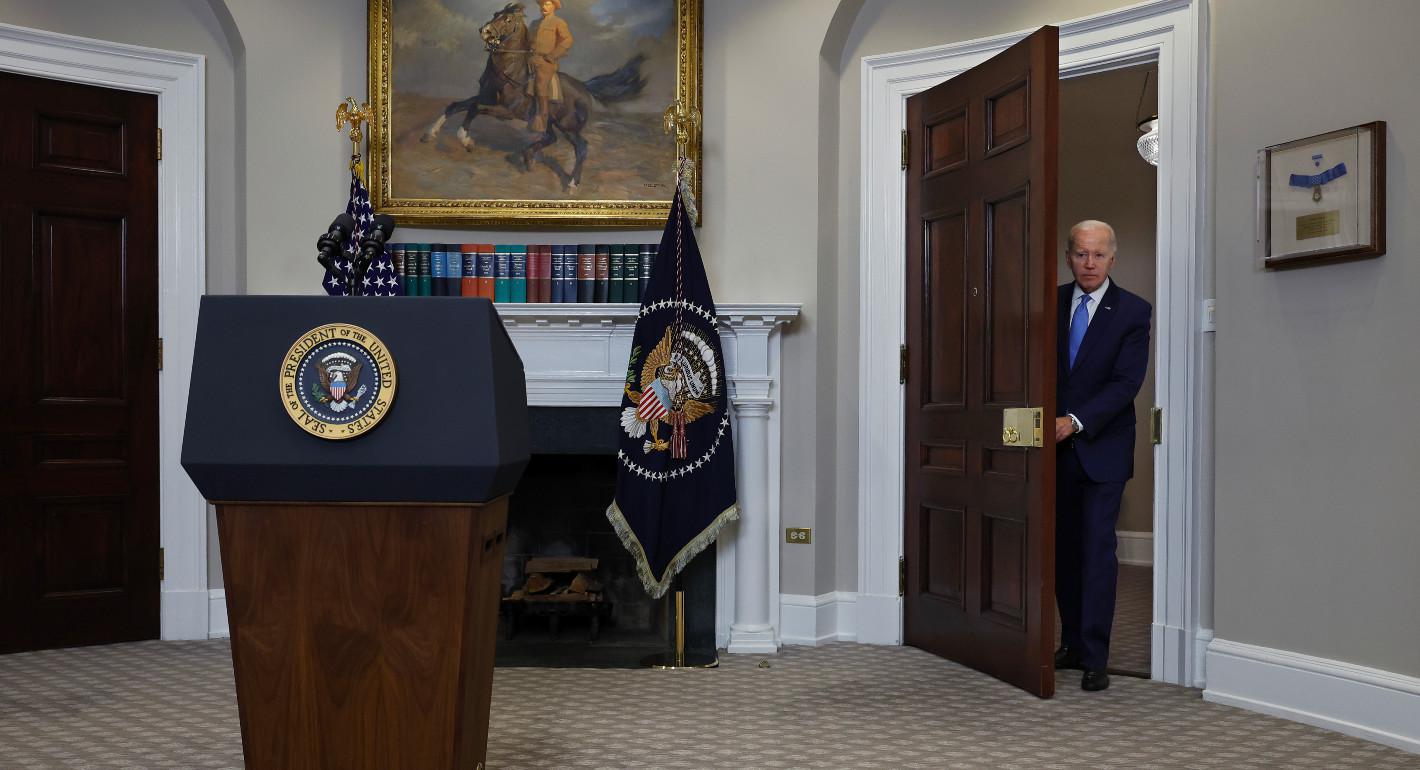
This week’s drama over the federal debt ceiling almost certainly has U.S. allies and adversaries scratching their heads and wondering how serious Washington is about leading the world. Not only has the United States appeared to verge on a debt default—an act that would buckle the international economy—but President Joe Biden has also been forced to cancel part of a major trip to Asia that aims at two top U.S. foreign policy priorities, Russia and China.
Regardless of whether one thinks the debt limit should be raised, this week’s showdown is a sign of the risks that mounting partisanship in Washington poses to America’s traditional world leadership role. In an era of global strategic competition, the United States will be entering the ring with one hand tied behind its back if its leaders can’t make progress on their domestic disagreements and moderate vicious political polarization.
The cancellation of Biden’s visits to Papua New Guinea and Australia isn’t catastrophic in itself. Biden will still attend the G7 in Japan, where he will also meet with the leaders of Australia, India, and Japan, known as the Quad. (The Quad meeting was originally planned to take place in Australia.) Biden plans to use these meetings to tighten sanctions on Russia and reinforce the Quad as a democratic alternative to China in the Indo-Pacific. But the episode underscores serious risks that Washington’s dysfunction poses to America’s future role in the world.
Foreign leaders will doubt American reliability more and more, hurting Washington’s relationships with the very countries whose loyalty it’s competing for with Beijing. Nations such as Brazil, India, Indonesia, South Africa, and Turkey have been hedging their bets and avoiding caucusing with the United States on major priorities like the war in Ukraine. But Washington’s apparent willingness to throttle the global financial system and bring down their economies is only going to make these fence-sitters more reluctant to lean toward Washington on the issues that will matter in the future.
Meanwhile, the high jinks puts another dent in the armor of the U.S. dollar, whose hegemony in the international monetary system has brought extraordinary advantages to the United States for decades. The rapid enlargement of so-called secondary sanctions in recent years has already led countries to begin looking for alternatives to the dollar for their international transactions. Beijing hopes someday to fill in the gap with the yuan. Even if it’s decades before that happens, the possibility of U.S. default is bound to help make Beijing’s case that its time will come.
More important, the very fact that the president was forced to scratch parts of a trip that aimed at one of his top foreign policy priorities—building a coalition of partners in Asia who are also uneasy about China—shows how much U.S. domestic squabbles can damage America’s ability to make credible commitments, whether to allies, partners, treaties, or other global contracts. Such polarization means that American diplomats will face an uphill battle when they try to convince other nations that Washington can keep its word beyond one election cycle. This is also going to intensify the tendency of many countries to hedge their bets between the United States and its adversaries, especially Russia and China.
Washington’s dysfunction also helps its autocratic adversaries in the global contest over ideology. China has been trying to woo countries around the world by offering an authoritarian alternative to America’s liberal economic and political model, one that touts the purported advantages of political and economic stability through authoritarian means. But the more chaotic U.S. democratic politics looks from Africa, the Middle East, Asia, and Latin America, the more Beijing will make headway in persuading the undecideds that its authoritarian alternative actually makes sense.
There are no easy solutions for political polarization, and it’s likely that the worst of this current brinkmanship will be avoided. But America’s leaders need to do more to get their domestic house in order if the United States is to maintain the far-reaching global role to which it aspires.
Senior Fellow and Director, American Statecraft Program
Christopher S. Chivvis is the director of the American Statecraft Program at the Carnegie Endowment for International Peace.
Recent Work


Christopher S. Chivvis, Rohan Mukherjee, Milan Vaishnav
Christopher S. Chivvis, Senkai Hsia
Carnegie does not take institutional positions on public policy issues; the views represented herein are those of the author(s) and do not necessarily reflect the views of Carnegie, its staff, or its trustees.

A leak of Russian gas price data helps establish that China is paying Russia far less than Central Asian countries and Gazprom’s former European customers.

Sergey Vakulenko

Japan’s long-term security policy is driven by concerns about China, and there is little appetite for (or interest in) pursuing a confrontation with Moscow.

James D.J. Brown

The truth of the strategic situation is that Europe and Russia are extremely unlikely to be able to “turn the page” on their confrontation within the next two decades.

Arkady Moshes

Russia’s AI-driven propaganda campaigns operate in a fragmented, chaotic, and often illogical manner. That’s not necessarily a problem for the Kremlin, though: It’s much easier to mimic genuine public debate that way.

Ilya Klishin

Without a ceasefire with Ukraine on attacking each other’s energy infrastructure—to which the Kremlin is unlikely to agree—the diesel agreement between Putin and Trump is largely for show, rather than representing a genuine increase in the volumes of Russian diesel on the global market.
Sergey Vakulenko