

Paper
Sarah Yerkes, Natalie Triche, Amr Hamzawy
{
  "authors": [
    "Natalie Triche"
  ],
  "type": "commentary",
  "centerAffiliationAll": "dc",
  "centers": [
    "Carnegie Endowment for International Peace"
  ],
  "collections": [
    "Governance in the Arab World"
  ],
  "englishNewsletterAll": "menaTransitions",
  "nonEnglishNewsletterAll": "",
  "primaryCenter": "Carnegie Endowment for International Peace",
  "programAffiliation": "MEP",
  "programs": [
    "Middle East"
  ],
  "projects": [],
  "regions": [
    "Morocco",
    "Middle East"
  ],
  "topics": [
    "Democracy",
    "Civil Society",
    "Domestic Politics"
  ]
}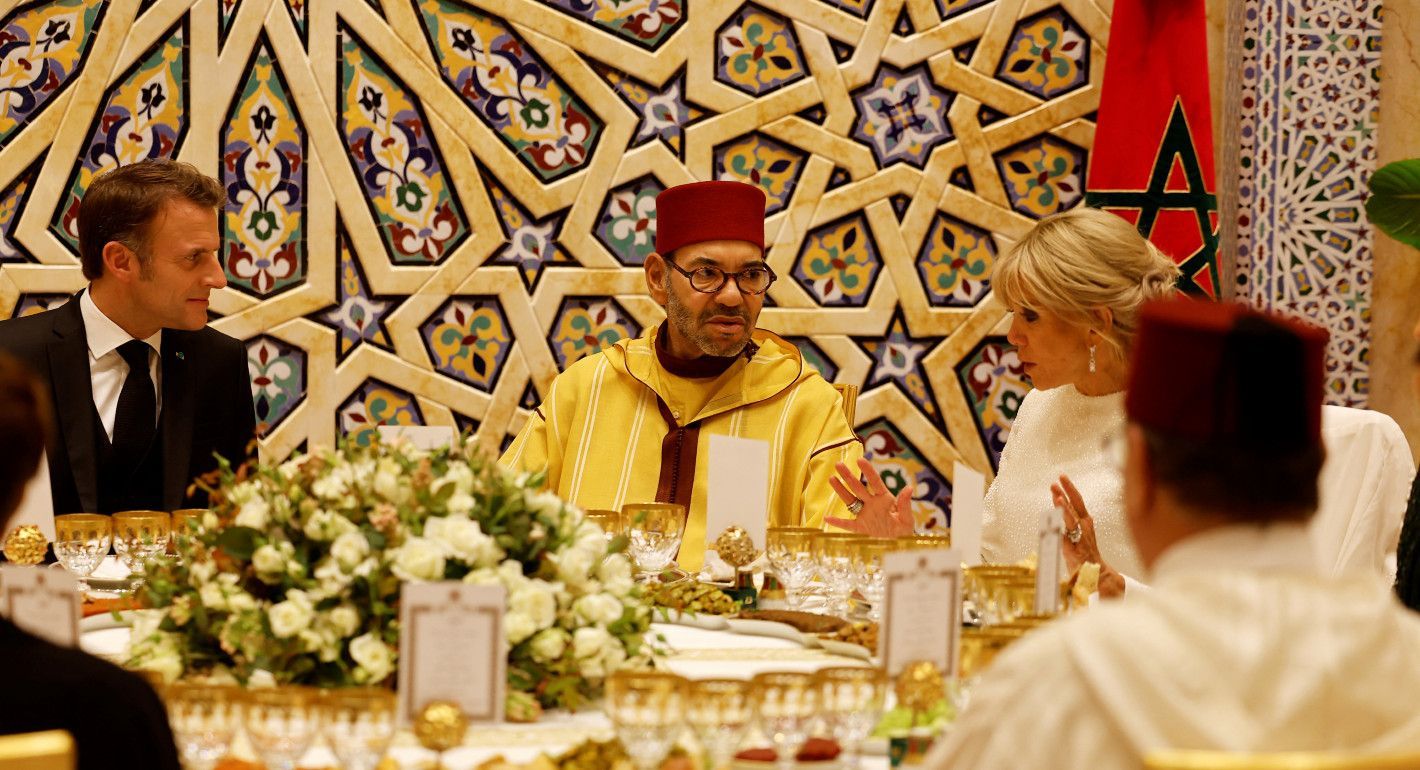
King Mohammed VI at a state dinner in Rabat in 2024. (Photo by Ludovic Marin/pool/AFP via Getty Images)
The approach includes democratic principles, but the king has ultimate say.
In the past twenty years, the kingdom of Morocco has changed remarkably, including in its legal code. Women have grown dominant in education and increased their employment rate. Revisions to the Moroccan family code, or moudawana, have granted women the right to self-guardianship, divorce, and some custody rights. However, women remain vulnerable.
Two years ago, King Mohammed VI made a second call for an update to the family code to rectify some of these issues. The approach the government has taken to the reform process mirrors Moroccan governance today: the government expresses, albeit limitedly, commitment to certain democratic principles around issues that have grown increasingly socially accepted in popular culture like gender-based rights, yet the king has the ultimate say on the outcome of all deliberations.
Moroccans are bound by several legal codes, including criminal, civil, and the moudawana. As a former French colony, Morocco retains several elements of French law, especially in its civil code. As a majority-Muslim country, Morocco employs Islamic values and principles in its judicial system, notably in the moudawana. Implementation measures for the law are not centralized, leading to incongruence in enforcement of the various codes. Women have been subject to such incongruencies and lacking rights, a fact that many NGOs and governmental programs alike have sought to rectify.
The moudawana has been reformed three times—in 1957, 1993, and 2004. In each case, the reforms have been met with both approval and disapproval, given the varying extent to which citizens believe traditions of Islam should play a role in legal institutions of the country.
The most recent reforms came after a three-part process that considered input from civil society, other countries’ moudawana, and a royal commission. The reforms raised the legal age of marriage from fifteen to eighteen, expanded women’s rights in marriage and divorce, and allowed custody rights for divorced women with children under seven years old. However, the changes faced implementation challenges related to issues such as illiteracy, lack of updates to judicial training, and the separation of family court from the court where legal proceedings begin.
In addition, the reforms failed to criminalize violence against women in Morocco. In the following decade, women’s rights organizations pushed for legislation that protects women against all forms of violence. In 2016, the House of Representatives adopted a law into the criminal code aiming to eliminate violence against women, and in 2018, the House of Councillors followed suit.
Although the law was an important moment for women in the kingdom, transparency was missing from the legislative process, and the law itself did not do enough to fully protect women. The Mobilising for Rights Association, a Rabat-based nongovernmental organization that reports to the UN on the rights of Moroccan women, indicated that the lack of reform on the definition of rape, failure to criminalize marital rape, absence of standards for reporting and investigating cases of violence against women, and failure to protect women who have been victims of violence from experiencing violence again prevent the law from being impactful in a meaningful way.
Activism around women’s rights remains relatively permitted—an exception to the heightened governmental scrutiny and judicial proceedings against other areas of activism in Morocco. The king’s leadership on gender reforms creates space for this activity, as advocates are often working in conjunction with parts of the government rather than against it. In his 2022 Throne Day speech, King Mohammed VI centered women’s status in the kingdom and made clear his intention to task the government with fixing inequalities: “The question here is not about giving women unwarranted privileges; rather, it is about giving them their legal and legitimate rights.”
The speech came in the context of a Morocco struggling with inflated food prices resulting from the Russian invasion of Ukraine, high youth unemployment, and lasting effects of the COVID-19 pandemic. Improving women’s status is a promise the government can deliver on in a challenging period.
The king’s 2023 instruction to Prime Minister Aziz Akhannouch to revise the kingdom’s family code has led to an extensive period of consultation and negotiation. Similar to the 2004 process, various entities—including women’s rights organizations, the High Council of the Ulema, cabinet ministers, academics, and political parties—have engaged in discussions regarding reform.
Most meetings have occurred behind closed doors, but from what has been released, the reforms change several dynamics. They would allow for shared custody of children beyond age seven and for a woman to maintain shared custody of her children if she remarries. They allow the wife in a marriage to agree to or reject polygamy in her marriage contract, granting her control of the decision, and they allow for living parents to give property to their daughters, circumventing traditional inheritance customs that grant sons preference in inheritance of land in Morocco.
These reforms would advance gender parity in ways unimaginable in 2004. The custody change allowing women to remarry without fear of losing their children would give women the freedom to build lives outside of their ex-husbands’ influence. The right to grant land to daughters would increase female land ownership in a country where women own a mere 6.9 percent of agricultural land. But although moudawana revisions could eventually rectify cross-cutting gender disparities in Morocco, implementation measures would need to be carefully designed—and followed.
The process to revise the moudawana reveals much about the state of governance in Morocco. Despite monarchical control of the political landscape, democratic principles—political pluralism, civic participation, and to a limited extent, individual rights—are shaping the process. Voices from opposing sides are not only allowed but are clear, offering evidence of free speech. The Islamist-aligned Justice and Development Party has spoken out against the reforms, calling for protest if needed. Conversely, a coalition of women’s rights-focused NGOs are campaigning on social media, in the news, and directly with the committee responsible for the reforms to support significant changes to the moudawana. Users comment on news posts about the reforms and post their opinions on social media.
The inclusive approach taken by the government in its efforts to reform has also embodied democratic principles. The government consulted civil society activists, academics, religious leaders, and government representatives. But ultimately, King Mohammed VI’s absolute power over the reforms limits the impact of such democratic practice.
Morocco could increase democratic values in future reform efforts. The process has failed to be transparent as hearings have often been closed-door, and the king’s ultimate say on what is included stymied the democratic elements of reform. Furthermore, Morocco lacks the ability to cohesively implement new policies across the whole kingdom, leading inevitably to disparities. Major cities such as Rabat and Casablanca offer women greater awareness of their rights, while women in rural areas remain subject to cultural traditions that do not adjust simply because a new set of laws is introduced. The tools Morocco has to implement gender-focused laws are extremely limited, due in part to the fact that many of the issues occur in private spaces. Without clearly defined reporting mechanisms and coalitions of governmental and nongovernmental forces working to educate all Moroccans on their rights, the reforms will remain merely performative.
Former Research Assistant, Middle East Program
Natalie Triche was a research assistant in the Carnegie Middle East Program. She was previously a James C. Gaither Junior Fellow in the Middle East Program.
Recent Work


Sarah Yerkes, Natalie Triche, Amr Hamzawy
Sarah Yerkes, Natalie Triche
Carnegie does not take institutional positions on public policy issues; the views represented herein are those of the author(s) and do not necessarily reflect the views of Carnegie, its staff, or its trustees.

Putin’s conservative staffing policies and search for ever greater control have cemented parliament’s transformation into a bureaucratic appendage of the executive branch.

Andrey Pertsev

Ex-president Gurbanguly Berdimuhamedov remains interested in politics, but his son Serdar, Turkmenistan’s current president, is becoming increasingly independent and willing to break with his father’s legacy. If their covert rivalry goes too far, both risk losing power.

Galiya Ibragimova

For every ruble allocated to social policy, health, and education in 2027, double that amount is earmarked for the army, the police, and the security services.

Alexandra Prokopenko

An analysis of traffic accident data suggests that Ukrainian drone attacks caused a material but not disastrous fall in Russian gasoline consumption over the summer.

Sergey Vakulenko

Sergei Kiriyenko used Russia’s parliamentary vote to further hone his strategy of corporate mobilization that is designed to maximize votes for United Russia.
Andrey Pertsev