

In The Media
Lahcen Achy
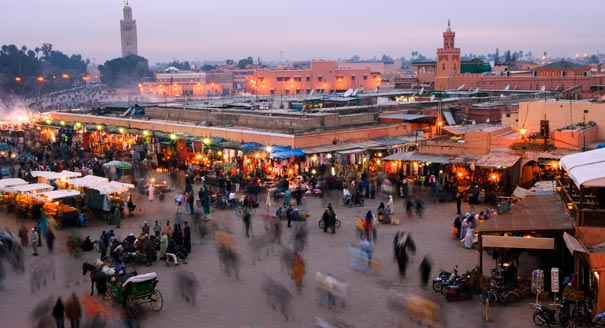
Source: Getty
Morocco's Royal Institute for Strategic Studies has reported that the country's biggest challenges to economic growth stem from a lack of leadership, inconsistent policies, and poor governmental communication. Though the diagnosis is accurate, the proposed recommendations fail to address the root causes of these problems.
Morocco has so far managed to limit the impact of the international financial crisis on its economy. Real challenges facing the country existed long before the crisis, however, and are likely to persist beyond recovery. A report recently published by the royal think tank, the Royal Institute for Strategic Studies (IRES), has identified three key findings. According to IRES, the challenges facing Morocco emanate primarily from a lack of leadership at the decision-making level, inconsistent economic policies, and the absence of effective governmental communication. Though the diagnosis is accurate, the proposed recommendations fail to address the real roots of the problem.
For the first time, the Royal Institute for Strategic Studies (IRES) took a decisive stance regarding the challenges facing the Kingdom by publishing this first report assessing the impact of the international financial and economic crisis on Morocco and future public policy challenges. The public has long been awaiting such a step as IRES had been criticized in the press for its resounding silence on the issue up till now.
The royal think tank has identified the key issues that impede policy making in Morocco, and revealed the risks and critical socio-economic challenges that must be addressed.
The report identifies the channels through which the international crisis has impacted the Moroccan economy—trade, tourism, remittances, and foreign direct investment—and underlines five potential risks that Morocco might face in the case of prolonged global recession. Those risks include the exhaustion of foreign exchange reserves; decline in budgetary room to finance government programs; a slowdown in domestic demand; and increased unemployment and poverty. These changes in turn would impact social stability and expose the financial sector to the adverse effects of default by insolvent households and firms.
The report suggests a four-part road map for Morocco’s future policies. The first part recommends strengthening social cohesion through democracy, good governance, and the reinforcement of social safety by more efficient and effective social policies. The second part―improving governance by rationalizing and effectively implementing economic and social policy―requires leadership and the development of an effective communication strategy that allows the people to understand both the gains and the sacrifices involved.
The third part recommends strengthening Morocco’s competitiveness by modernizing its productive sectors and improving product diversification and technology. Finally, the fourth part focuses on regional integration—with Europe as the priority, along with the reinforcement of economic links with sub-Saharan Africa, and a conditional and selective orientation toward the Maghreb.
Although the report’s analysis is not particularly new, it endorses many of the findings of academics, journalists, and international organizations on both the conduct and the performance of public policy in Morocco. The World Bank’s 2007 Investment Climate Assessment, for example, identified the lack of leadership and institutional organization as key deficits, concluding that the real problem in Morocco is not so much about what to do but about how to do it.
The establishment of a new parallel structure would not answer the urgent need for empowering the executive and legislative institutions that are already in place, but lack the power to effectively fulfill their functions.
The IRES report suggests creating a “coordination entity” tasked with ensuring coherence and consistency among government bodies and programs. However, there is a risk that such an entity would only add to an already complex bureaucracy. Ensuring coherence and providing leadership is a key task of any prime minister, while monitoring and assessing government programs and their implementation falls under the purview of parliament. An ad hoc coordination office would only interfere with the role of existing institutions, creating an extra layer in a complicated and dysfunctional landscape.
The real challenge in Morocco is not to create a new ad hoc institution but to provide sufficient authority to the prime minister and parliament so they can discharge their existing responsibilities effectively. The prime minister cannot explain the tradeoffs implied in policy decisions to the public if he is not empowered to make those decisions. And parliament cannot play its monitoring role if the prime minister, the person accountable for decisions, is not actually the decision maker. The problems revealed by the report are caused by an excessive concentration of power, the lack of democratic governance, and ineffective political participation. There is, therefore, no real need for new institutions, but existing institutions must become more effective. This is particularly essential at a time of rising economic and social challenges.
In short, the royal think tank has identified the key issues that impede policy making in Morocco, and revealed the risks and critical socio-economic challenges that must be addressed. It has also gone one step further, by acknowledging the need for more democracy, transparent intergovernmental communication, and better control of economic policies. However, it fails to follow to its logical conclusion―the need for more democracy, and effective and accountable institutions. The establishment of a new parallel structure would not answer the urgent need for empowering the executive and legislative institutions that are already in place, but lack the power to effectively fulfill their functions.
Former Nonresident Senior Associate, Middle East Center
Achy is an economist with expertise in development, institutional economics, trade, and labor and a focus on the Middle East and North Africa.
Recent Work
Lahcen Achy
Lahcen Achy
Carnegie does not take institutional positions on public policy issues; the views represented herein are those of the author(s) and do not necessarily reflect the views of Carnegie, its staff, or its trustees.

The European far right might fail to steer EU policy in the direction Russia wants, but they will create enough chaos inside Europe to benefit the Kremlin.

Dimitar Bechev

If the Russian-speaking community in Latvia cannot articulate their interests without being seen as disloyal, they could end up embracing a pro-Kremlin agenda.

Sergejs Potapkins

Russia’s ruling party would have benefited from Putin appearing as its distant patron, but as an active frontman imposing his views on the public, he has done nothing but harm both the party’s election campaign and the ruling system overall.

Andrey Pertsev

Depleted financial reserves and a shrinking tax base mean it is no longer possible to simultaneously deliver high defense spending, price stability, and economic growth.

Alexandra Prokopenko

In the tenth year of his presidency, President Mirziyoyev’s system is becoming even more personalized than that of his predecessor Karimov.

Galiya Ibragimova