







• Research
  • Politika
  • About
Carnegie Russia Eurasia center logoCarnegie lettermark logo
  • Donate
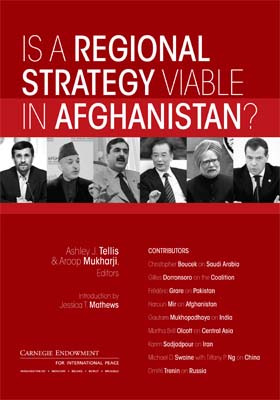
Is a Regional Strategy Viable in Afghanistan?
Report

Is a Regional Strategy Viable in Afghanistan?

President Obama has placed a greater emphasis on the need for a regional approach to Afghanistan. Leading experts analyze what a regional strategy would mean in practice through the eyes of key states, including Russia, Iran, Pakistan, and India, and what it could mean for U.S. policy.

Link Copied
By Ashley J. Tellis, Aroop Mukharji, Jessica Tuchman Mathews, Christopher Boucek, Gilles Dorronsoro, Frederic Grare, Haroun Mir, Gautam Mukhopadhaya, Martha Brill Olcott, Karim Sadjadpour, Michael D. Swaine, Tiffany P. Ng, Dmitri Trenin
Published on May 6, 2010

Additional Links

Full Text
Project hero Image

Project

Eurasia in Transition

Learn More

President Obama made decisive changes to U.S. policy in Afghanistan—increasing forces on the ground, modifying the original goals, and placing a greater emphasis on the need for a regional approach. Leading experts analyze the interests of Afghanistan’s neighbors, what they mean in practice, and what it could mean for U.S. policy. 

“All the relevant states will continue to act in and around Afghanistan, pursuing their national interests as they see them,” writes Carnegie President Jessica Mathews. “Whatever succession of strategies the United States and its partners adopt in the years ahead in pursuit of a peaceful and stable Afghanistan, a deep and nuanced understanding of the interests and policies of the neighboring states—not as the United States would like them to be, but as these states actually perceive them—will be essential to a successful outcome.”

Countries Analyzed:

  • Pakistan, Frédéric Grare
    “Preventing a dominant Indian influence in Afghanistan, which could evolve into an alliance between the two countries and trap Pakistan in a two-front situation, is Islamabad’s first objective.”
  • India, Ambassador Gautam Mukhopadhaya
    “There is intense political competition between India and Pakistan in Afghanistan today driven by real or imagined security concerns. But India’s larger interests in Afghanistan extend beyond Pakistan.”
  • Iran, Karim Sadjadpour
    “The current Iranian government’s deep animosity toward the United States often trumps the two countries’ shared interests in Afghanistan, motivating Tehran to undermine U.S. efforts even though the repercussions may be inimical to its own national interests.”
  • Saudi Arabia, Christopher Boucek
    “Saudi Arabia has had very real concerns with regard to Afghanistan because of the historic presence of al-Qaeda and Osama bin Laden. Saudi Arabia also has a deep and multifaceted relationship with its close ally Pakistan and an increasingly troublesome relationship with Iran—both of which play out in Afghanistan.”
  • Central Asian Republics, Martha Brill Olcott
    “All five Central Asian Republics perceive their own national security as directly tied to developments in Afghanistan because of the transnational threats that originate in that country—or just beyond in Pakistan.”
  • China, Michael D. Swaine with Tiffany Ng
    “Beijing’s stance toward Afghanistan is rooted largely in fundamental Chinese strategic interests that extend well beyond Afghanistan itself: specifically, China’s suspicion toward and nascent rivalry with the United States, and its support for Pakistan in the latter’s struggle with India.”
  • Russia, Dmitri Trenin
    “Russia views Afghanistan today largely through the prism of security threats to itself and its Central Asian neighborhood, over which Moscow aspires to soft dominance.”
  • Afghanistan, Haroun Mir
    “Afghanistan is an integral part of South and Central Asia and the Greater Middle East, and could play a central role at the crossroads of the three regions. Thus, regional cooperation can serve to benefit all countries of the region.”
  • Coalition Partners, Gilles Dorronsoro
    “A regional approach favoring negotiation over war is supported by most of the European members of the coalition as a way to exit the whirlpool of conflict that is slowing destroying NATO without reasonable prospects of success.”

In its final chapter, Ashley J. Tellis concludes that “the regional approach to Afghanistan—understood as an effort to incorporate all of Kabul’s major neighbors into a cooperative enterprise led by the United States, and aimed at stabilizing Afghanistan through successful counterterrorism, reconstruction, and state-building—is unlikely to succeed, first and foremost, because the key regional stakeholders have diverging objectives within Afghanistan.”

About the Authors

Ashley J. Tellis

Former Senior Fellow

Ashley J. Tellis was a senior fellow at the Carnegie Endowment for International Peace.

Aroop Mukharji

Former Junior Fellow, South Asia Program, US Role in the World Program

Jessica Tuchman Mathews

Distinguished Fellow

Mathews is a distinguished fellow at the Carnegie Endowment for International Peace. She served as Carnegie’s president for 18 years.

Christopher Boucek

Former Associate, Middle East Program

Boucek was an associate in the Carnegie Middle East Program where his research focused on security challenges in the Arabian Peninsula and Northern Africa.

Gilles Dorronsoro

Former Nonresident Scholar, South Asia Program

Dorronsoro’s research focuses on security and political development in Afghanistan. He was a professor of political science at the Sorbonne in Paris and the Institute of Political Studies of Rennes.

Frederic Grare

Former Nonresident Senior Fellow, South Asia Program

Frédéric Grare was a nonresident senior fellow at the Carnegie Endowment for International Peace, where his research focuses on Indo-Pacific dynamics, the search for a security architecture, and South Asia Security issues.

Haroun Mir

Gautam Mukhopadhaya

Former Visiting Scholar, South Asia Program

A serving Indian Foreign Service officer of Ambassadorial rank, Mukhopadhaya's research is focused on India’s Afghanistan policy and its relationship with U.S. Af-Pak strategy.

Martha Brill Olcott

Former Senior Associate, Russia and Eurasia Program and, Co-director, al-Farabi Carnegie Program on Central Asia

Olcott is professor emerita at Colgate University, having taught political science there from 1974 to 2002. Prior to her work at the endowment, Olcott served as a special consultant to former secretary of state Lawrence Eagleburger.

Karim Sadjadpour

Senior Fellow, Middle East Program

Karim Sadjadpour is a senior fellow at the Carnegie Endowment for International Peace, where he focuses on Iran and U.S. foreign policy toward the Middle East.

Michael D. Swaine

Former Senior Fellow, Asia Program

Swaine was a senior fellow at the Carnegie Endowment for International Peace and one of the most prominent American analysts in Chinese security studies.

Tiffany P. Ng

Dmitri Trenin

Former Director, Carnegie Moscow Center

Trenin was director of the Carnegie Moscow Center from 2008 to early 2022.

Authors

Ashley J. Tellis
Former Senior Fellow
Aroop Mukharji
Former Junior Fellow, South Asia Program, US Role in the World Program
Jessica Tuchman Mathews
Distinguished Fellow
Jessica Tuchman Mathews
Christopher Boucek
Former Associate, Middle East Program
Christopher Boucek
Gilles Dorronsoro
Former Nonresident Scholar, South Asia Program
Gilles Dorronsoro
Frederic Grare
Former Nonresident Senior Fellow, South Asia Program
Frederic Grare
Haroun Mir
Gautam Mukhopadhaya
Former Visiting Scholar, South Asia Program
Martha Brill Olcott
Former Senior Associate, Russia and Eurasia Program and, Co-director, al-Farabi Carnegie Program on Central Asia
Martha Brill Olcott
Karim Sadjadpour
Senior Fellow, Middle East Program
Karim Sadjadpour
Michael D. Swaine
Former Senior Fellow, Asia Program
Michael D. Swaine
Tiffany P. Ng
Dmitri Trenin
Former Director, Carnegie Moscow Center
North AmericaUnited StatesMiddle EastIranSaudi ArabiaSouth AsiaIndiaAfghanistanPakistanEast AsiaChinaCentral AsiaCaucasusRussiaWestern EuropeGulfAsiaEuropePolitical ReformSecurityMilitaryForeign Policy

Carnegie does not take institutional positions on public policy issues; the views represented herein are those of the author(s) and do not necessarily reflect the views of Carnegie, its staff, or its trustees.

More Work from Carnegie Russia Eurasia Center

  • Commentary
    Carnegie Politika
    Why Has Kazakhstan Started Deporting Political Activists?

    The current U.S. indifference to human rights means Astana no longer has any incentive to refuse extradition requests from its authoritarian neighbors—including Russia.

      Temur Umarov

  • Commentary
    Carnegie Politika
    Why Are China and Russia Not Rushing to Help Iran?

    Most of Moscow’s military resources are tied up in Ukraine, while Beijing’s foreign policy prioritizes economic ties and avoids direct conflict.   

      • Alexander Gabuev

      Alexander Gabuev, Temur Umarov

  • Commentary
    Carnegie Politika
    Georgia’s Fall From U.S. Favor Heralds South Caucasus Realignment

    With the White House only interested in economic dealmaking, Georgia finds itself eclipsed by what Armenia and Azerbaijan can offer.

      Bashir Kitachaev

  • Commentary
    Carnegie Politika
    What Does War in the Middle East Mean for Russia–Iran Ties?

    If the regime in Tehran survives, it could be obliged to hand Moscow significant political influence in exchange for supplies of weapons and humanitarian aid.

      Nikita Smagin

  • Commentary
    Carnegie Politika
    How Trump’s Wars Are Boosting Russian Oil Exports

    The interventions in Iran and Venezuela are in keeping with Trump’s strategy of containing China, but also strengthen Russia’s position.

      • Mikhail Korostikov

      Mikhail Korostikov

Get more news and analysis from
Carnegie Russia Eurasia Center
Carnegie Russia Eurasia logo, white
  • Research
  • Politika
  • About
  • Experts
  • Events
  • Contact
  • Privacy
Get more news and analysis from
Carnegie Russia Eurasia Center
© 2026 Carnegie Endowment for International Peace. All rights reserved.