

Commentary
The European far right might fail to steer EU policy in the direction Russia wants, but they will create enough chaos inside Europe to benefit the Kremlin.
Dimitar Bechev
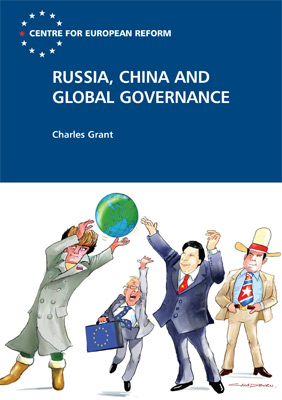
Russia and China are suspicious of multilateral institutions created by the West and hostile to anything that could justify external intervention in a sovereign state’s affairs, but both are learning to use international forums to their advantage.
Source: Centre for European Reform Report

The nature of the emerging multipolar order remains unclear. Will it be a world based on strong multilateral institutions, or one revolving around balance-of-power politics, in which big countries strive to achieve their objectives by forming alliances or acting unilaterally? The latter seems more likely: the US, which has sometimes championed multilateralism, is becoming weaker in relative terms, and also more prone to unilateralism; the EU, which believes in multilateralism, is under-performing diplomatically and economically; and the increasingly strong BRICS countries (Brazil, Russia, India, China and South Africa) take an instrumental approach to international institutions, usually supporting them only when they have an immediate interest in doing so.
This report compares the attitudes of Russia and China to global governance.
In many ways, Russia and China have a similar attitude to global governance. Both view it as a Western concept, used by the West to promote the interests of the West; both remain strongly committed to the principle of non-interference in other countries’ affairs; both prefer concert diplomacy—informal gatherings of great powers—to other sorts of global governance; both like to use regional bodies to strengthen their positions in their neighborhood and globally; and in both countries there are struggles and arguments between two broad tendencies—one relatively liberal, that is fairly positive about engaging in global institutions, and one more nationalist, that is suspicious of engagement.
The big difference between the two countries is that China does not take global governance very seriously on issues of security, but it does engage, when it sees an interest in doing so, on economic subjects. Russia has tended to take the opposite approach: it has been willing to sign up to international rules on security, but reluctant to engage in economic global governance.
Their differing histories and economic structures explain the contrast. China is the world’s biggest exporter, mainly of manufactured goods, and therefore has a strong interest in backing international rules on free trade. Russia, by contrast, exports a lot of oil and gas, for which there is no international regime. In the field of security, China is a rising power, increasingly confident of its newfound strength. So it is unwilling to be shackled by international rules on armaments. Russia, though in certain respects a declining power, retains a huge nuclear arsenal. It therefore sees arms control regimes as a means of protecting its status and position.
Charles Grant is director of the Centre for European Reform.
Charles Grant
Carnegie does not take institutional positions on public policy issues; the views represented herein are those of the author(s) and do not necessarily reflect the views of Carnegie, its staff, or its trustees.

The European far right might fail to steer EU policy in the direction Russia wants, but they will create enough chaos inside Europe to benefit the Kremlin.

Dimitar Bechev

Minsk clearly expected the dialogue with Washington to yield more results, in particular the lifting of EU sanctions and permission to export potash.

Artyom Shraibman

If the Russian-speaking community in Latvia cannot articulate their interests without being seen as disloyal, they could end up embracing a pro-Kremlin agenda.

Sergejs Potapkins

Russia’s ruling party would have benefited from Putin appearing as its distant patron, but as an active frontman imposing his views on the public, he has done nothing but harm both the party’s election campaign and the ruling system overall.

Andrey Pertsev

Depleted financial reserves and a shrinking tax base mean it is no longer possible to simultaneously deliver high defense spending, price stability, and economic growth.

Alexandra Prokopenko