

Article
C. Raja Mohan, Darshana M. Baruah
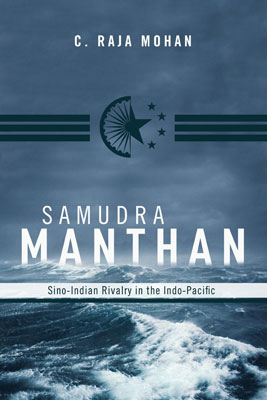
Despite the huge differences in the current naval capabilities of China, India, and the United States, the three countries are locked in a triangular struggle destined to mold the future Indo-Pacific.
Source: Washington

Invoking a tale from Hindu mythology—Samudra Manthan or “to churn the ocean”—C. Raja Mohan tells the story of a Sino-Indian rivalry spilling over from the Great Himalayas into the Indian and Pacific Oceans. He examines the prospects of mitigating the tensions and constructing a stable Indo-Pacific order.
America, the dominant power in the area, is being drawn into the unfolding Sino-Indian competition. Despite the huge differences in the current naval capabilities of China, India, and the United States, Mohan argues that the three countries are locked in a triangular struggle destined to mold the future Indo-Pacific.
“Samudra Manthan offers deep insights into the emerging Indo-Pacific theatre as the rising maritime profiles of India and China begin to intersect. Raja Mohan’s perceptive analysis of the U.S. role in shaping Sino-Indian rivalry is a valuable contribution to the debate on changing great power relations in Asia and its waters.”
—Shyam Saran, former foreign secretary and special envoy of the prime minister of India
"Mohan’s realist approach to the Sino-Indian competition in the Pacific and Indian Oceans merits serious reflection. His penetrating strategic analysis underlines the importance of the two Asian powers dispelling mutual suspicion and stabilizing the oceans in our rapidly changing world."
—Shen Dingli, professor of American Studies, Fudan University, Shanghai
“C. Raja Mohan demonstrates once again why he is India's finest strategic thinker. In Samudra Manthan, he explores a complex issue, namely the prospect for a serious Sino-Indian naval rivalry in the Indian Ocean, well ahead of its time. As the United States sustains its own strategic rebalancing towards the Indo-Pacific, Mohan's judicious and balanced analysis bears close reading not only for its insights into how the evolving naval contestation between China and India promises to intensify their existing security competition but also how American choices will shape, and be shaped by, the outcomes produced by this encounter.”
—Ashley J. Tellis, senior associate, South Asia Program, Carnegie Endowment for International Peace
Former Nonresident Senior Fellow, Carnegie India
A leading analyst of India’s foreign policy, Mohan is also an expert on South Asian security, great-power relations in Asia, and arms control.
Recent Work

C. Raja Mohan, Darshana M. Baruah


Alexander Gabuev, Paul Haenle, C. Raja Mohan, …
Carnegie does not take institutional positions on public policy issues; the views represented herein are those of the author(s) and do not necessarily reflect the views of Carnegie, its staff, or its trustees.

When faced with fuel shortages in the past, Central Asian governments could always count on additional supplies from Moscow. That safety net no longer exists.

Galiya Ibragimova

Two divergent trends—Putin’s hardline vision of how to prosecute the war in Ukraine, and a growing desire for change in Russia—could tear the regime apart.

Tatiana Stanovaya

Andrey Melnichenko’s essay offers no answer to the fundamental question of how, under any kind of negotiated settlement, Europe can protect itself from the Russian ressentiment that is inevitable in all scenarios except for an outright victory for Putin.

Leonid Bershidsky

Despite unhappiness on the ground, Moscow is determined to use both carrot and stick to ensure there is record support for United Russia in occupied Ukraine.

Konstantin Skorkin
The recent damage inflicted by Ukrainian drones and missiles on Russia has made Belarus aware of its own vulnerabilities—and surprisingly amenable to Kyiv’s demands.

Artyom Shraibman