• Research
  • Politika
  • About
Carnegie Russia Eurasia center logoCarnegie lettermark logo
  • Donate
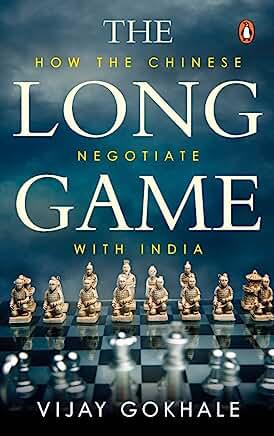
The Long Game: How the Chinese Negotiate with India
Book
Carnegie India

The Long Game: How the Chinese Negotiate with India

This book explores the dynamics of negotiation between India and China, from the early years after Independence until the current times, through the prism of six historical and recent events.

Link Copied
By Vijay Gokhale
Published on Jul 19, 2021

Additional Links

<em> PENGUIN RANDOM HOUSE </em>
Project hero Image

Project

Security Studies

India’s evolving role in regional and global security is shaped by complex dynamics. Experts in the Security Studies Program examine India’s position in this world order through informed analyses of its foreign and security policies, focusing on the relationship with China, the securitization of borders, and the geopolitics of the Indo-Pacific. 

Learn More

PENGUIN RANDOM HOUSE

About the Author

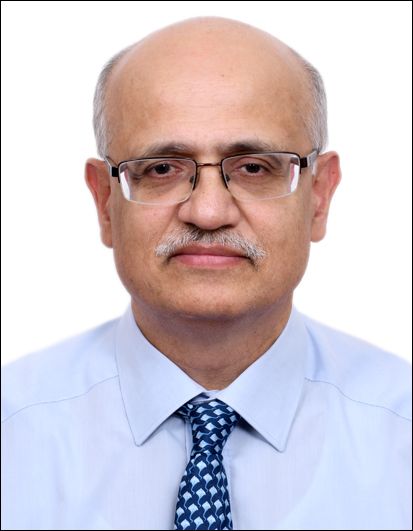
Vijay Gokhale

Nonresident Senior Fellow, Carnegie India

Vijay Gokhale is a nonresident senior fellow at Carnegie India and the former foreign secretary of India. He has worked extensively on matters relating to the Indo-Pacific region with a special emphasis on Chinese politics and diplomacy.

    Recent Work

  • Research
    Views From Taipei: Essays by Young Indian Scholars on China
      • +1

      Vijay Gokhale, Suyash Desai, Amit Kumar, …
  • Paper
    The Next Dalai Lama: Preparing for Reincarnation and Why It Matters to India

      Vijay Gokhale

Vijay Gokhale
Nonresident Senior Fellow, Carnegie India
Vijay Gokhale
South AsiaIndiaEast AsiaChinaForeign Policy

Carnegie does not take institutional positions on public policy issues; the views represented herein are those of the author(s) and do not necessarily reflect the views of Carnegie, its staff, or its trustees.
More Work from Carnegie Russia Eurasia Center

  • Commentary
    Carnegie Politika
    What Does Nuclear Proliferation in East Asia Mean for Russia?

    Troubled by the growing salience of nuclear debates in East Asia, Moscow has responded in its usual way: with condemnation and threats. But by exacerbating insecurity, Russia is forcing South Korea and Japan to consider radical security options.

      James D.J. Brown

  • Commentary
    Carnegie Politika
    What’s Having More Impact on Russian Oil Export Revenues: Ukrainian Strikes or Rising Prices?

    Although Ukrainian strikes have led to a noticeable decline in the physical volume of Russian oil exports, the rise in prices has more than made up for it.

      • Sergey Vakulenko

      Sergey Vakulenko

  • Commentary
    Carnegie Politika
    Russia Is Meddling for Meddling’s Sake in the Middle East

    The Russian leadership wants to avoid a dangerous precedent in which it is squeezed out of Iran by the United States and Israel—and left powerless to respond in any meaningful way.

      Nikita Smagin

  • Commentary
    Carnegie Politika
    Will Hungary’s New Leader Really Change EU Policy on Russia and Ukraine?

    Orbán created an image for himself as virtually the only opponent of aid to Ukraine in the entire EU. But in reality, he was simply willing to use his veto to absorb all the backlash, allowing other opponents to remain in the shadows.

      Maksim Samorukov

  • Commentary
    Carnegie Politika
    Power, Pathways, and Policy: Grounding Central Asia’s Digital Ambitions

    Central Asia’s digital ambitions are achievable, but only if policy is aligned with the region’s physical constraints.

      Aruzhan Meirkhanova

Get more news and analysis from
Carnegie Russia Eurasia Center
Carnegie Russia Eurasia logo, white
  • Research
  • Politika
  • About
  • Experts
  • Events
  • Contact
  • Privacy
  • For Media
Get more news and analysis from
Carnegie Russia Eurasia Center
© 2026 Carnegie Endowment for International Peace. All rights reserved.